


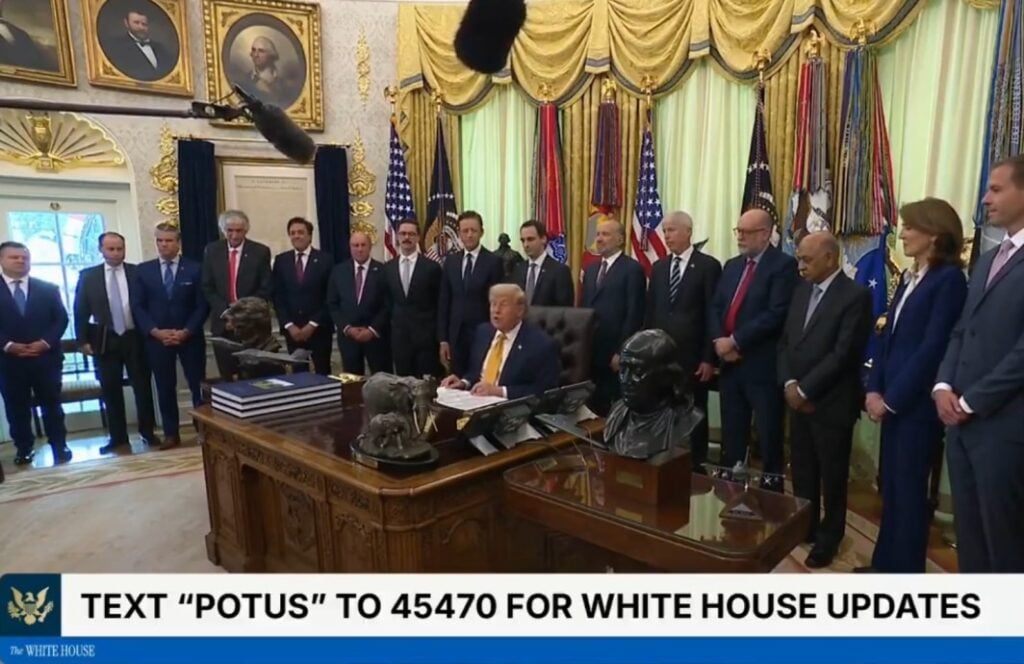
U.S. President Donald Trump signed two new executive orders (EOs) on quantum technologies, accelerating the federal post-quantum cryptography deadline from 2035 to 2031.
The first order launches a national effort to build a quantum computer within five years and develop quantum-enabled sensors and networks. The second one requires federal agencies to make the jump to post-quantum crypto by 2031, starting with a pilot program in 2027.
The two orders: build and transition
- The first executive order is about building: a national effort to produce a quantum computer capable of performing important scientific calculations, plus quantum-enabled sensors and networks, all within five years.
- The second order is about securing: it directs federal agencies to transition to post-quantum cryptography by 2031 and lead the way for wider adoption of these standards.
- The distinction is critical: post-quantum cryptography uses classical math algorithms [National Institute of Standards and Technology (NIST)-standardized Module-Lattice-Based Key-Encapsulation Mechanism (ML-KEM) and Module-Lattice-Based Digital Signature Algorithm (ML-DSA)] designed to resist quantum attacks, not quantum cryptography, which requires new physics and hardware.
A 2027 pilot and a 2031 deadline
The detail under the headline matters more than the headline. Basically, the order tells Commerce and NIST to get a pilot migration of federal systems up and running by the end of 2027, well before the final 2031 deadline. Plus, the Cybersecurity and Infrastructure Security Agency (CISA) is now focusing on critical infrastructure, which means these changes will hit contractors and the private sector sooner rather than later.
The tech giants are already on it, too: Google and Microsoft both shifted their roadmaps to 2029. Meanwhile, the Treasury is investing; it took equity in nine quantum firms. And Quantinuum’s initial public offering (IPO) was a massive hit, being oversubscribed 20 times. With the White House setting a 2031 deadline and a 2027 pilot, it’s clear that everyone is racing toward the same finish line.
What this means for crypto and blockchain
These new orders are a big deal for crypto and blockchain with direct implications. Most of the current digital signatures [Elliptic Curve Digital Signature Algorithm (ECDSA), Ed25519] and proof systems are vulnerable to quantum attacks and could be cracked at some point in time.
The feds basically just cut their own deadline by four years. This new timeline sets the pace for everyone else. If you are a business working with the government or just using this kind of tech, you are going to need to jump on board. The 2027 pilot is the real litmus test: if they can successfully switch over to post-quantum standards, it’s pretty much guaranteed that the rest of the industry will follow suit soon after.


