

Stablecoins are the most highly used financial product in the crypto space. According to data sources like Artemis, over $321.5B in the supply parameter is currently on-chain. Yet, the majority of the users of them do not understand the mechanisms behind how they retain their $1 peg or how they lose that peg when that mechanism breaks. Here, we look into that.
What does “backing” actually mean?
All stablecoins are essentially just making a commitment that 1 token = $1. The way in which the stablecoin fulfills that commitment is defined by what lies behind it. For example, fiat-collateralized stablecoins, such as USDC or USDT, have a balance that contains $1 in the form of either actual dollars or Treasury Bills held in an account. Here, the risk is custodial: you are relying on the company, the bank, and the auditor.
Crypto-backed stablecoins require users to lock up crypto assets as collateral; this is exemplified by DAI where it might require you to lock up $150 of ETH to borrow $100, with automatic liquidation in the case the price experiences a fall. The risk here is volatility overwhelming the liquidation mechanism.
The third is most dangerous. Algorithmic stablecoins are actually not backed at all. Their peg is based solely on a mint-and-burn system that reacts to supply and demand. The biggest to ever exist was UST, which no longer is a thing.
How a depeg happens
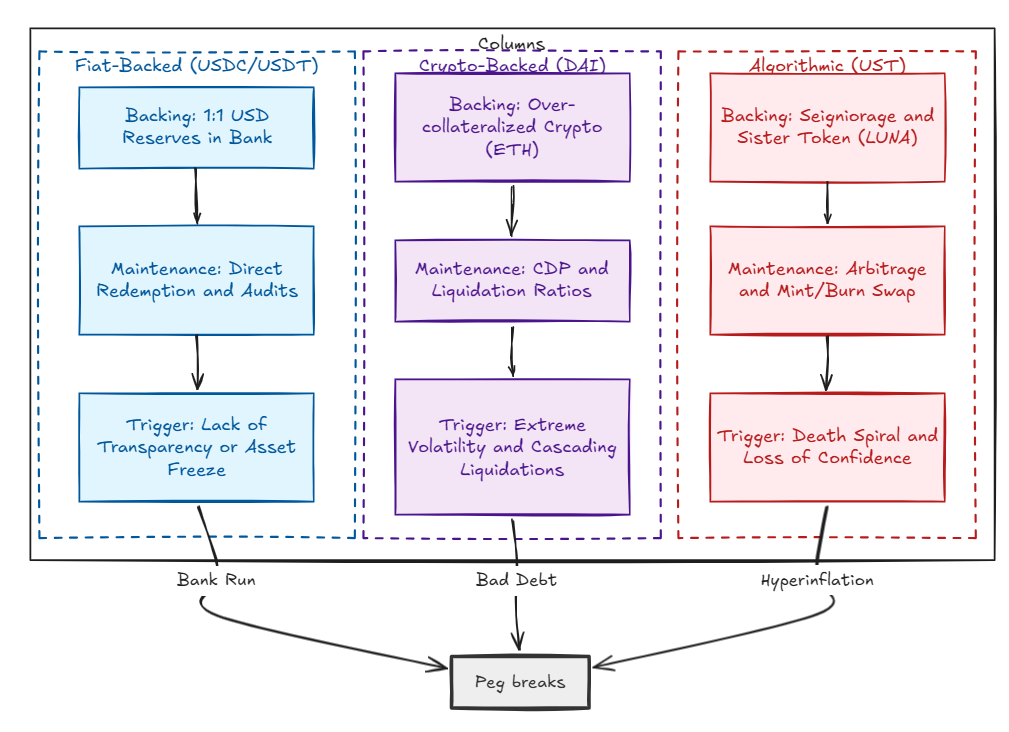
The depeg occurs as soon as the market no longer believes in the peg. Depending on the type, the mechanism is different.
The most common trigger event for a fiat-backed currency is a bank run or confidence crisis. In March 2023, there was a similar case that briefly pushed the stablecoin USDC below $0.87 after an announcement that $3.3B was deposited at Silicon Valley Bank (which was simultaneously failing) in the course of only one day. No one really knew how much would be recoverable; this uncertainty and lack of information caused the peg to break-until the FDIC guarantee was secured, the price returned within days.
It is important to note that a fiat-backed stablecoin can depeg even in the case when its reserves are largely intact. It is so because disbelief progresses much more quickly than verification.
Depegs can occur with crypto-collateralized coins when there is an inability for the system to liquidate in response to declining collateral values in the market. Severe market stress conditions can make the distance between “the liquidation should have happened” and “the liquidation actually processed” far enough to create an undercollateralized system.
Algorithmic depegs are fundamentally different in their nature and, generally, in their outcomes. UST’s collapse back in May 2022 serves as a clear case study here. UST maintained its peg via a mint/burn mechanism with LUNA, Terra’s native token. When confidence faltered and large holders started exiting their UST positions, more LUNA was minted by the protocol in an attempt to absorb UST selling pressure. With more LUNA supply in circulation, LUNA’s price decreased.
The lower price of LUNA means more LUNA had to be minted to absorb an equivalent amount of UST selling. The spiral began. $40B of the combined market caps of LUNA and UST vanished within a short period of time; with no underlying collateral, there was no floor for the depegging asset.
Regulatory risk: the layer most people ignore
Stablecoins fall into the overlapping space of payments, securities law, and banking regulation in nearly all significant jurisdictions, and no jurisdiction has yet cracked how they should fit in. The U.S. has been developing stablecoin legislation for years and is yet to pass a framework. MiCA regulation within the EU covers stablecoins, but it imposes heavy compliance obligations on reserve composition, reporting, and issuance limits, which are currently being stress-tested.
For the holders, the risk is practical rather than direct but real. A regulatory move against an issuer could lock out redemptions, remove the user from the banking rails, or cause a restructure that’s faster than your exit velocity. USDT has been subject to years of regulatory questioning regarding the composition and auditability of the reserves. It has not depegged, but the risk persists: the redemption mechanism is dependent on its banking relationships (if primary ones were terminated, it would fail even if its assets were otherwise healthy).
What to actually watch
Stablecoin’s peg price in itself doesn’t cover the whole mechanics of how the stablecoins operate. Reserve composition, redemption mechanism, audit quality, and on-chain supply dynamics are of far greater significance.
The risk profile of a stablecoin backed by mostly short-term U.S. Treasuries and cash differs hugely compared to one backed by commercial paper, unsecured lending, or crypto collateral even if the stablecoin trades at $1. The redemption mechanism also has significance. Some issuers only permit direct redemption by institutional partners, and retail users are dependent on secondary market liquidity during stressed periods and are exposed to widening spreads and depegging.
The other area where differences are usually mistaken is in terms of audit quality. A monthly attestation just says the reserve balance at that point in time; a full audit determines whether the accounting and liability are accurately ongoing. Changes in on-chain supply besides issuer disclosures are usually the first indicators of strain. Rapid large decrease in supply, including from the issuer’s mint wallet, often represent redemption wave, illiquidity or lost of market trust before it is priced in.