

OpenAI launched GPT-5.6, a new family of AI models built for tougher work across ChatGPT, Codex and the OpenAI API, as OpenAI pushes further into coding, research, cybersecurity, science, design and computer-use tasks.
The new lineup includes GPT-5.6 Sol, OpenAI’s flagship model, GPT-5.6 Terra, a lower-cost option, and GPT-5.6 Luna, the fastest and most affordable model in the family. OpenAI said the rollout is starting globally and will continue gradually toward full availability over the next 24 hours.
GPT-5.6 family targets longer, tougher workloads
With GPT-5.6, OpenAI is leaning into higher-stakes work, from software engineering and cybersecurity to scientific research and computer-use tasks that require planning, tool use and follow-through.
The company said GPT-5.5 Instant remains the default model in ChatGPT for fast everyday responses, while GPT-5.6 Sol powers standard and higher reasoning settings on eligible plans.
OpenAI added that Sol Pro is reserved for difficult tasks and longer-running workflows, giving advanced users more capacity when deeper reasoning is needed.
That shifts the product’s focus from answering questions to carrying more of the work users once had to manage step by step.
OpenAI gives GPT-5.6 more ways to plan and act
OpenAI is tying GPT-5.6 more closely to agent-style workflows, where a model can use tools, process intermediate results and coordinate more complicated tasks without forcing the user to guide every move.
For developers, the API includes access to Sol, Terra and Luna, along with programmatic tool-calling features that allow the model to write and run in-memory programs to coordinate tools and handle intermediate work.
OpenAI also said multi-agent support will let GPT-5.6 run concurrent subagents and combine their results in a single request.
OpenAI is signaling a shift toward AI systems built to handle full workflows, not just respond to individual prompts, as GPT-5.6 is designed to work across files, code, tools, systems and decisions with less step-by-step direction from users.
Stronger models demand stronger safeguards
OpenAI said GPT-5.6 brings stronger capability to cybersecurity work, including tasks such as vulnerability research, software debugging and defensive testing. Those capabilities could help security teams find flaws faster and strengthen systems, but they also raise misuse concerns if similar reasoning is applied in harmful ways.
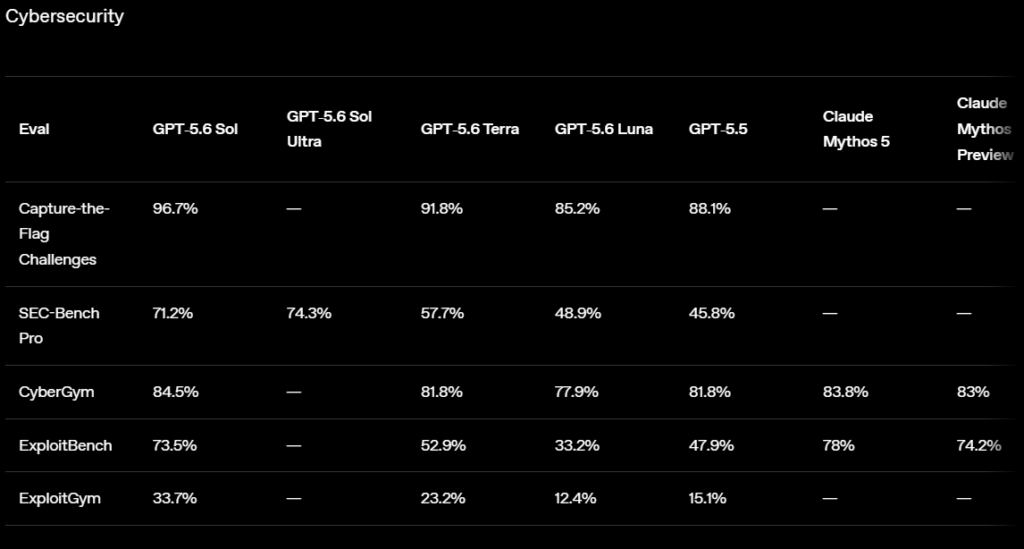
To address that risk, the company said it is adding stronger monitoring, expanded bug bounty work and rapid-remediation processes as real-world use grows.
It has been a busy week for OpenAI
OpenAI’s GPT-5.6 rollout comes during a broader product push that also includes GPT-Live-1 and GPT-Live-1 mini, offering more natural voice conversations that can listen and speak at the same time, handle interruptions, use web search and memory, and work with text and images in the same chat.
The company also introduced ChatGPT Work, an agent-style workspace powered by GPT-5.6 that brings together context from a team’s tools, files and desktop apps to create polished spreadsheets, documents, slides and interactive Sites, signaling a wider effort to turn ChatGPT into a full work system rather than a standalone chatbot.