

Monad crashed below the 200-day moving average, despite recording its highest monthly transaction count ever and expanding its ecosystem with the launch of an AI-focused Agent Hub. This signals weakening technical momentum even as on-chain activity reaches new highs.
Monad launches an agent hub
Monad recently launched an Agent Hub, which enhances the Monad ecosystem by making AI agents accessible to everyday users, allowing them to automate interactions across decentralized applications with minimal effort.
Instead of manually navigating multiple protocols, users can deploy AI agents in one click to perform on-chain tasks, execute predefined strategies, and interact with DApps on their behalf. This lowers the barrier to entry for both new and experienced users while improving efficiency across the network.
The platform also encourages ecosystem participation by enabling AI agents to join campaigns, complete tasks, and engage with Monad-native applications. As more developers build AI-powered tools and integrate them with DApps, Agent Hub could increase network activity, improve user retention, and accelerate the adoption of AI-driven blockchain applications within the Monad ecosystem.
Monad processes more than 92 million transactions
In addition to this, the on-chain activity has been spiking on the Monad network. Processing 92.62 million transactions in a single month is a significant milestone because it demonstrates that the Monad network is seeing growing real-world usage and can handle a high volume of on-chain activity.
Rising transaction counts typically indicate that more users, decentralized applications (DApps), and developers are actively interacting with the blockchain, whether through transfers, DeFi, gaming, NFTs, or AI-powered applications.
For the network, reaching an all-time high in monthly transactions validates its scalability and performance, which are core selling points for Monad as a high-throughput Layer 1 blockchain.
Sustained growth in transaction volume can strengthen developer confidence, attract additional projects to build on the network, and enhance the overall ecosystem. If this activity continues rather than being driven by short-term incentives, it could support long-term network adoption and increase the demand for its infrastructure and native token.
MON bulls need to defend 50-day MA if price is to make a recovery
Despite the ongoing development, Monad (MON) has crashed below the 200-day moving average, which is at $0.0241. Falling below the 200-day moving average (MA) is considered a major bearish signal because it suggests the asset’s long-term trend has weakened.
The 200-day MA is one of the most closely watched technical indicators among traders and institutions, often serving as the dividing line between a long-term uptrend and downtrend. When a token drops below this level, it indicates that selling pressure has overtaken long-term buying momentum, potentially reducing investor confidence.
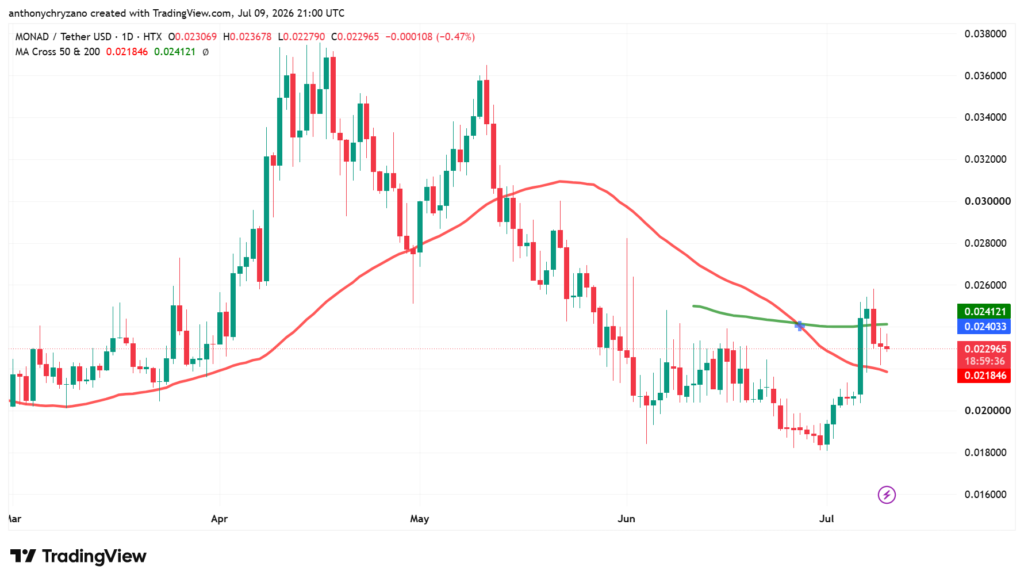
The breakdown also turns the 200-day MA into a key resistance level, meaning any recovery may face selling pressure near that price. Unless MON quickly reclaims the moving average, the loss of this support could encourage further downside as traders interpret the move as confirmation of a broader bearish trend, despite the network’s strong on-chain growth and ecosystem developments.
Monad recently confirmed a breakout from a falling wedge, a bullish reversal pattern that typically signals the end of a downtrend and the beginning of a sustained recovery. Following the breakout, MON gained momentum and started moving higher, with the pattern projecting an upside target of around $0.027, based on the height of the wedge.
However, the rally failed to reach its full projected target after encountering strong resistance at the 200-day moving average. This long-term technical level has acted as a major barrier, with sellers stepping in and preventing the breakout from fully materializing. The rejection pushed MON back below the 200-day MA, highlighting that the broader trend has yet to turn decisively bullish.
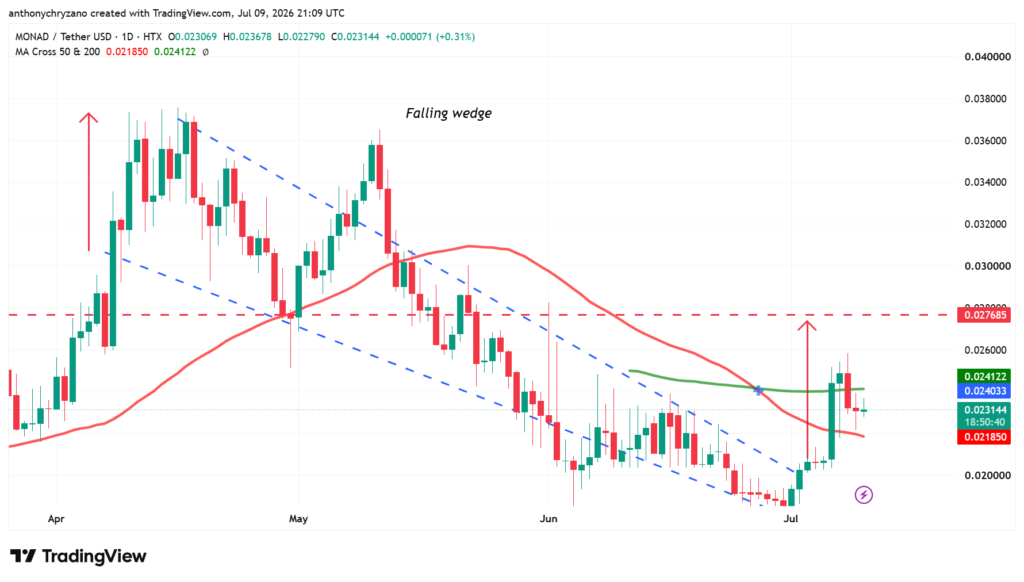
Despite the setback, the bullish structure has not been invalidated. The 50-day moving average continues to provide dynamic support beneath the current price, suggesting buyers are still defending the recent breakout. As long as MON remains above this level, the possibility of another attempt to reclaim the 200-day MA remains intact.
A successful defense of the 50-day MA could restore bullish momentum and allow MON to challenge the 200-day moving average once again. If buyers manage to overcome this resistance, the original falling wedge target near $0.027 could still come back into focus, reviving the bullish outlook for the token.