

Following a decline of 8.1 percent over the past week, it seems that troubles aren’t quite over for Bitcoin (BTC) yet. Data shows that there may be more room for BTC price to slide, as the cryptocurrency’s short-term holder (STH) loss pressure remains below prior capitulation levels.
More room to fall for Bitcoin
As of Tuesday, Bitcoin is trading slightly above the strong $60,000 support level. At the same time, the STH market value is hovering slightly above $224.3 billion, while the digital asset’s realized value is somewhere around $275.4 billion, showing a difference of close to 18.6 percent.
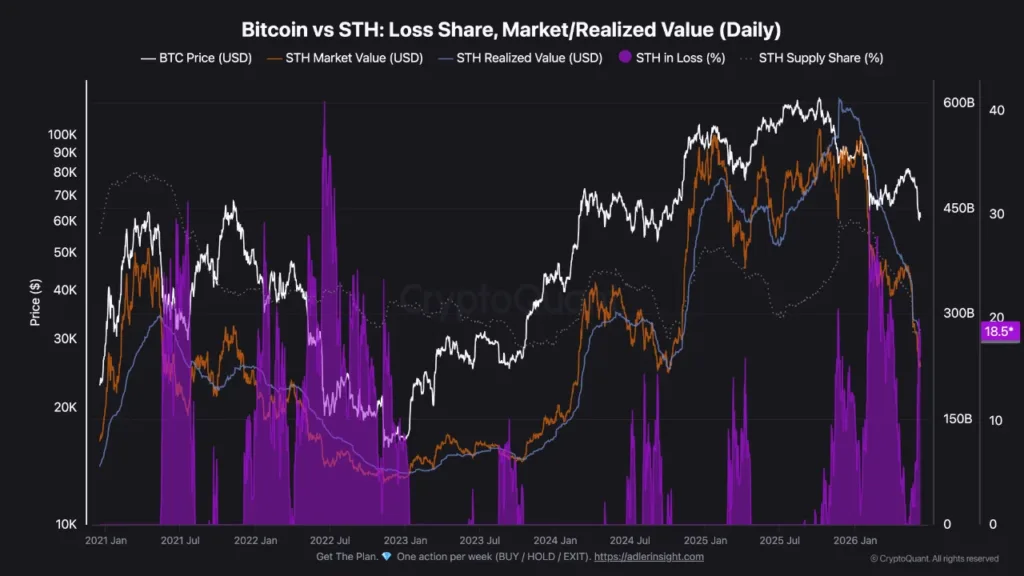
To explain, the STH market value represents the current market value of all BTC held by investors who acquired their coins relatively recently – typically within the last 155 days.
On the other hand, the STH realized value measures the value of those same coins based on the prices at which they last moved on-chain, providing an estimate of the group’s aggregate cost basis.
What stands out is that the current gap is well below the 30.8 percent figure recorded earlier this year on February 5. At the time, Bitcoin traded at around $64,200. The current reading is also slightly below the 20.9 percent observed in November 2025, when BTC was exchanging hands around $84,800.
During the June 2022 capitulation phase – when BTC hit a local bottom of $29,917, the gap between the STH market value and realized value had widened to 40.9 percent.
The comparison with gap levels is critical because even though BTC is currently trading below its February 2026 level, the STH gap is materially smaller.
At the same time, the STH supply share has fallen from around 28.2 percent in February to 18.3 percent as of Tuesday. In simple words, it means that a smaller proportion of BTC can today be classified as short-term.
Down and then up for BTC?
It won’t be surprising if BTC first performs another leg down before resuming its upward price trajectory. The bullish sentiment surrounding the digital asset needs to be absolutely decimated for any meaningful uptrend to start.
On Monday, BTC displayed an extremely rare bearish signal that it has shown only 3 times in the last 7 years, confirming the weak demand for the asset. On-chain data from June 2 also points toward STH selling BTC at the fastest pace since February, signaling weak confidence in its ability to reverse trend.