

There’s a version of the Bitcoin chart that the bulls have been showing since March, which shows a deep correction, a bottom that has been formed in the mid-60k range, a relief rally up to near 80k, and a market going through the last major shakeout phase before the next major run-up. The narrative was questioned when $65,592 fell. The question that actually seems most compelling is will this zone hold?
It appears that the $60,000 level is holding. Additionally, in an environment where for months the market has punished any calls of early recoveries, this carries more importance than it might appear.
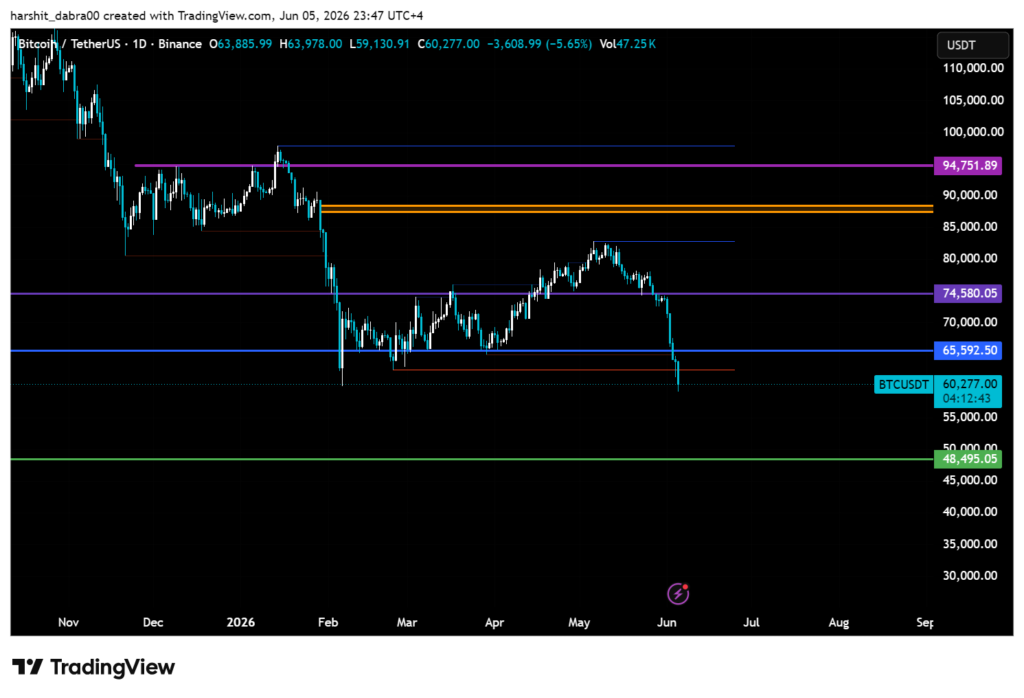
Breaking $65,592 totally flips the usual view of Bitcoin’s chart starting from February. What was considered a trend resumption from April to May, whereby BTC ran up above $82,000 and briefly mentioned a potentially positive breakout above it, is now a distribution period to get larger holders out of the market. This is a bearish interpretation, and that’s valid.
However, what that also indicates is that supply has already been consumed above that level. Whoever intended to sell the $80,000 sold. Now we have to know if the buyers at $60k are genuine.
What the moving averages are actually saying
Six moving averages are above the current price, from SMA7 at $69,506 up to EMA 200 at $80,903. Bearish by mechanical reading.
The second read is much more interesting. A full stack of this magnitude above the price in recent cycles has been a sign of exhaustion and this can’t be termed as a continuation. All sellers who wish to depart have had three months to do so. Recovery back above the 200-day signifies a 31 percent move, meaning that it will take time to recover; however, markets that flush this aggressively with such an abundant supply already liquidated typically find bases around exactly these levels.
What the Fibonacci levels are highlighting
The retracement points drawn from the swing low at $61,335 to the high at $82,792 would correspond to the 61.8 percent retracement at $69,532, a level that the price surged right through without any really decent support defense. The 78.6 bounce at $65,927 was supported briefly before the price continued lower.
So what this signifies for the next move is that every weak-handed buyer who accumulated in the range between $65,000 and $82,000 has been tested. They all got stopped out or capitulated. The buyers who have been left at this level are either going towards the longer-term hands who do not care about short-term structure or new capital flowing in. Based on the levels where they have a historical discount in their opinion, neither of them is expected to panic sell at $60,000 the way leveraged longs at $75,000 would have.
The extensions at 127.2 percent ($88,628) and 161.8 percent ($96,052) are actually not what I will be discussing today, although those are where the chart leads if the level of $60k makes a true base.
The $60,000 case that needs to be addressed
However, while the level of $48,495 would be the next level of major downside target if $60,000 doesn’t hold, the $60,000 area is one that has immense technical significance, as well as psychological significance, as it has been a level of both support and resistance over many market cycles and the indicators. The RSI specifically shows that selling pressure is softening. It is unlikely that this level is going to create an upside bottom on a failure of sellers. A strong bottom is going to most likely take time and include a few failed attempts of sellers driving it lower, with volume declining as it fails and buying interest returning. Confirmation will likely take a while, though, but this is a more promising-looking situation in the $60,000 area than anything else in the last 3 months.