

Short-term holders of Bitcoin deposited 16.4k BTC into Binance at a loss on Tuesday that marks the biggest loss-side deposit the exchange has seen ever since February 6. To be on the blunt side, the profit-side flow over the same time barely exists, close to 462 BTC. The spread is the sign; over 30 coins are being transferred in at a loss versus one being transferred in at a profit. No one here is currently looking to lock the profits on strength. Newer buyers are more into sending back coins that they accumulated for a $69.4k spot price, and they are doing it harder than they have at any point in close to 4 months, only on the largest CEX like Binance.
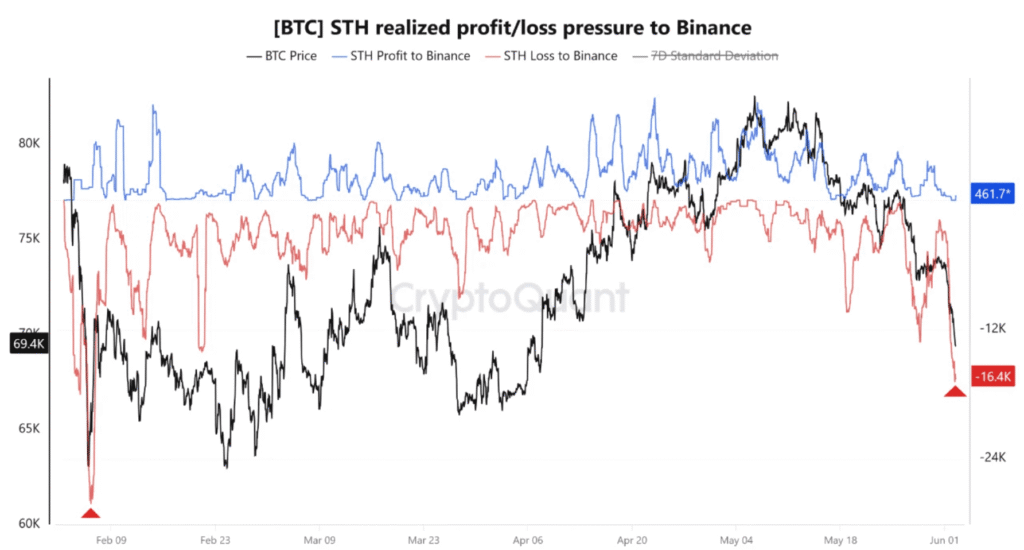
And the trend holds on each individual exchange, but for one slight anomaly: Overall STH loss-side flow across all exchanges reached 38,700 BTC on Tuesday compared with ~742 Bitcoin of profit-side deposits. Thus, the same unbalanced chart is evident market-wide. However, today’s total was below Thursday’s 41,300 BTC, the greater of the two spikes that surrounded last week. So, while the centralized exchange like Binance posted a new four-month stress high, the cross-venue figure has cooled off slightly from its peak.
That split matters more than the raw size of either print
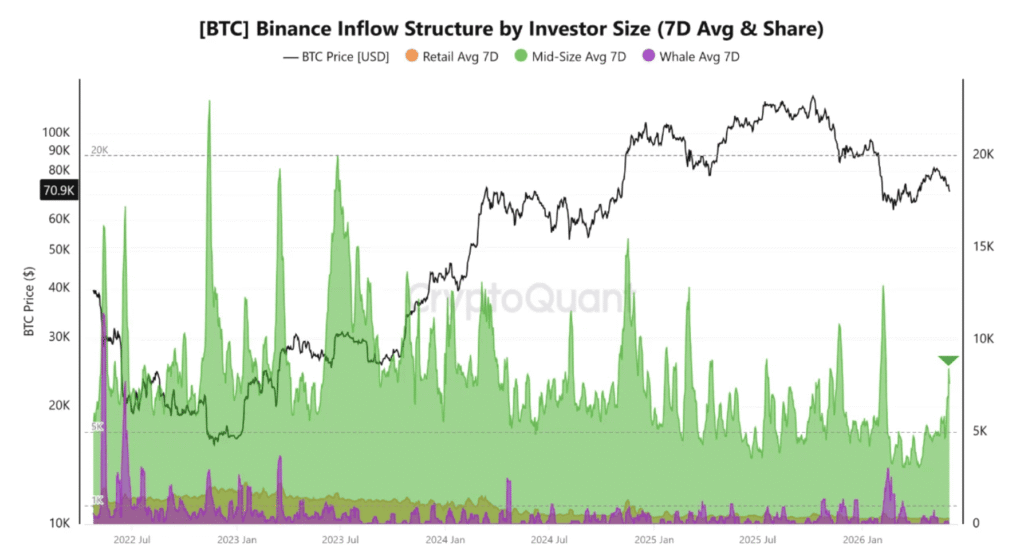
According to the current situation, the loss pressure appears to be bottlenecking onto Binance and not spreading across the entire market, and the inflow-by-size data identifies the seller. The seven-day moving average of mid-size wallet inflows to Binance is noted at roughly 8,400 BTC (the highest seen since February 6th), higher than average for the better part of a week and this is not a single-day spike. On the inflow side, it remains flat from both whales and Retail. The retail panic deposits, which typically mark a crucial capitulation low, aren’t present for this, which is the critical point that should concern anyone who considers the sub-$69K price a completed bottom.
So the seller’s stuck in the middle of the market, at one location, pulling back from risk. This situation isn’t top holders selling; it isn’t the weakest hands blowing out.
It’s good to recall, in reference to the February 6 stress being used over and over, how that particular event actually concluded. That event did not cascade smoothly into a broader selloff. The price of the asset wicked down, and bids stepped in. The following weeks were spent meandering horizontally. This is the hallmark of a significant realized loss event being processed at support. Spikes in realized loss are characteristic of both capitulations and floor landings. The visual pattern is the same until you get the subsequent print to tell you which you have.
Concentrated sell that come relentlessly are still sell and a week of large mid-size deposits implies it is a trend rather than a one-time venting. Whales remaining passive does remove the ‘worst-case,’ in which the wealthy are slowly handing it off into decline, but supply coming from one source and to one market is easier to absorb than a dispersed sell from everywhere.
Price makes the call, and $69,000 is the line. BTC has come off an early-May peak above $80,000 and is now below $69K, a drawdown north of 15 percent, sitting right on the level where this wave gets absorbed or doesn’t. Absorption is the question that still needs more attention as of now. If spot bids can soak up nearly 39,000 BTC of loss-driven supply a day and hold the figure, that is, demand showing up at a price. If they can’t, the overhang runs.
So, we have two potential directions to move, and the next flow print will dictate which direction we end up taking. If Tuesday’s softer print of aggregate activity was simply the first leg of a short-term washout that held a buyer while price was attempting to defend $69,000 and reclaim $72,000, we file this under a failed washout that found a buyer and use back-to-back spikes as the likely floor tested on the push up.
In the case that the flow appears to begin to reaccelerate and the largest cryptocurrency is not able to close above $69,000 on HTF, the picture flips entirely, with the $64,000-$65,000 support shelf we watched defend during the months of March and April becoming significant again. the February wick down towards the $62,000 zone is starting to look a lot less like an outlier, and retail’s steady commitment can be termed more of an issue, as genuine bottoms normally begin with the weak hands dispersing first, which they did not.