

Zcash has just activated its NU6.3 upgrade, referred to as Ironwood, on block 3,428,143. NU6.3 includes a new shielded pool by deprecating the deprecated “Orchard” shielded pool that “has kept all its users’ private balances safe-havened until now.” All ZEC in an Orchard wallet needs to be migrated into Ironwood to be spendable.
The current price action of Zcash
ZEC opened at $476.71 today, currently trading $468.40 (down 1.75 percent for the day). The intraday range has so far peaked at $480.16 and dipped low at $457.20 with this candle not yet concluded.
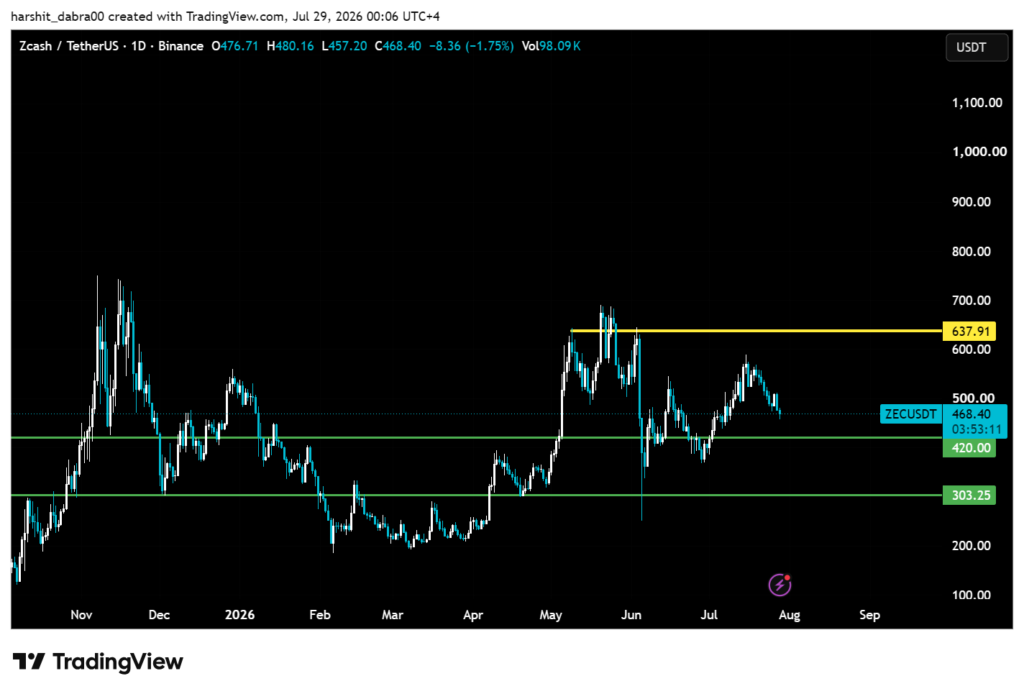
ZEC prices have come in considerably from recent highs, but it does have support to come around to $637.91. Which is where the digital asset was traded between May and June and has had yet to come back to since the beginning of June. ZEC prices have traded in a range since then, coming into test the $420 level once more.
Below the actual next major support level is $303.25, which is a level that has not been seen since last April. That is a large chunk between them, and if the $420 fails, that is just about the only support between here and $303.25, and the mentioned gap is about 35 percent lower, in which case $420 becomes a more meaningful level to traders just due to what stands below it.
Today’s price action doesn’t occur in isolation due to the timing of the Ironwood migration. Historically, protocol upgrades and pool shutdowns don’t move prices spontaneously and in today’s 1.75 percent decline of prices, there’s no obvious link to the NU6.3 activation in the immediate present. The migration of today, however, occurs while the ZEC has begun approaching a significant level of support with little room on the downside; in the case the upgrade injects any short-term market volatility on the charts, the level of $420.
The level is one that the market participants are closely watching. As for the Ironwood migration, regardless of what occurs with the actual event, the charts already signal that $420 is significant at this point.
The migration of Zcash is putting privacy as the main focus
Ironwood inserts a supply auditing tool, which is called a “turnstile,” before crossing over into the new supply; it moves ZEC to the old original pool until it is counted towards overall supply. Thus, the network is confident that the true supply value of ZEC is truthful. The concession for that assurance is that tokens passed through the turnstile are at some point displayed on-chain, but again, this is a turnstile the ZEC has to run through to begin any of the migrations, with nothing at all to do with the Cake wallet itself.
In discussion with The Coin Headlines, the COO of Cake Wallet says the following:
“Cake Wallet has been working tirelessly to ensure that the migration is seamless for our two million users while also preserving their privacy. We do this by splitting their Zcash coins into standard denominations (i.e. 10 ZEC, 1 ZEC, 0.1 ZEC, etc.) to blend in with other user’s migration transactions. Besides, we are spacing out migration transactions instead of sending them all at once. Ensuring that all Cake Wallet users use this privacy-preserving path so no one stands out on chain”
Standardizing balance denominations standardizes migration transaction appearances against other individuals in the public record in such a way that it does not reveal a particular user’s holdings as a specific amount. Staggering these transactions out, instead of sending them in bulk, allows for a second layer of anonymization when compared to patterned analysis bursts of consistent-size transactions. This is all coming from the same wallet address at the same time and is simpler to correlate with one another.