

Brazil’s Central Bank just rolled out a fresh real-time alert system meant to give financial institutions and crypto exchanges a serious hand in spotting, reacting to, and cutting down on cyberattacks that use crypto as a getaway route.
The initiative was accelerated by a massive breach in July 2025, when cybercriminals exploited a software vulnerability at financial middleware company C&M to steal $180 million from the financial system and convert part of the funds into Bitcoin and USDT through exchanges.

The $180 million wake-up call
The incident exposed a major vulnerability in the crypto space: tracking illicit funds becomes vastly more challenging once they exit traditional banking networks and move into crypto.
Regina Pedroso, Executive Director of the Brazilian Tokenization Association – ABToken – emphasized that maintaining fund traceability when money crosses from traditional finance into crypto is the primary concern in such incidents.
How the alert system works
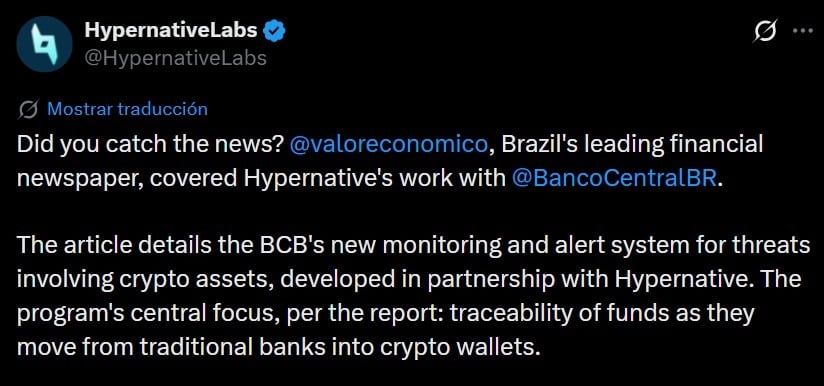
The system was developed in collaboration with Hypernative, a digital asset threat protection company that aims to neutralize threats to digital assets before they materialize.
The alert system will connect banks and domestic crypto exchanges in a joint network. Thus, when a threat is detected, the system will issue alerts to a group of exchanges and banking institutions, which can then redistribute warnings to their members.
The system has already been tested by the Central Bank with undisclosed market participants, and some alerts have already been issued.
The challenge now is implementation: associations must adapt to receive and distribute the alerts effectively.
Integration timeline and new regulations
Foxbit and Mercado Bitcoin will be the first exchanges to integrate the alert system, beginning within the next two weeks.
Alongside the alert system, Brazil will implement a 24 hour preventive hold on crypto transfers exceeding $10,000 per transaction or per day for individuals. This program gives officials a window to check out anything fishy before those funds can actually disappear elsewhere.
A new enforcement standard
Brazil is creating a framework that blends regulatory and technological intervention. The system’s development with Hypernative shows a willingness to deploy private-sector expertise for public security.
As other nations in Latin America and beyond face similar cyber threats, Brazil’s “real-time surveillance + temporary holds” model could become a regulatory blueprint for balancing innovation with security.