

Tether on Monday announced its partnership with the government of Georgia to back its national stablecoin initiative. The Georgian government is looking to improve its position in international commerce, digital payments adoption, and elevating its expertise in handling programmable financial infrastructure.
Tether’s announcement on the development, however, left certain key details about the project undisclosed. Plans outlining GEL₮’s structural details, rollout strategy, and regulatory implementation have not been brought to light as yet. It seems, Tether and Georgia have still not chalked-out details like GEL₮’s reserve custodian, launch date, and redemption rights.
Pegged against the Georgian Lari, the GEL₮ token is intended to make low-cost cross-platform transactions accessible in Georgia, which hosts an estimate population of around four million. According to the announcement, the National Bank of Georgia will be actively involved in overseeing the stablecoin’s ecosystem.
“The National Bank of Georgia welcomes collaboration with global innovators like Tether,” said Natia Turnava, President, National Bank of Georgia.
Let’s breakdown Georgia’s expectations with GEL₮
Georgia’s GDP reportedly hit over $38 billion in 2025 having clocked a growth rate of 7.5 percent. Around 12 to 15 percent of Georgia’s national GDP comes from inbound remittances. Up until now, traditional international money transfers have kept the residents of Georgia under massive intermediary fees and slow bank processing times. With the GEL₮ stablecoin, however, transactions will not only cost next-to-nil but will also only take just a few minutes to be completed.
At the time of writing, the USD was trading at GEL 2.64 — reflecting a strong conversion rate. With its national stablecoin, Georgian nationals will be able to lock in USD’s value locally without having to bear immediate fiat-exchange friction.
Earlier this month, the National Bank of Georgia released charts showing its ongoing flight against its current inflation of 5.9 percent. The bank is targeting to bring this inflation percentage down to three percent. On May 6, the Monetary Policy Committee of the central bank in Georgia announced a 0.25 percent interest rate hike — aiming to rope-in the excess cash out of the economy.
The launch of a national stablecoin at this point could prevent the local wealth from seeping into foreign currencies like the USD. Instead, the GEL₮ will hold Georgia’s capital within its territory which could eventually bring major stability to the national economy there.
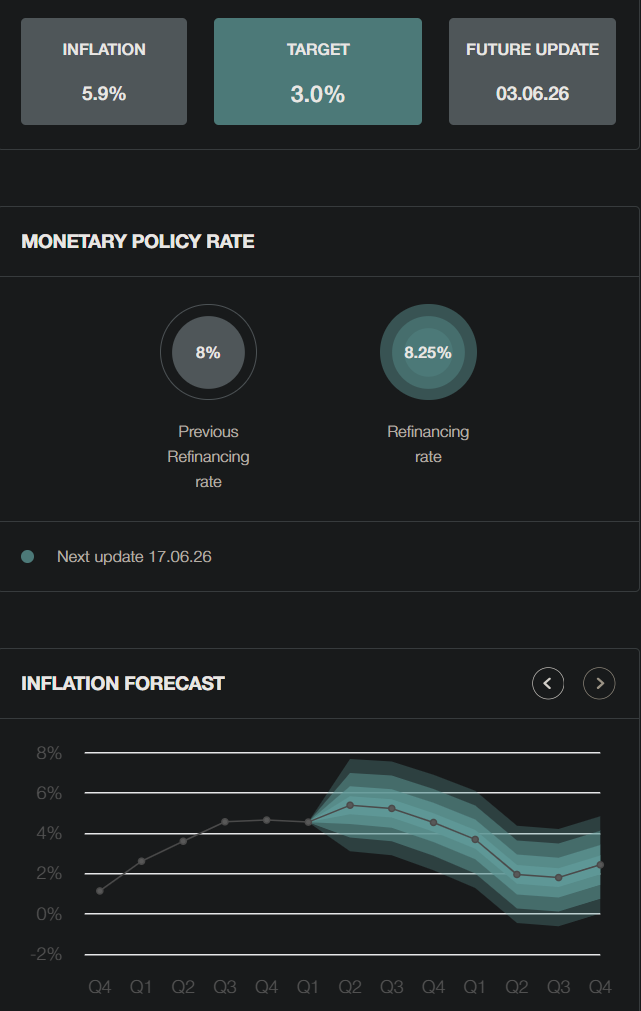
Source: National Bank of Georgia
In its announcement on Monday, Tether pointed out that the digital fiat infrastructure is increasingly becoming part of global trade, remittances, and payment systems.
It said, Georgia’s stablecoin framework sits already in alignment with the global standards around reserve management, redemption rights, issuer oversight, and AML compliance — making it a feasible market to explore a stablecoin partnership in.
Crypto firms looking to set up shops in Georgia have to first obtain a mandatory Virtual Asset Service Provider (VASP) license to obtain legitimacy. Additionally, stablecoin issuers in Georgia are legally required to guarantee that users can redeem their tokens for physical fiat lari at face value within three-to-five business days.
Tether is touted as the largest stablecoin player in the world, with its USD₮ stablecoin having hit a market cap of nearly $190 billion. Georgia has essentially tapped into Tether’s market expertise to modernize its financial ecosystem through Tether’s advanced stablecoin ecosystem.
Uzbekistan, El Salvador, and Argentina are other nations working with Tether to explore the stablecoin arena.