




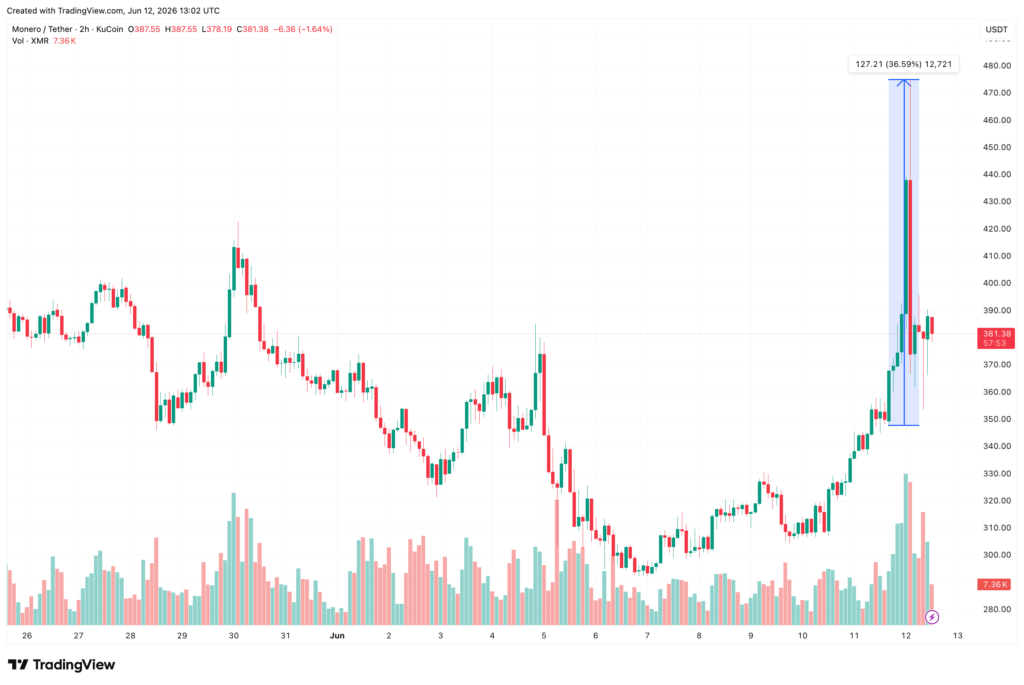
Top privacy-focused cryptocurrency by market cap, Monero (XMR), saw explosive price action on Friday, as it surged from $373 to as high as $474 within a duration of 6 hours. According to on-chain investigator ZachXBT, an unknown entity trying to distribute their USDT holdings was behind the digital asset’s violent price appreciation.
Monero sees parabolic rise in price
ZachXBT stated that someone tried to route $120 million received in stablecoins through a series of token swaps. The amount was received in USDT stablecoin on the Tron network on Thursday.
Soon, the receiver began splitting the amount into tranches and sent them across different destinations. A portion of the proceeds was sent to the Monero blockchain, in an attempt to hide the details of the transaction, including the sender and receiver.
The Monero buy orders placed by the aforementioned entity were so big that they had a direct impact on the cryptocurrency’s price. In his Telegram broadcast message, ZachXBT remarked that the sudden XMR buy sent its price from around $330 to $420 – an appreciation of almost 25 percent.
The following 2-hour XMR chart shows the chaotic price action over the past 24 hours. The digital asset made a high of $474 before losing some of its gains, and consolidating around the $380 price level.
The reset of the funds were sent to different venues, such as a $12 million deposit to KuCoin crypto exchange, and $8 million transferred to instant swap services, typically used to convert a cryptocurrency to another with minimal identity checks.
Another chunk of $8 million was passed through a cross-chain swap tool called Near Intents, which off-boarded the amount from Tron network, and into Ethereum and Bitcoin blockchains.
The remaining approximately $72 million in funds were frozen by USDT issuer Tether. Being a centralized stablecoin, a wallet holding USDT can immediately be blacklisted by Tether, leading to the wallet holder being unable to move or cash out the funds.
At present, the source of the $120 million amount is not known. However, seeing the entity trying to erase the digital trail of the funds by converting to XMR, and using instant swap services hints that it could be illicit money.
Privacy coins are not just for money laundering
Reducing the idea of privacy coins to mere money-laundering tools would be unjust. Privacy is essential at a time when tech firms are regularly caught exercising power overreach, and spying on their users without consent.
Consequently, digital assets such as XMR and Zcash have significantly outperformed large-cap coins like BTC and ETH over the past year. On Wednesday, Ethereum layer-2 network StarkNet unveiled STRK20 ZK privacy layer for shielded ERC-20 token transfers.


