

For four years, two lines of buggy code stayed in Zcash’s Orchard shielded pool that was live and potentially exploitable. A security researcher named Taylor Hornby noticed the vulnerability on May 29th, and with the help of a custom audit framework combined with the latest released Claude Opus 4.8, he right away realized the risk that a malicious individual would have been able to endlessly mint illegitimate ZEC within the shielded pool. What this will do is that it will not be leaving any on-chain trace: no signature, no record, and no ability to confirm the fact that the minting had already occurred.
Shielded Labs stated that this vulnerability existed since the activation of Orchard in May 2022 until the emergency fix that occurred on June 1st, 2026. As they put it, given the privacy properties of Orchard, there is not and there will never be a cryptography-based way to check if such a leak has occurred.
The statement mentioned is more of a structural admission, and we can’t ignore that wording, as it’s not a legal disclaimer.
The bug can be put under the category of the most frequent vulnerabilities present in production ZK systems, as pointed out by Joe Andrews at Aztec Labs: an under-constrained elliptic curve check within the Halo 2 proving circuit. Any system in which reliability is more on an opaque mathematical proof in comparison to the clearly maintained ledger accounting is vulnerable to this.
The most important reason the Zcash case is particularly problematic is that the privacy mechanism doesn’t simply hide the transaction thing; additionally, it covers up the vulnerability itself. Following this, the network cannot distinguish a real shielded transaction from a false one if the proof complies with the circuit checks.
The ironwood update
On Saturday, June 6, Shielded Labs, the Zcash Foundation, and ZODL together put forward the “Ironwood” update, which is an implementation plan that will focus on encouraging the current ecosystem’s existing users to enter a new privacy pool implemented based on the fixed circuit and make further coin production in the existing Orchard pool forever impossible. Once the funds move out of Orchard, counterfeit ZEC will be stranded and destroyed. This proposal is the first mechanism that Zcash has produced that can possibly help in resolving the problem of “did exploitation occur?”
Monero’s architecture
In contrast, Monero doesn’t operate with a vulnerable circuit that can stealthily falsify the supply due to the fact it uses ring signatures, stealth addresses, and RingCT. To make it simpler, there is no centralized circuit that, if gets into any kind of failure, will invisibly fail. In comparison to Zcash’s loss of stronger anonymity in the face of certain forms of sophisticated chain analysis (FCMP++ is one effort that was focused on reducing the chance of those events by widening the anonymity sets). Each of these networks contains a different type of failure.
Why Monero matters more going forward
Vikrant Sharma, Co-founder of Cake Labs mentioned to The Coin Headlines that
“Independent audits of privacy protocols are a good thing. Monero has been battle-tested for more than a decade, but serious scrutiny, including AI-assisted review, makes the whole ecosystem stronger. The Zcash bug is a reminder that privacy coins should compete on security, transparency, and resilience, not marketing claims. At Cake Wallet, we welcome responsible disclosure and more eyes on Monero.”
The technical side
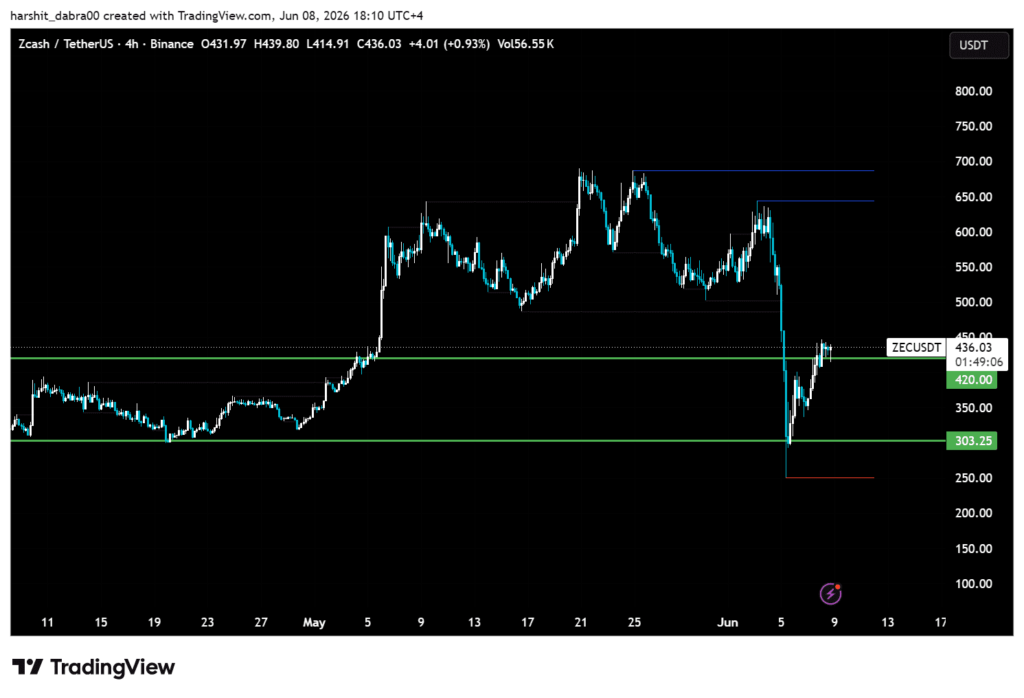
If we look at the technical side of ZEC, the chart shows market sentiment to be divergent between both coins. ZEC continues to come under pressure with the critical moving averages above the current trading price and momentum continuing to move lower with the bears aiming for support around the $420 region.
XMR has continued to show a bearish technical posture but if we consider the momentum, it continues to fall at a less drastic rate with short-term periods of oversold signals being approached.
This, however, acts as a bigger threat than price for Zcash. In the case of the weakness for Monero, it has mainly been through a lack of liquidity and exchange access; Zcash is dealing with a confidence shock post-Orchard. The effectiveness of Ironwood may well still depend on whether or not it can reassure users and avoid shielded activity from shrinking to the point where it harms the privacy network of the ecosystem.