

ENA is trading at $0.0926 and remains in the same orange zone, which has capped and supported the price back from February. The daily candle is still pending to be closed and nothing has resolved yet, and this point is worthwhile interacting with before the next part, given the fact that on-chain activity just did something that the price is not caught up with.
The important range that wont let go
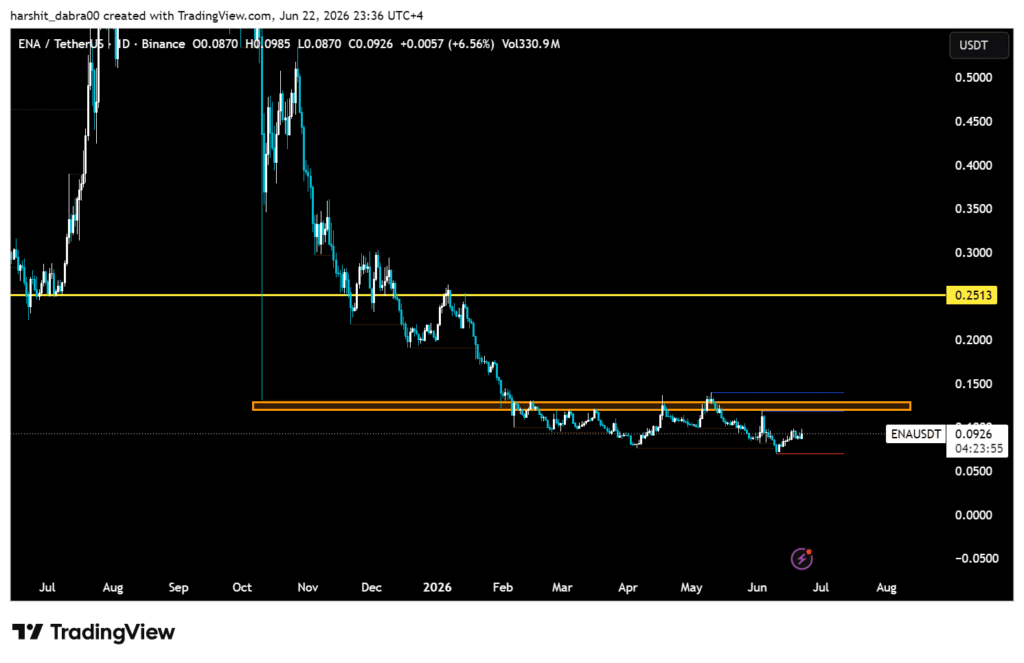
The orange channel that indicates the range of $0.085-0.135 has been ENA’s entire market since early February. The majority of ENA’s rallies within the range have so far failed just below $0.135 and meanwhile all declines have been met by offering buying support at the low. That has remained ongoing for over five months. Currently at $0.0926, ENA’s price is in the lower half of that specified range and positioned just under this morning’s pivot at $0.09248. This is what keeps it more neutral to biased short rather than outright bull/bear. In simpler terms, it means that bears are not in control and therefore it can be called marginally weaker than balanced.
RSI7 is showing a reading of 35.44, which means it is close to what is called “short-term oversold.” RSI14 stands at 46.66, and RSI21 stands at 49.83, and both of these figures lie in the essentially neutral category and this spread is relevant.
A short-term dip within a market that is otherwise flat would be a distinct setup compared to an asset that is on the oversold side across multiple timeframes at a single point of time. The MACD histogram is negative at -0.00041 and the MACD line is standing at 0.00094 at the time of writing, although it is sitting just under the signal line at 0.00136. This reading can be called more of a weak reading rather than the collapsed or turning one.
The moving averages indicate a somewhat different perspective than the oscillators. Considering the simple and exponential moving averages, SMA7 is standing at $0.09517 and EMA7 at the level of $0.09433 and both of them are positioned above the current price, and this means that the last week of trading has actually been more concentrated on the downside rather than the upside.
But the long-term MAs, SMA200 at $0.08893 and EMA200 at $0.08842 are positioned slightly below spot and this is indicating that the longer trend underneath this position chop is still pointed up, barely. This indicates short-term weakness that is lying within a longer-term floor that is presently holding.
The fibonacci levels needs attention
Considering the Fibonacci levels from the recent swing low of $0.08693 to the swing high of $0.09823. For ENA, the 50 percent retracement is sitting at the price point of $0.09258 and this is almost exactly where the underlying price sits right now.
A 61.8 percent extension value of $0.09125 is expected to be the next downside support if it fails and 38.2 percent at $0.09391 would likely be the initial resistance up in the case any snapback occurs. These are not going to be major areas but can be tested quietly without that much public attention.
Wallets have locked in before the price moved
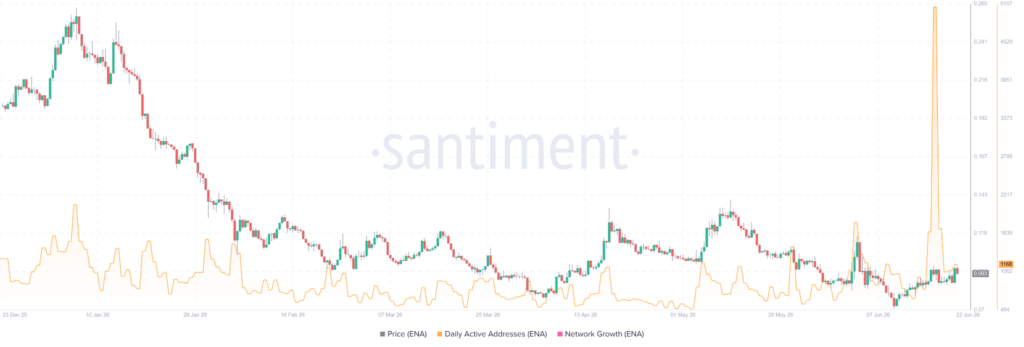
As per the santiment data, the Daily active addresses metric marked their highest level since November 2025 on June 19. In addition to this, the new wallet creation achieved an all-time high since launch. In the event where two metrics move in tandem, instead of one spiking while the other lags, it signifies the fact that there is a trend of new capital entering the market instead of holders that are cycling the same supply.
The timing lines up with buyback-and-burn chatter for ENA and expanded staking utility, alongside restaking initiatives giving yield seekers and governance participants reason to show up. New wallets at an all-time high rules out the lazier explanation, that this is DeFi users rotating between platforms; fresh wallets mean fresh capital, a distinction no chart shows.
This isn’t reflected in price yet; ENA remains within the same range since Feb. A confirmed breakthrough of $0.098 needs to take place for that to be meaningfully technically reflected. Whether this demand takes hold or evaporates depends on a few catalysts not even on the charts: the passing of the buyback-and-burn through governance and an increase of USDe supplied coupled with a growth in the total number of wallets, and if that remains the case, the discrepancy in value becomes the narrative.