

Stablecoin reserves appear to be depleting on major crypto exchange Binance. According to exchange data received on Thursday, USDC reserves on Binance have fallen by about 21.6 percent over the past month, showing a serious lack of “dry powder” to withstand high selling pressure in the market.
USDC reserves slide on Binance exchange
The fall in exchange stablecoin reserves signals a strong withdrawal of the crypto market’s immediate purchasing power. On Binance, USDC reserves have plunged from roughly $5.75 billion to $4.6 billion within a month.
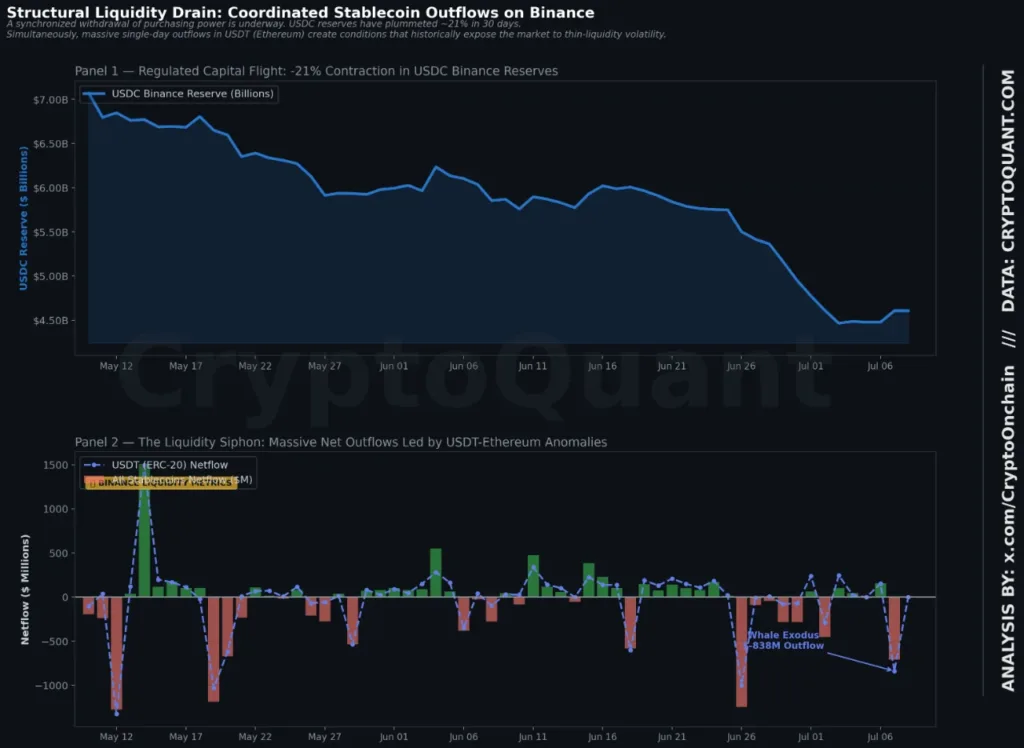
At the same time, Ethereum-based USDT reserves have recorded massive single-day outflows. On June 26, $997 million worth of USDT left the exchange, while on Wednesday (July 7), stablecoins worth $838 saw exodus. Consequently, the aggregate stablecoin netflow for Binance has averaged a deficit of $115 million per day over the past week.
As mentioned earlier, stablecoins play an important role in that they sustain upward price discovery for cryptocurrencies during bullish phases. When USDC – representing regulated, risk-averse capital – and USDT-ETH – representing crypto-native whales – exit a major exchange like Binance, it points toward capital preservation.
As a result, a declining exchange supply ratio (ESR) across the aforementioned crypto assets shows that liquidity is slowly migrating toward cold storage, DeFi protocols, or over-the-counter trading desks.
The current market dynamics differ from previous phases where stablecoin reserves merely rotated among different cohorts. Although the market is maintaining a relatively stable price action in the short-term, the stablecoin exodus is occurring against a backdrop of thinning order books.
The withdrawal of more than $1 billion in stablecoin liquidity pretty much removes the underlying cushion that tends to dampen volatility during market shocks. Such conditions have historically preceded periods of volatile price action, suggesting the market may require an inflow of stablecoin deposits to create a strong structural floor.
Stablecoins continue gaining traction
While thin liquidity on exchange order books might be a concern for crypto market, stablecoins, on their own, are continuing to witness greater adoption and new use-cases. On June 3, Moneygram unveiled their own MGUSD stablecoin, powered by the Stellar network.
Stablecoin adoption is not just limited to a particular geography. For instance, on July 1, Taiwan announced that it is in the process of finalizing stablecoin regulations in the island nation.
Elsewhere, in Europe, France’s Credit Agricole expressed desire to enter the Euro stablecoin space and capture Circle’s turf. In a similar vein, on June 30, an alliance of more than 140 global companies unveiled the OUSD stablecoin.