



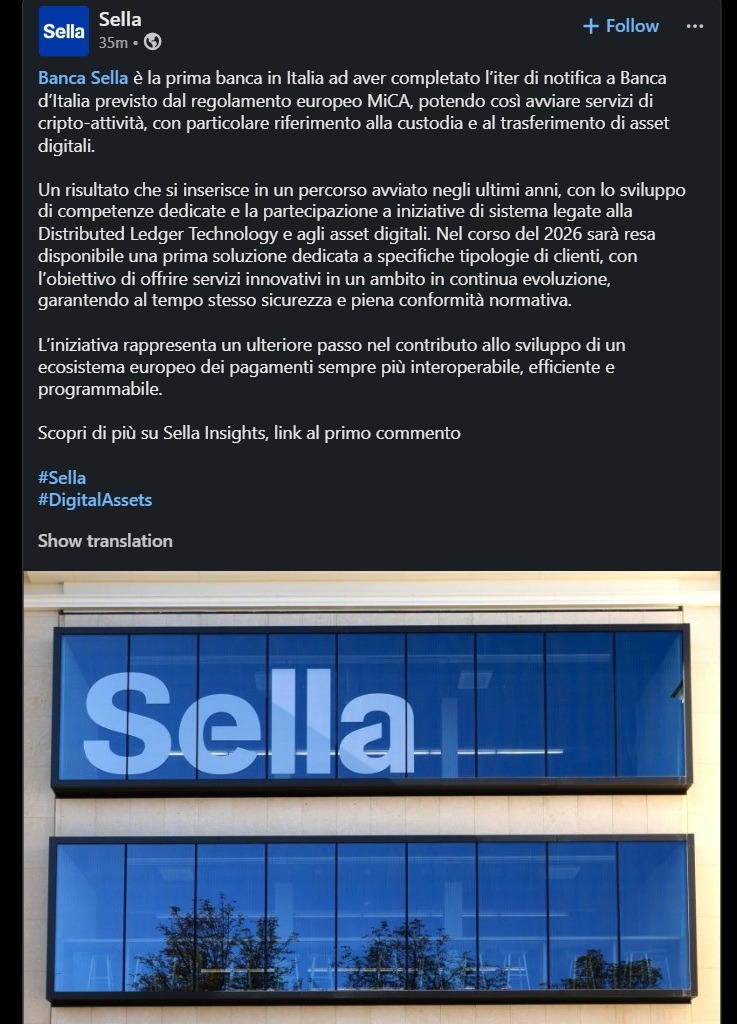
Europe is getting on. Banca Sella completed its Markets in Crypto-Assets (MiCA) notification with Banca d’Italia, becoming the first Italian bank authorized to launch crypto-asset services, including Bitcoin custody and transfers, in 2026.
Why Italy’s oldest banking dynasty just embraced crypto
If you didn’t know, Banca Sella is not some tiny neobank testing the waters. It was founded in 1886, manages over $40 billion in assets, and serves over 30,000 corporate clients across Europe. This is a heavyweight for sure. So why now? Because MiCA finally gave them a clear rulebook.
Andrea Tessera, Managing Director of Digital Banking, put it simply: payments are evolving toward instant, interoperable, programmable models fueled by tokenization. Sella realized they could either watch from the sidelines or become the infrastructure. They chose the latter, quietly building a Distributed Ledger Technology (DLT) and digital assets team since 2022 and joining Banca d’Italia’s Fintech Milano Hub experiments. Now they are first across the finish line.
How crypto custody accelerates Banca Sella’s business
Here’s the smart play: Sella isn’t launching a retail crypto exchange. They’re targeting specific client segments with custody, sending, and receiving of digital assets. Think family offices wanting Bitcoin exposure, corporates accepting stablecoin payments, or asset managers tokenizing real-world assets (RWAs).
This is beyond speculation; it’s service expansion. To this point, by offering regulated, insured custody, Sella can charge fees, deepen client relationships, and cross-sell traditional banking products to crypto wealthy customers. Meanwhile, their involvement in Qivalis (a 37-bank euro stablecoin consortium) pushes them into the euro-denominated onchain payments race. One stone, many birds.
What this means for Italy and Europe
Italy just got its first regulated bank crypto player, but others will follow fast. Spain’s BBVA and Germany’s Commerzbank have already secured MiCA licenses, but Sella now leads in Southern Europe. The real signal? It seems that traditional banks are not fighting crypto anymore (at least in Europe), they’re absorbing it. And for Italian regulators, this is proof that MiCA works; for instance, clear rules brought a $40 billion institution into compliance, not exile. Expect Sella’s move to pressure Intesa Sanpaolo and UniCredit to accelerate their own crypto roadmaps.