

In TradFi, when yields compress, capital flows higher up the risk curve. Exactly, that’s happening right now in the tokenized RWA market. 7-Day APY on tokenized U.S. Treasury products plunged to 3.38 percent, off 1.59 percent over one week, and Maple’s premier Syrup products declined 39.89 percent and 49.14 percent in 30-days. Opposite to that trade were Superstate’s Crypto Carry Fund at 9.56 percent APY; Spiko’s EUR overnight fund, up 127.4 percent to $333.8 million; and Franklin Templeton, which saw a net of $688 million in net inflows. The total distributed value for RWA reached $30.14 billion, an increase of 5.41 percent for the month.
The treasury market: who is winning and why it matters
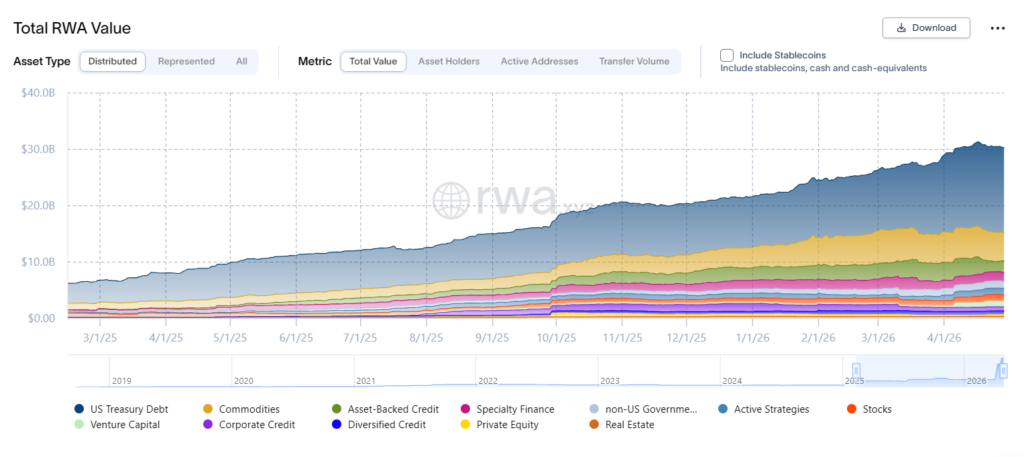
The total value of tokenized U.S. Treasury debt has reached $15.07B and has increased 12.69 percent in 30 days. The percentage value still constitutes approximately 50 percent of all distributed non-stablecoin RWA values. The segment has brought in 76 fast products and 61,099 holders distributed through 8 different blockchains.
Effectively, the platform race is a four-way battle. Circle’s USYC ($2.9 billion/19.28 percent) has the top spot in terms of total value, followed closely by Ondo ($2.9 billion/18.92 percent). Next comes Securitize/BlackRock’s BUIDL with $2.7 billion/17.62 percent market share. Rounding out the four is Franklin Templeton’s BENJI at $2.0 billion/13.45 percent. Combined, these four platforms hold just under 70 percent of the entire treasury tokenization market.
Yet market share understates the momentum narrative. Franklin Templeton’s 30 day flow of $688 million leads across all of the treasury products, not by a slim margin. BUIDL brought in $355 million. Ondo’s USDY brought in $379 million. Franklin’s strategy of distributing BENJI across 12 blockchains (Stellar, Polygon, Ethereum, Arbitrum, Aptos, and others) is clearly providing the kind of distribution the competitors simply have not. 30 day RWA value on Stellar increased 42.68 percent, almost exclusively a BENJI play.
Conversely, Matrixdock’s STBT has shed 57.71 percent value over 30 days. Institutional capital is not spreading evenly among treasury products; rather, it is concentrating on brand-name, well-distributed Issuers, consolidating away from smaller, less distinctive products. The market is becoming more organized.
Yield compression is pushing capital toward complexity
Treasury yields are currently going through a fall. As a 7-day APY of 3.38 percent is down 1.59 percent in a week, they are approaching levels where vanilla yields are unlikely to warrant on-chain settlement operations for institutional allocations. Syrup liquidity provisioning products offered by Maple Finance are down 47 percent in TVL in a month-presumably driven by reduced DeFi lending spreads. Superstate’s Crypto Carry Fund (USCC) now has $203.1M and generates 9.56 percent APY by collecting returns from basis trades between spot and futures crypto assets and is up 1.10 percent this month over a fairly large base.
It is a pattern that the active market participants know from TradFi. As short-end sovereigns compress, money chases yield up the risk curve into credit, alternatives, and structured products. For the first time, we can notice this dynamic in the on-chain RWA flows.
The on-chain active strategies and private credit bucket have begun receiving most of the flows. One of the key beneficiaries is the eurSAFO from Spiko, denominated in euros and utilizing Amundi’s overnight swap infrastructure, which has grown by 127.4 percent in one month, to reach $333.8 million. The market for European institutional capital looking for dollar-neutral yield-seeking products with known regulators seems to have identified a suitable on-chain solution. This is one segment of tokenized non-USD yield, which barely existed 1 year ago.
The commodity story no one noticed
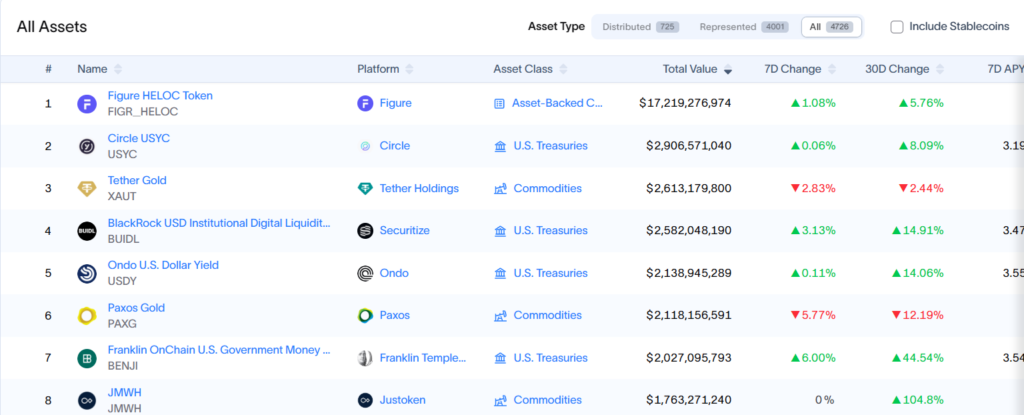
Interest is turning towards the gold tokenization narrative. Well known are the ones by Tether, Gold (XAUT) at $2.61 billion and by Paxos, Gold (PAXG) at $2.12 billion. Both tokens saw their value drop during April 2026. The following value comes as a 2.44 percent loss for XAUT and 12.19 percent for PAXG, possibly indicating some profit-taking after a sustained gold bull cycle.
$2.6 billion of tokenized agricultural commodities are tokenized on XRP Ledger & Polygon through Justoken, barely cracking major crypto narratives. JMWH, wheat futures, has increased 104.8 percent to $1.76 billion in 30 days. JSOY_OIL, soy oil, sits at $475.2m (+$8.70 percent). JSOY, soybeans, represents another $371.6 million.
For perspective: Paxos Gold, the other of the two main gold tokens, is at $2.12 billion; Tether Gold is at $2.61 billion; both are down in April. Tokenized wheat is now only very slightly behind PAXG in value. The total tokenized commodity market is worth $5 billion in value, spread around the world and for the first time, a decent proportion is not represented by gold.
Tokenized equities: the holder growth signal
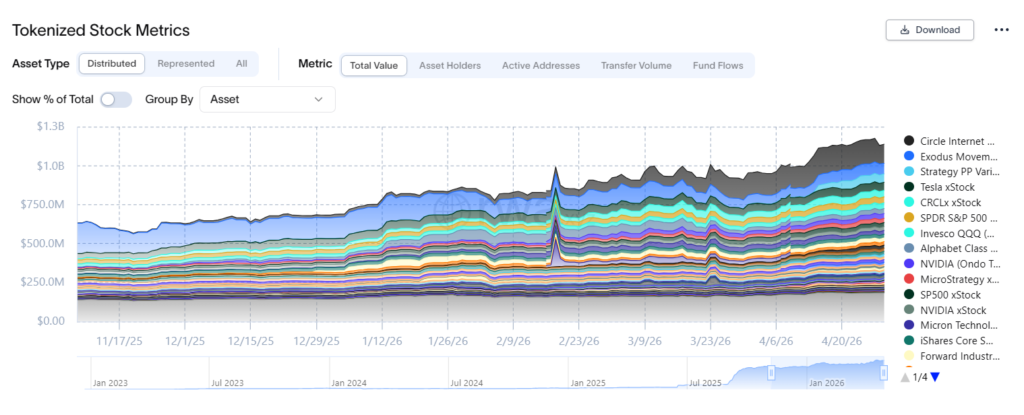
The tokenized stocks, $1.14 billion in distributed value, were up 19.23 percent in 30 days, the largest of all classes. While active monthly addresses declined by 14.56 percent, holder numbers increased by 9.62 percent, and this is noteworthy. There are fewer distinct transactions but there are more addresses holding the history of acquisition, not speculation.
The outlier numbers are enormous. STRcx (x Stocks’ tokenized MicroStrategy product) is up 2,621 percent in 30 days to $54.3 million and the tokenized stock price of SanDisk is up 3,967 percent. These are small-base numbers and small-base products, but they suggest tokenized equities are being used for directional bets with huge thematic tailwinds (e.g. Semiconductor recovery, BTC proxy leverage) that are functionally inaccessible to the average retail investor in traditional markets due to structural inefficiency in the U.S.
The stronger, lasting signal is provided by Ondo’s equity index products. The QQQon (Invesco QQQ) increased 35.18 percent. Google (Alphabet) increased 34.19 percent. NVDAon saw a growth of 33.98 percent and SPYon increased 16.99 percent. Consistent double-digit increases across broad blue-chip equity coverage suggest more than a trend-driven demand.