

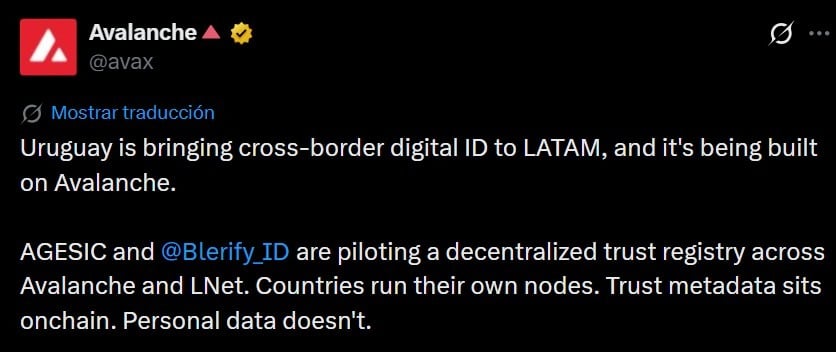
Uruguay’s Agency for Electronic Government and Information and Knowledge Society has teamed up with Blerify to test out a new decentralized digital ID system for cross-border use. By using Avalanche and LNet, Latin American countries can run their own nodes and keep personal info private; only the essential trust data actually goes on the blockchain.
Blockchain’s real identity use case
This approach positions blockchain as a solution for cross-border interoperability, not as a database for sensitive information.
The pilot project is a natural extension of Uruguay’s digital identity leadership. Since launching ID Uruguay, the country has enabled over 1.6 million citizens to securely access more than 190 government services and complete 1,500 online procedures.
Uruguay has also integrated its physical ID cards, held by 85 percent of citizens, into a digital framework that serves as the foundation for regional interoperability.
How the decentralized trust registry works
The system uses smart contracts across Avalanche and LNet to synchronize trust metadata approximately every two seconds. This metadata includes information about credential issuers and credential status, such as whether a digital ID has been revoked or is valid, but never stores personal information about citizens themselves.
In this case, in Latin America, each participating country runs its own nodes, maintaining sovereignty over its identity infrastructure while enabling cross-border verification.
The architecture builds on Uruguay’s digital ID broker model, which has already proven it can work across borders with Brazil.
Back in October 2024, they actually pulled off the first real-world cross-border digital ID link in Latin America. It let citizens from Brazil access 40 different Uruguayan services using their own GOV.br credentials.
The new pilot expands this concept to a decentralized framework, with support from the GEALC Network, the Inter-American Development Bank, and the Organization of American States.
Why this matters for Latin American integration
The pilot is part of a broader initiative to create a standardized digital ID broker across the region. Participating countries are currently developing a minimum viable product, expected to be implemented in three or four countries by the end of 2026.
The model has attracted support from the World Bank, Co-Develop, the Center for Digital Public Infrastructure, and the Digital Public Goods Alliance.
Using blockchain for trust coordination instead of storing personal info solves a huge problem: it allows for cross-border verification without creating those risky centralized data hubs.
As AGESIC’s Digital Identity Manager, Juan Pablo García Cairello, put it, the whole point is to make using your home ID in another country just as easy and trustworthy as showing a physical ID card.