

Stablecoins overtook Bitcoin in purchases on Bitso across Latin America in 2025, showing how digital dollars have become a practical financial tool in a region shaped by inflation, remittances and volatile currencies.
The findings were published in Bitso’s Crypto Landscape in Latin America 2025 Report, which analyzed retail user activity across Argentina, Brazil, Colombia and Mexico, using behavioral data from millions of interactions on the company’s mobile and web platforms.
Digital dollars take the lead
Across the four markets, USD-linked assets accounted for 40 percent of all purchases on Bitso in 2025, with USDC representing 24 percent and USDT 16 percent, putting digital dollars ahead of Bitcoin, which made up 18 percent of purchases, followed by XRP at 11 percent, Ether at 7 percent and Solana at 4 percent.

The shift marks a clear change in how crypto is being used across Latin America, where many users appear to be buying stablecoins not only to rotate into riskier assets, but to gain dollar exposure, preserve purchasing power, send payments and reach global liquidity through mobile financial tools.
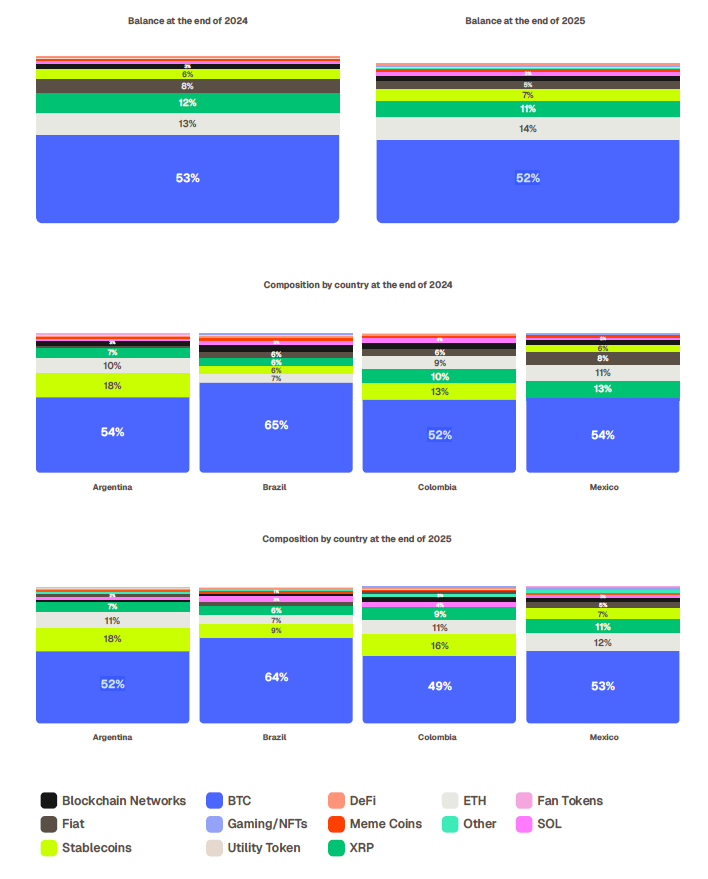
While stablecoins led purchasing activity, Bitcoin kept its place as the region’s main long-term crypto holding, with its share of regional balances slipping only slightly to 52 percent at the end of 2025 from 53 percent a year earlier, a sign that many holders stayed with the asset despite market volatility.
Argentina shows the strongest dollar demand
Argentina stood out as the clearest example of crypto dollarization in the region, with USDT alone accounting for 57 percent of purchases among Bitso users in the country, and combined USD-linked assets reaching 71 percent, the highest concentration recorded in the report.
Bitso said activity in Argentina often rises shortly after monthly salary payments, pointing to a routine pattern in which users convert pesos into stablecoins to preserve purchasing power, turning crypto into a money-management tool rather than only a speculative asset.
Brazil showed a more balanced profile, with USDC representing 23 percent of purchases, Bitcoin 22 percent and XRP 12 percent, while Bitso said the country’s stronger regulatory structure and higher levels of advanced trading activity suggest a market where users are building broader portfolios instead of relying mainly on stablecoins as an emergency reserve.
Young users keep crypto growth alive
Younger users continued to drive adoption in 2025, with the 18-to-24 age group rising to 29 percent of all users from 27 percent in 2024, challenging the idea that crypto adoption is slowing among new entrants as the market matures.
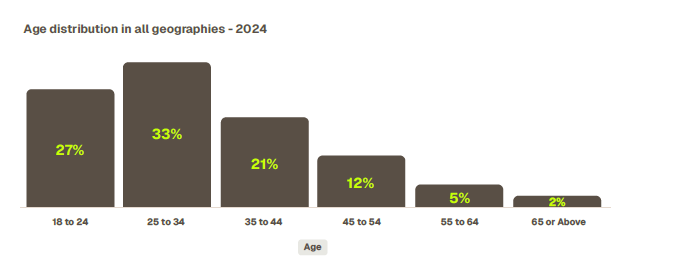
Bitso said the increase came during a more difficult market environment for first-time speculators, suggesting many younger users now see crypto as part of everyday digital finance, closer to mobile banking than a short-term bet, although participation remains uneven, with women representing 23 percent of trading users regionally.

Simple conversions dominate
Most users continued to interact with crypto through basic transactions in 2025, with 85 percent to 89 percent relying mainly on conversions throughout the year, while 8 percent to 10 percent placed trading orders and 4 percent to 7 percent used both methods.
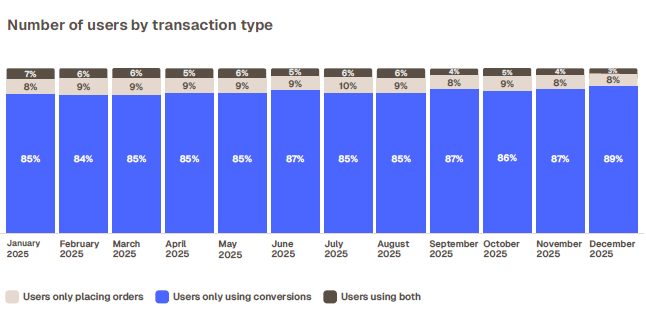
The pattern shows a market split between everyday users turning to crypto for dollars and payments, and a smaller group of advanced traders placing larger, more complex orders.
For Latin America, the report suggests crypto’s next phase may depend on whether exchanges can serve both worlds at once, from users seeking digital dollars to investors building longer-term crypto positions.