

S&P Dow Jones Indices and Pantera Capital have launched the S&P Pantera Digital Asset Index, a fundamentals-focused benchmark that screens cryptocurrencies for recurring network revenue, market size, liquidity and supply conditions while excluding meme coins and abandoned assets.
Launched on July 20, the index is designed for investors seeking broader digital-asset exposure without relying mainly on price momentum, token popularity or a single cryptocurrency.
S&P Dow Jones Indices said the benchmark could be used as a reference for investment products or by asset managers selecting digital assets, although investors cannot place money directly into the index.
Revenue becomes the entry test
The index draws potential members from the S&P Cryptocurrency Broad Digital Asset Index but applies additional requirements intended to identify tokens linked to measurable economic activity.
To qualify, a digital asset must have generated positive protocol-level revenue across the two most recently completed fiscal quarters and must be covered by blockchain-data provider Artemis Analytics.
New entrants must have both a market capitalization and an adjusted market capitalization above $500 million, while existing members face a lower $250 million threshold during index reviews.
The rules also require at least 30% of an asset’s total supply to be circulating and set a minimum liquidity threshold for new additions, while excluding meme coins and assets classified as abandoned.
Protocol revenue is used as an indicator that a blockchain network is generating recurring economic activity, although S&P said it should not be treated as proof of investor returns or future cash flows.
“For global investors, the biggest friction point in crypto hasn’t changed; it’s knowing how to allocate. We believe we’re at a pivotal moment for digital assets, and that’s why we worked with S&P Dow Jones Indices to build an index designed to identify which digital assets and infrastructure truly matter,” said Dan Morehead, Pantera Founder and Managing Partner.
Bigger assets cannot dominate the index
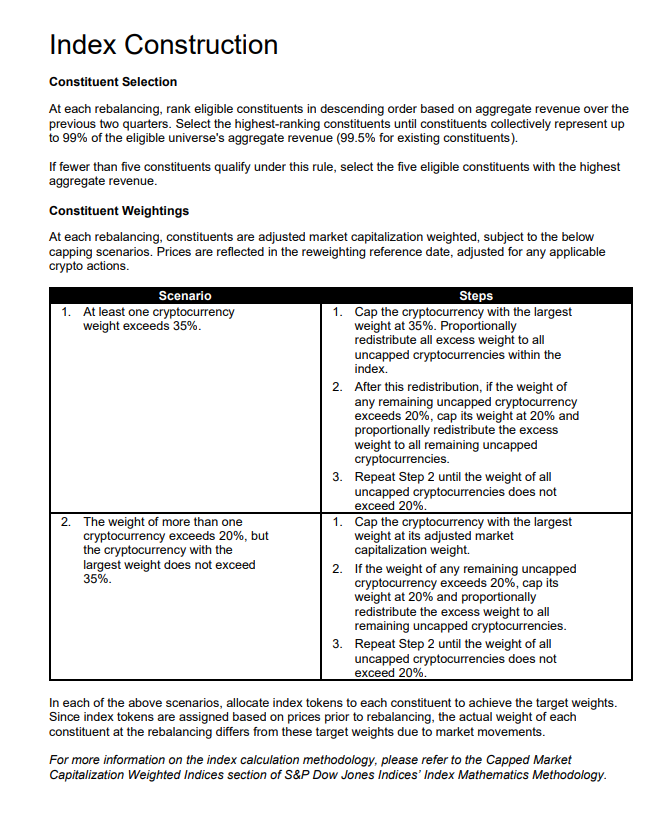
Eligible assets are ranked by the revenue their networks generated over the previous two quarters, with the index adding the highest-ranking names until they account for nearly all revenue across the qualifying group.
Each asset’s weight is based largely on its market value, but limits are used to prevent one cryptocurrency from dominating. The largest holding may be capped at 35%, while other major positions can be limited to 20%.
Lukka and Artemis provide the data
Crypto data provider Lukka supplies pricing, trading-volume and reference data, while blockchain analytics platform Artemis provides protocol-revenue and circulating-supply figures.
S&P Dow Jones Indices controls the methodology through an internal index committee, which can remove assets over legal, regulatory or practical concerns, including alleged market manipulation, sanctions exposure, privacy-related risks or hacking incidents.
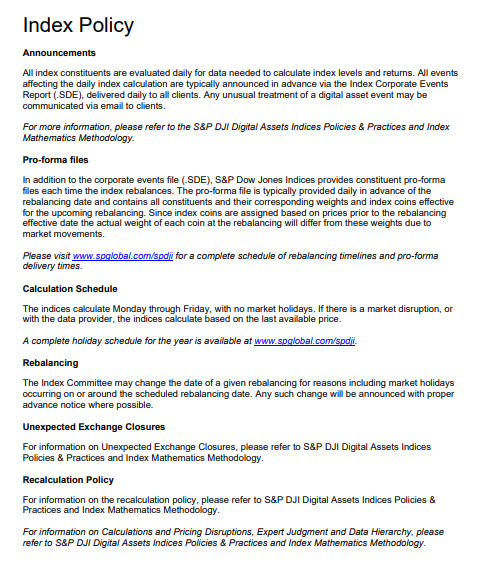
The index is calculated each weekday at 4 p.m. Eastern Time, even on some traditional market holidays, with its holdings reviewed every three months.