



Base Azul upgrade was activated on mainnet, introducing multi-proof systems [Trusted Execution Environment (TEE) and Zero-Knowledge (ZK)], Osaka Ethereum Virtual Machine (EVM) alignment, and a streamlined client stack that has already sustained 5,000 Transactions Per Second (TPS) bursts.
What makes Base Azul Upgrade different: Security as a double-lock
Here’s the clever bit: Azul is more than just speed. It’s about trust. The upgrade activates multi-proofs, a system combining TEE and ZK provers. Either proof type can finalize a proposal on its own, but when both agree, withdrawals from Base to Ethereum finalize in as little as one day. In an extreme case, an attacker would need to compromise multiple independent systems to force a fast withdrawal, not just one.
This design, inspired by Vitalik Buterin‘s Layer-2 (L2) finalization roadmap, gives Base ‘security-in-depth’ while satisfying a core technical requirement of Stage 2 decentralization: the ability to detect and handle proof system bugs onchain. Posting ZK proofs is permissionless and will override permissioned TEE proofs if there’s a contradiction. Example: think of it as two security guards checking each other’s work.
Most important aspects of the Base Azul Upgrade
- Multi-Proof System: TEE and ZK provers work in tandem; either can finalize, but both together enable around 1-day withdrawals
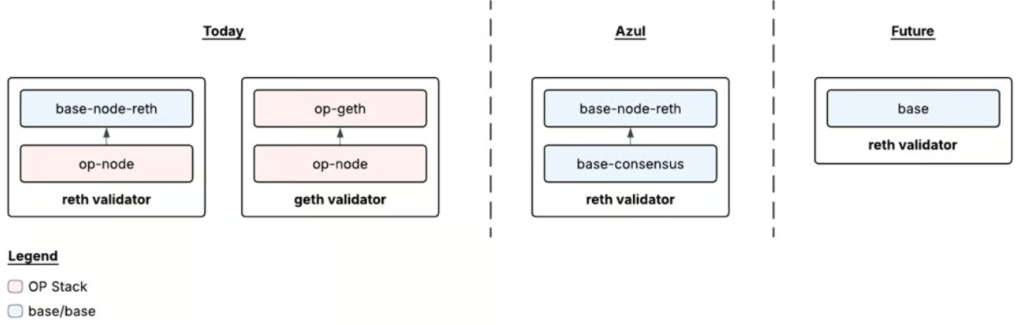
- Client Consolidation: Base blockchain now runs exclusively on base-reth-node (execution) and base-consensus (consensus). Op-geth, nethermind, and op-node are no longer supported
- Performance Leap: Network sustained multiple bursts of 5K TPS; empty blocks dropped from around 200/day to around 2/day
- Osaka EVM Alignment: Adopts Ethereum’s latest specs, including CLZ opcode (count leading zeros), per-transaction gas cap of around 17 million gas, and adjusted precompile costs
- Flashblocks Optimization: Websocket payload simplified (removed account balances and receipts) to free room for future performance hints
- Operator Migration Required: Node operators must migrate to the new clients before activation; existing Reth data is compatible, but op-geth users need a fresh sync from snapshots
What this means for devs and regular users
- For regular users: You don’t need to do anything. Base just got faster, safer, and withdrawals will gradually become quicker as the multi-proof system matures.
- For developers: Most apps require no changes. However, if you use Modular Exponentiation (MODEXP) heavily, send very large transactions, or consume the Flashblocks websocket directly, you’ll want to review the spec changes.
- For node operators: If you are running op-geth or nethermind must migrate to base-reth-node, or you will be left behind after activation.
The real impact on the blockchain space
To this point, Base is no longer just another Optimism fork. Azul marks the first upgrade on a stack Coinbase controls end-to-end, with a steady cadence of independent upgrades planned through 2026.
By consolidating to a single, high-performance client (Reth consistently ranks among Ethereum’s fastest), Base is aiming to scale to 1 gigagas/s while maintaining alignment with Ethereum’s spec. For the wider L2 ecosystem, Azul offers a production-tested template: multi-proof security, aggressive client simplification, and real performance metrics. Nevertheless, there’s a message to deliver to other rollups: “Decentralization is turning into something beyond fancy roadmaps, and now it’s more about shipping code that works.