

Solana on Monday claimed that its network dominates a majority of all agentic payments activities that are rapidly making inroads into the Web3 sector. The blockchain giant, through a post on X, said it is supporting 65 percent of all agentic AI transactions supported by Coinbase’s x402 technology — that allows autonomous AI agents to pay for internet services directly, without requiring human intervention.
Often pitted as a rival to Ethereum, Solana pointed out that transaction costs on its network averages at $0.00025 which has attracted a flock of developers to use its infrastructure who are creating agentic AI payment solutions on the network. Comparatively, average Ethereum transaction cost ranges between $0.05 to $0.50 — marking a visible spike against Solana.
Solana, that went live in 2020, credited its stellar results in capturing the agentic commerce dominance to its ultra-low latency and minimal transaction costs.
Solana on AI frenzy
In a two-minute long video shared on X, Solana featured multiple founders of AI-centric startups. They described an AI agent as the “Tony Stark, Jarvis version that you saw 10-15 years ago.” Erik Reppel, the creator of the x402 protocol was featured in the montage.
Speaking for Solana, Repple said, “The agents seem to prefer Solana just from what they see and learn. What has been really interesting about Solana is the ecosystem and community that they’ve managed to build. Now it’s the new part of the vision where agents are going to be using it to run the future of finance.”
Zach Meltzer, the founder and CEO of VeryAI was also part of Solana’s video. He explained that since AI agents themselves are assemblies of sophisticated codes, they will only get more into crypto and stablecoin payments in the coming times.
“The agents are definitely here. Agents really like to use crypto because it’s just code and their code. If you were trying to design financial infrastructure for AI from the ground up, you would probably end up at something that looks a lot like a blockchain,” Meltzer noted.
Insiders from the crypto and AI industries now believe that maybe crypto all along was designed to become the commerce infra for AI.
Solana V/S Base
Coinbase officially released the x402 agentic AI payments protocol in May last year. In the last one year, crypto and TradFi heavyhitters including Algorand, Circle, Stripe, and Stellar among others have tapped the protocol to enable autonomous AI transactions within their ecosystems.
Since x402 was created and incubated by the Coinbase Developer Platform, Coinbase’s native Layer-2 network, Base, is naturally one of the primary, fee-free EVM settlement rails for supported autonomous AI stablecoin payments.
On Monday, Solana claimed it controlled 65 percent of x402-enabled agentic AI payments, however, reports positioning Base as the majority share holder had surfaced just earlier this month.
Data by analytics firm Artemis graphs at an explosive growth of the x402 protocol in the last one year — suggesting that despite the technology being nascent, its still being widely experimented with within the Web3 and advanced tech arenas.
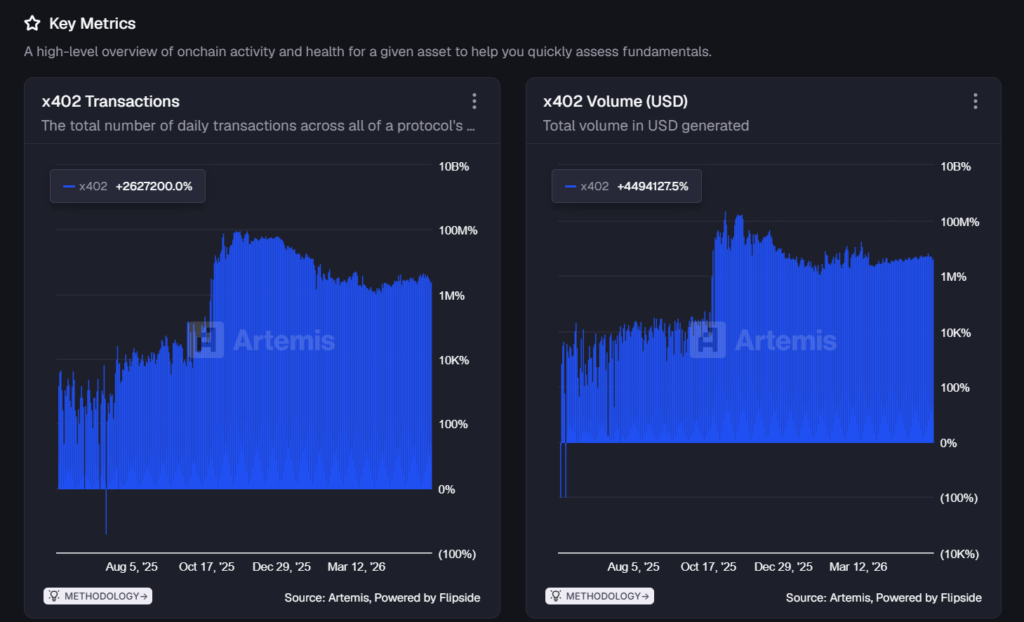
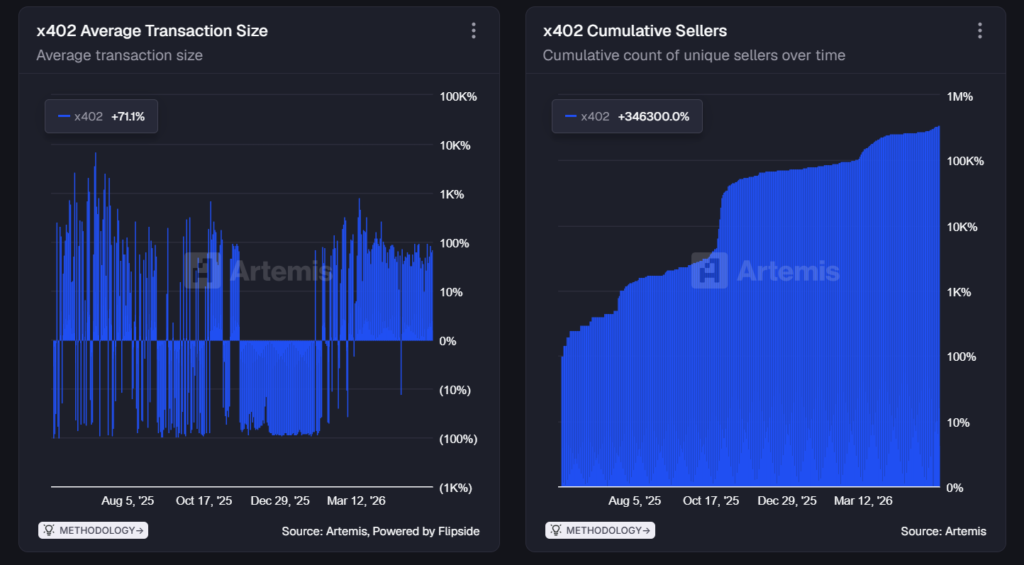
Source: Artemis
It appears that Base and Solana are competing with each other to race to the top host for agentic AI payments. Other blockchains, meanwhile, are also trying to position themselves as favourable alternatives to Solana and Base for hosting AI payments. Binance co-founder Changpeng Zhao (CZ), for instance, recently called the BNBChain the foundation of Agentic Money — which will make AI agents the largest economic participants on-chain.