

XRP isn’t giving off one single signal at the moment. Instead, it’s producing two distinct signals from two different exchanges. Binance shows the percentage of daily XRP flows originating from holdings of 1M+ XRP has risen to 57.6 percent, the highest seen since the jump of 66 percent on March 28. On Coinbase, that specific category has fallen to 14.8 percent, the lowest it’s been since April 11. The same asset, the same set of price levels, and completely different movements.
Binance: whales back at the window
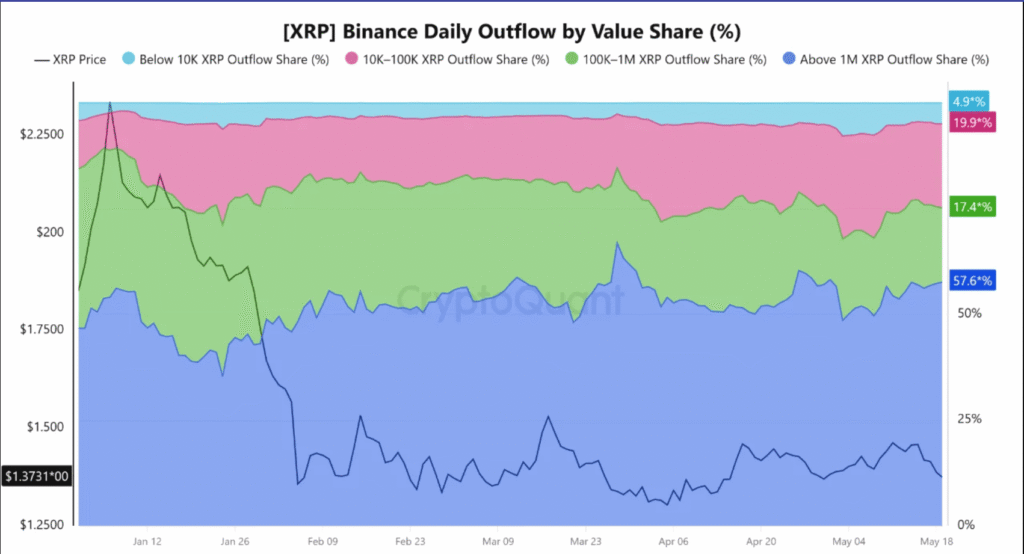
The 1M XRP outflow percentage for Binance has now had three high prints (a March 28 spike to 66 percent, around 60 percent in late April, and this 57.6 percent), and all three prints occurred when XRP was trading between $1.33 and $1.42.
It is unlikely that the whale money piling up at the same prices is a coincidence. The accumulation and redistribution around the same price area in the same way three times within the Binance outflow period suggests these are purposeful movements by these whales, not accidental.
The distribution of the remaining part of the outflow on Binance continues this whale-like story. 19.9 percent falls under 10k – 100k, 17.4 percent under 100k – 1M and only 4.9 percent under 10k. It is almost fully distributed between the large and very large movers.
Coinbase: mid-sized wallets take over

On the other side, Coinbase displays the exact inverse view. Over 1M XRP outflow share of 14.8 percent has not only been decreasing relative to Binance since April 11, but the 10K-100K bracket has been climbing from 19 percent up to 36 percent.
This transition is significant. Over on Coinbase, the key outward movement has moved from the largest of wallets to mid-tier ones. In that bracket (100K-1M), we have 42.6 percent (with retail under 10K accounting for 6.4 percent). Much more distributed than Binance, the middle tier is here driving. The mid-tier wallets were more of the metric driving the bulk of withdrawals; this profile is more distributed than binance.
Since Coinbase is already predominantly a U.S.-based institutional and high-net-worth entity, the decline of large-wallet outflow share in this entity is the more significant finding. This implies that the largest wallet holders in the institutionally dominated entity are holding their assets or are transacting these assets in non-outflow-dominant ways.
What the divergence actually means
The simple reading is that Binance whales are selling off at a high pace while Coinbase whales are not. However, the price at which XRP is trading provides further context. The three consecutive Binance whale-outflow peaks over $1.33-1.42 could either indicate that the whale holders see this price range as a structure support entry point and are positioning themselves or could simply refer to large wallet addresses removing XRP from the exchanges in order to stake, use for OTC settlement or place in self-custody.
Where it’s unlikely to be represented is distribution. Pressure at a large level of selling would normally drive the price down, not create a range where whale outflows are consistently happening time and time again. All three readings of XRP have remained in that range and that damages the bear case of this particular spike.
Coinbase data provides another layer of interesting detail. The prevalence of mid-sized wallets as the largest outflow category may suggest a more retail-like aggregation below the institutional level, a sort of retail pre-breakout accumulation pattern.
None of the signals alone can be deemed decisive. Alone, the signals present a market with the largest players concentrated on Binance in a zone that they seem to have revisited multiple times already, while movements on Coinbase are smaller, spread out, and in much smaller quantities. The pair of signals indicates positioning, not distribution and capitulation.
The $1.33–$1.42 zone is the number to hold
For a trader, the range in which these whale spikes have predominantly congregated is going to be the major one to keep in mind. Three distinct events of strong Binance whale-outflow dominance, clustered together around one ~$0.09 wide price zone, make this zone an accumulation region where large holders appear to be making definitive moves. A continued close above $1.42 with whale outflows still in the strong Binance zone would indicate a major trend toward accumulation to break out. A close under $1.33 with an outflow share remaining strong would call into question whether large wallets are front-running a move lower.
Until one of the previously mentioned criteria is met, the disparity between whale dominance on Binance and mid-wallet activity on Coinbase actually defines a market that is undergoing repositioning, rather than one that decided a long time ago.