

Walrus Protocol launched Walrus Memory, a portable memory layer that enables AI agents to retain context across different applications and sessions. Built by Mysten Labs (the team behind Sui), the product integrates with leading AI platforms including ChatGPT, Claude, and Gemini, with Software Development Kits (SDKs) for Python and TypeScript, plus native Model Context Protocol (MCP) support and plugins for OpenClaw and NemoClaw.
Walrus Memory: Solving AI’s most annoying bottleneck
Ask any developer building production AI agents what their biggest headache is, and they’ll likely say memory. Agents lose context when a session ends. Workflows restart from zero every time. Multi-agent systems hit context window limits. The typical fix? Devs stitch together vector databases, runtime state, and custom access controls, which breaks the moment you switch from OpenAI to Anthropic.
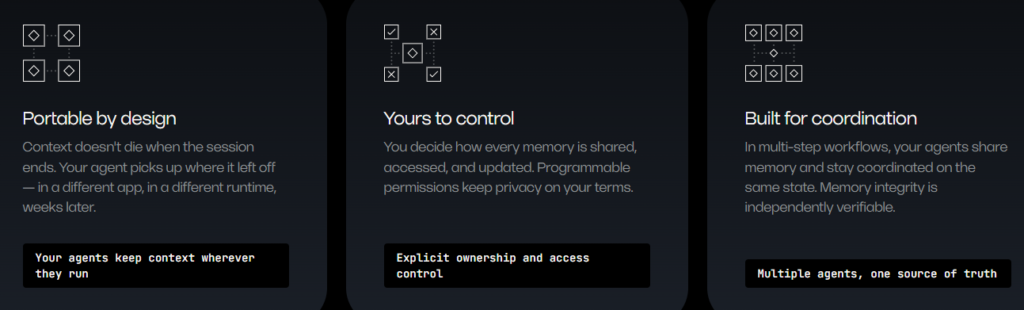
Walrus Memory fixes this by separating memory from the specific app the agent runs in. It’s basically a brain transplant for AI: the memory stays with the agent, not the chat window. You can wrap up a chat with ChatGPT, hop onto Claude the next day, and your agent still knows your style, your old notes, and what you’re working on. Kostas Chalkias from Mysten Labs put it simply: “Most agent memory is stuck inside single platforms. Walrus Memory changes the game.”
How it works: Encryption, verifiability, and portability
So far, the technical flow is elegant but simple. A developer installs the Walrus Memory SDK, adds two calls (remember and recall), and the SDK handles everything else: authentication via Ed25519 signing, semantic embedding for search, encryption before storage, and finally storing the encrypted memory on Walrus (the Verifiable Data Platform).
The team explains that when an agent needs to recall something, the SDK sends a signed query; the relayer checks permissions, retrieves the most relevant memories from Walrus, decrypts them, and injects them into the model’s context. Every memory carries a verifiable ID and tracked history, so you can prove it hasn’t been tampered with. No middle layer (not even Walrus) can read your encrypted memories. Only requests signed by your private key can decrypt them.
Walrus Memory use cases: From customer support to personal assistants
Teams already integrating Walrus Memory include Allium, Conso Labs, Inflectiv, OpenGradient, Talus Labs, and Tatum. The use cases include:
- Customer support agents who pick up where the last conversation ended, remembering what was tried and what failed.
- Multi-agent workflows where one agent’s learning becomes available to the entire team.
- Personal assistants that remember your tone, preferences, routines, and relationships.
- Monitoring agents that retain prior observations to avoid reprocessing the same events, with every decision producing an audit trail.
- Notes and research apps that act as a second brain, compounding over time.
Dion Cornett, CEO of Tatum, commented: “Walrus Memory is going to let our monitoring agents retain prior observations, so they can avoid reprocessing the same events. Every decision will also produce an audit trail, allowing us to verify and explain why activity was flagged.”
How this contributes to the agentic economy
The “agentic economy” (a future where millions of AI agents coordinate and transact on our behalf) has a hidden prerequisite: memory that works across platforms. For example, without portable memory, agents are like amnesiac workers who forget everything between shifts. And with it, agents become reliable, long-term collaborators. Walrus Memory also introduces programmable access controls via delegate permissions.
You can let one agent write to a memory folder while another just reads from it, and you can pull the plug on that access whenever you want; it’s all locked down with tech. This is basically the starting point for agents paying each other, teaming up on tasks, and decentralized AI. If agents are going to run our schedules, cut deals, and handle money, they need a memory layer that moves with them and is as solid as the blockchain they are using.