

Crypto intelligence firm Sentora has argued that DeFi vault management is heading toward an AI-agent-led model, saying the growth of modular lending markets has made manual curation too slow for the sector’s increasingly fragmented risk landscape.
In a report titled The Smart Vault Paradigm, the firm said protocols such as Morpho Blue, Euler v2 and Kamino v2 have moved DeFi lending away from broad, pooled markets and toward more granular systems built around isolated collateral, debt, oracle and loan-to-value settings.
That shift has improved flexibility and reduced some forms of shared risk, but Sentora said it has also created a level of complexity that human curators, governance committees and multisig processes are no longer able to manage in real time.
Modular lending raises the risk burden
The report frames the current DeFi lending market as a transition from “monolithic” systems, such as Aave and Compound, to modular architectures where risk is separated across many smaller markets.
In older lending models, risk teams could adjust a limited number of protocol-wide parameters. In modular systems, however, each new vault, asset pair, oracle feed and LTV curve adds another layer of decision-making.
Sentora said this creates a “complexity wall” for human-led curation, as vaults may need to allocate liquidity across dozens of isolated markets with different liquidity depths, oracle risks and collateral behavior. The firm said this makes curation less like traditional risk oversight and more like a high-dimensional optimization problem.
Human oversight seen as too slow
The report argues that human curation is constrained by coordination delays, manual approvals and governance cycles, while on-chain markets continue operating at block speed.
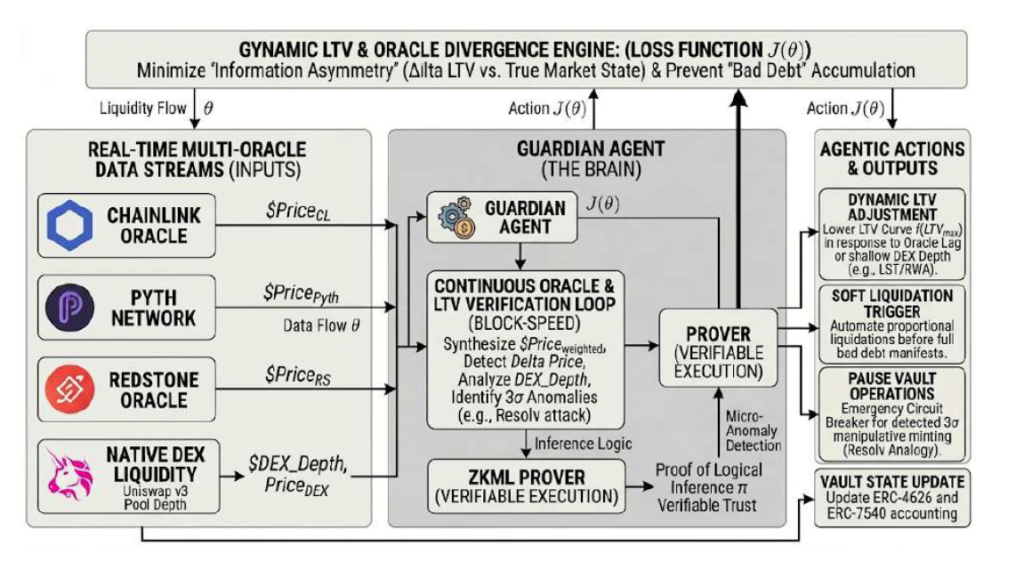
Sentora pointed to past stress events, including the 2025 xUSD liquidity crunch and the March 2026 Resolv exploit, as examples of how information delays can expose vaults to losses or trapped withdrawals.
In the Resolv case, the report said an abnormal minting event should have been visible to an automated system as a major outlier, but human monitoring did not react quickly enough.
The firm said these cases show that DeFi security is no longer only about whether smart contract code has been audited, but whether risk conditions can be monitored and acted on continuously.
Smart vaults would use multiple AI agents
Sentora proposes a “Smart Vault” model built around a multi-agent system rather than a single automated tool. Under that framework, different AI agents would handle specific parts of vault management.
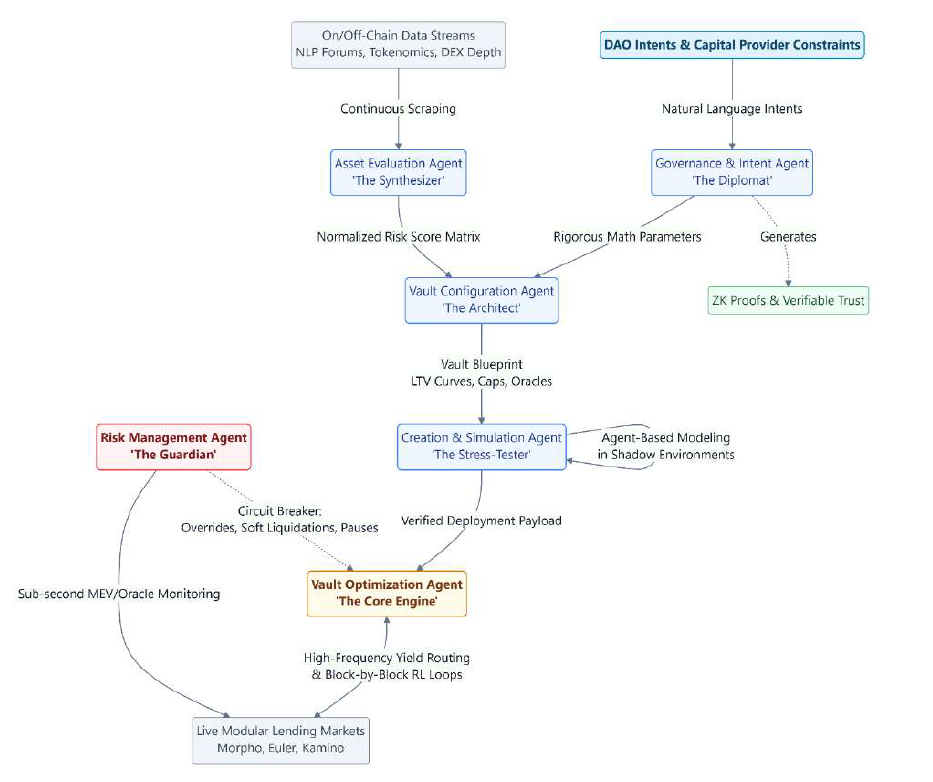
An asset evaluation agent would assess collateral risk using on-chain and off-chain data. A vault configuration agent would set structural parameters such as LTV curves, supply caps and oracle rules, while a simulation agent would test vault designs under stressed market conditions before deployment.
Once live, an optimization agent would route liquidity across markets, while a risk management agent would monitor oracle divergence, MEV activity and liquidation thresholds. A governance and intent agent would translate user or DAO instructions into machine-readable policies.
DeFi could move toward autonomous curation
Sentora said adoption would likely happen in stages, beginning with AI tools that assist human curators, followed by policy-driven vaults where agents execute within predefined limits. The final stage, according to the report, would be protocol-native AI vaults that manage liquidity, collateral tiers and market creation autonomously.
The broader implication is that DeFi curation may shift from reputation-based trust in human teams to verifiable, software-driven execution. For the market, the key question will be whether AI agents can improve speed and risk control without introducing new governance, model or accountability risks.