


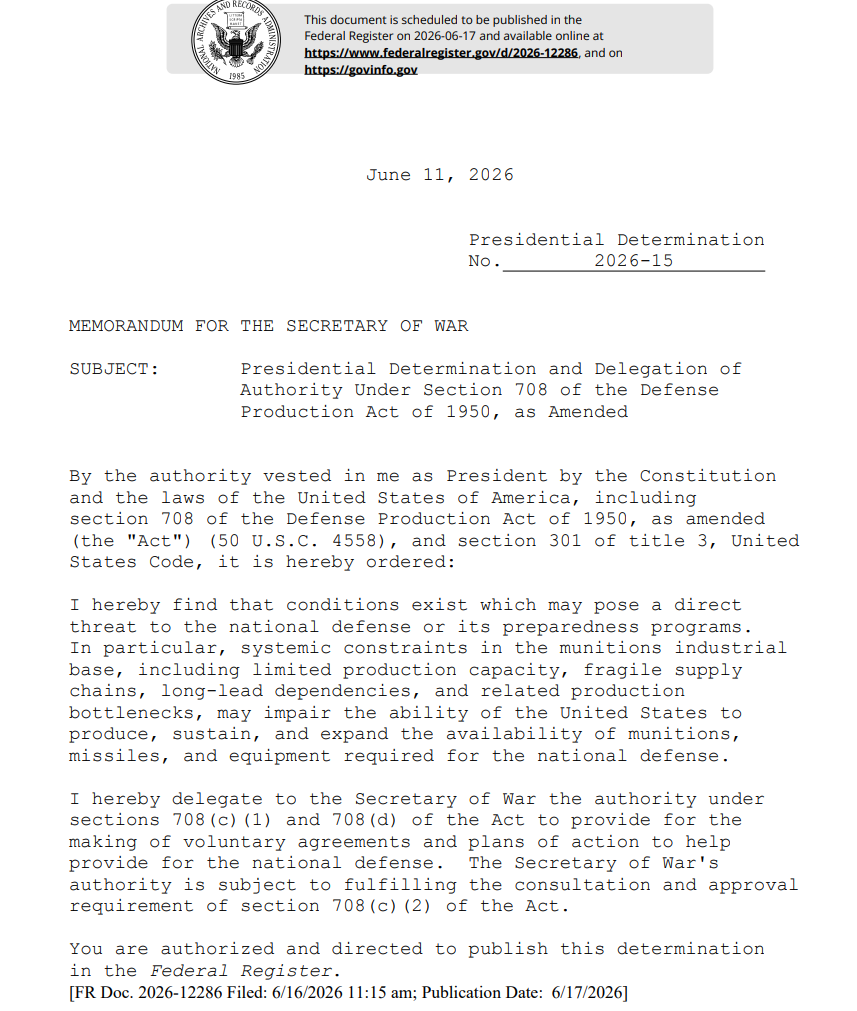
President Trump is using the Defense Production Act (DPA) to address “systemic constraints” in U.S. munitions production, delegating authority to Defense Secretary Pete Hegseth to forge voluntary agreements with private industry. The move comes as the war with Iran has strained U.S. weapons stockpiles. In fact, a Center for Strategic and International Studies (CSIS) analysis shows the U.S. might have already burned through more than half its stock of four key types of munitions, like Tomahawk missiles.
What the Defense Production Act order does
The memorandum, published in the Federal Register, points out that “limited production capacity, fragile supply chains, long-lead dependencies, and related production bottlenecks” are issues that “may pose a direct threat to the national defense.” This order is going after the biggest holdups, like solid rocket motors, igniters, and guidance systems that we need for both old-school weapons and new tech.
“Sometimes we need the collective wisdom of all the assembled companies to collaborate and solve our problems for us,” Michael Cadenazzi, the assistant secretary of defense for industrial base policy, said when explaining why they’re doing this. The DPA lets the government and private companies work out “voluntary agreements and plans of action to help provide for the national defense,” which basically lets competitors team up on production without getting in trouble for antitrust liability.
Why now: Iran war depletes stockpiles
The 15-week Iran conflict has exposed deep vulnerabilities in U.S. munitions reserves. Defense Secretary Pete Hegseth has pushed back on crisis narratives. He told “Face the Nation” that “stockpiles are great, and they’re only getting stronger,” but he also testified in April that replenishing depleted stocks could take “months to years.”
Republican Senator John Cornyn mentioned to reporters that the Pentagon is “running short of funding they need to acquire the weapons and messages and things like that that they need to protect the nation.” And now, the administration is pushing for a massive $1.5 trillion Pentagon budget.
What this means for the defense industry
The DPA invocation is a strategic shift, not a sudden reaction. Cadenazzi said he has been working since September to launch a voluntary agreement framework, and the nine-month effort predates the current conflict. “These conversations can’t happen across companies unless we provide the framework for it,” he told reporters.
The framework will allow the Pentagon to gather solid rocket motor providers, for example, to strategize investment and production plans, something that would normally violate antitrust law.
The administration has already tried a few things, like putting $1 billion into L3Harris for their solid rocket motors business and making deals for companies to upgrade their own factories. Now, this DPA order gives the Pentagon the legal cover they need to floor it.


