

Meta announced Brain2Qwerty v2, a non-invasive AI system that converts brain activity into text using magnetoencephalography (MEG) recordings. The system, trained on approximately 22,000 sentences from nine volunteer participants, achieves up to 78 percent word accuracy for its best participant, a major leap from the 8 percent accuracy of earlier non-invasive methods.
How Brain2Qwerty v2 works
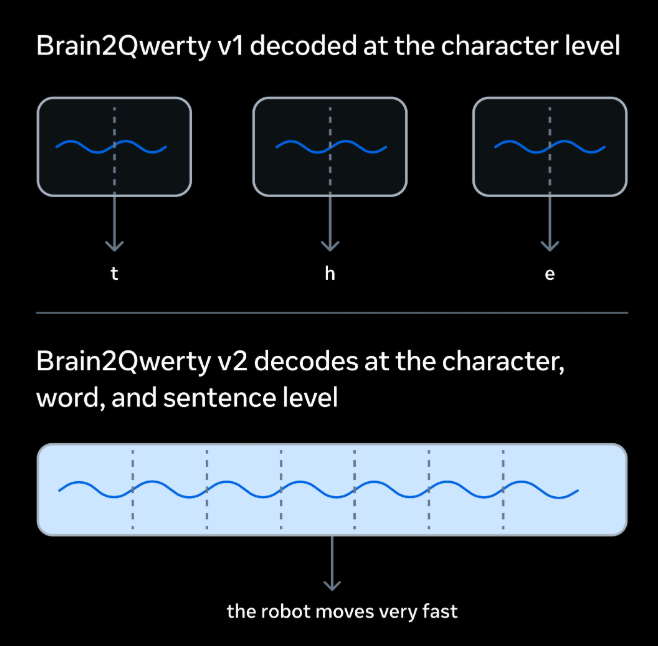
Brain2Qwerty v2 builds on last year’s v1 model, which could predict keystrokes from MEG brain activity but couldn’t operate in real time because it needed the timing of every keypress.
Now, the new version overcomes this limitation by generating sentences directly from continuous brain recordings. The system uses a three-module hierarchical architecture that together improves the decoding of letters, words, and sentences.
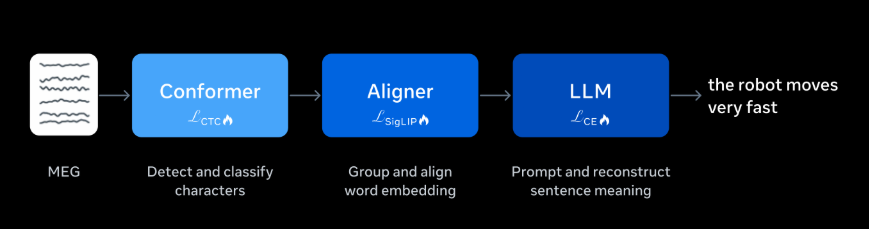
Fine-tuning large language models (LLMs) on neural data allows the system to use semantic context, thus bridging the gap between noisy brain recordings and coherent language.
Meta also deployed AI agents to explore optimizations for the decoding pipeline. The research team trained on 10 times more data per participant than v1, with each volunteer recorded for 10 hours while actively typing.
Performance and remaining challenges
The results are striking. And here’s where the magic happens: Brain2Qwerty v2 recovers sentences coherently from noisy neural inputs, achieving a 61 percent average word accuracy. For instance, for the best participant, word accuracy reaches 78 percent, where more than half of all sentences are decoded with one word error or less.
The system also follows a scaling law: decoding accuracy improves log-linearly with data volume, suggesting that the remaining performance gap with surgical approaches could be narrowed through data scaling alone.
Two major challenges remain before clinical use: decoding performance is not yet good enough for everyday use, and the MEG scanner is large and not portable either. However, Meta seems optimistic that wearable MEG sensors could make the technology more practical in the future.
The scaling law: Why more data means better decoding
Maybe the biggest takeaway from Meta’s work is not just the accuracy, but what it shows about the future. Brain2Qwerty v2 gets better at decoding in a steady, predictable way as more data is added; this means the more brain recordings fed into the system, the better it performs, with no detectable performance plateau yet in sight.
So, this suggests that the remaining gap between non-invasive methods and surgical implants could be narrowed substantially through data scaling alone. So far, the research team trained v2 on approximately 22,000 sentences from nine participants (10 times more data per person than the original v1 model).
Meta’s team put it this way: “We are hopeful that larger datasets will thus further improve decoding and reduce the remaining gap with invasive neuroprostheses.” By open-sourcing the full training code and partnering with Basque Center on Cognition, Brain and Language (BCBL) to release datasets, Meta is effectively inviting the broader research community to help scale this work.
The implication is profound: the big idea here is that non-invasive brain-computer interfaces might not be limited by physics; they might just need more data to catch up to surgical tech.