
BMW announced it is establishing its Landshut plant as a central hub for humanoid robotics software development, advancing artificial intelligence (AI) models, simulation, and robot training for future manufacturing applications.
The plant will develop open modular software architecture combining deterministic programming with AI models, while existing pilot projects in Leipzig and Spartanburg test live applications. The focus is on tasks requiring flexibility and fine motor skills.
The technology stack
In context, Landshut is development focuses on tasks that are just too tough or pricey for traditional automation (changing sequences, varying component positions, or fine motor requirements).
The main architecture mixes deterministic coding with smart vision-language-action models that use what the robot sees and hears to help it figure out exactly how it should move.
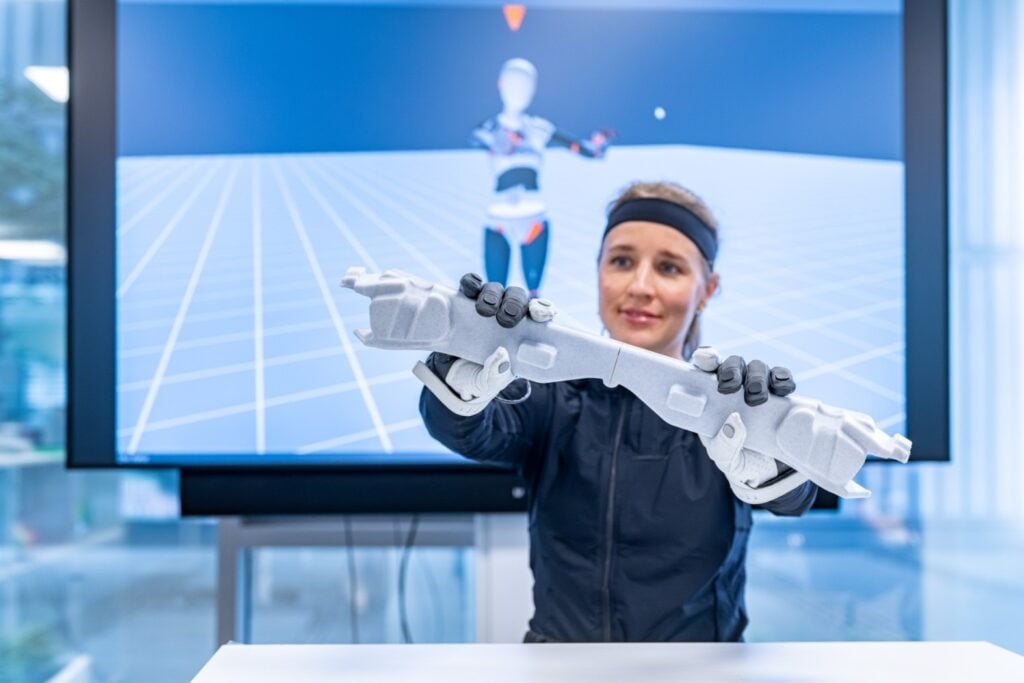
These robots scan their surroundings with sensors and cameras, assess the situation, and derive suitable movements. Before deployment, they practice in digital worlds using data from suits and gloves.
The big idea is to build versatile and generalizable behavior models that can be shared across all kinds of different robot systems.
Partners and future scaling
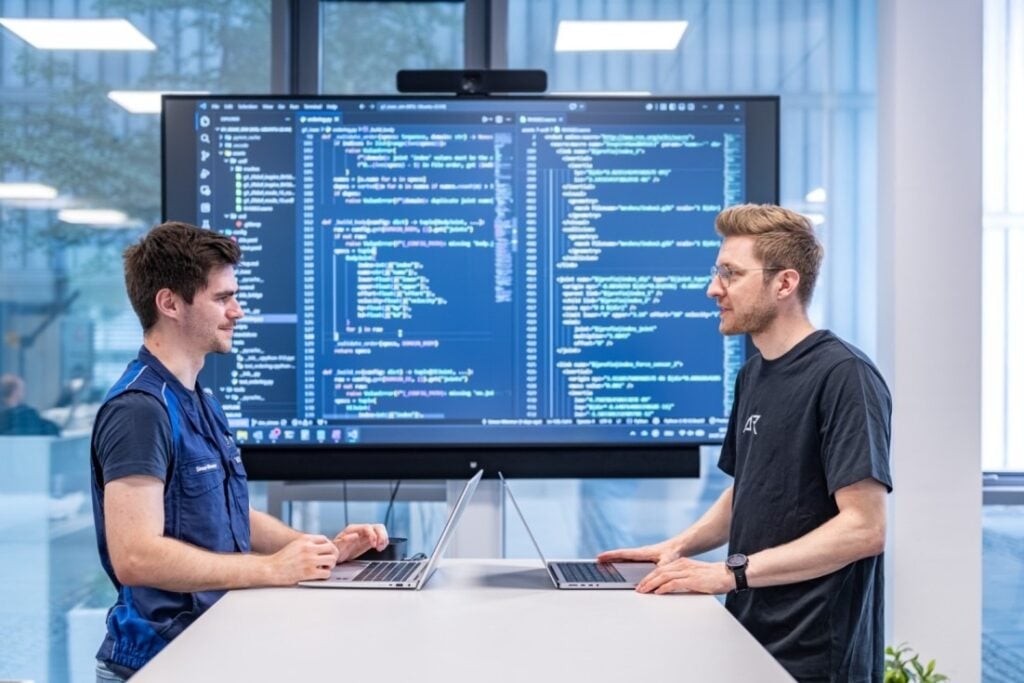
BMW is partnering with Athenyx Robotics (a startup from RWTH Aachen University) and Landshut University of Applied Sciences to develop an “intelligence stack” covering perception, learning, simulation, and decision-making.
BMW wants to investigate technical feasibility and assess in which processes humanoid robots can offer economic benefits. The company has already established pilot projects at its Leipzig and Spartanburg plants.
The Landshut site will serve as the software development center, while Leipzig and Spartanburg provide real-world testing. What remains decisive for later scaling is how reliably the systems operate under changing production conditions.
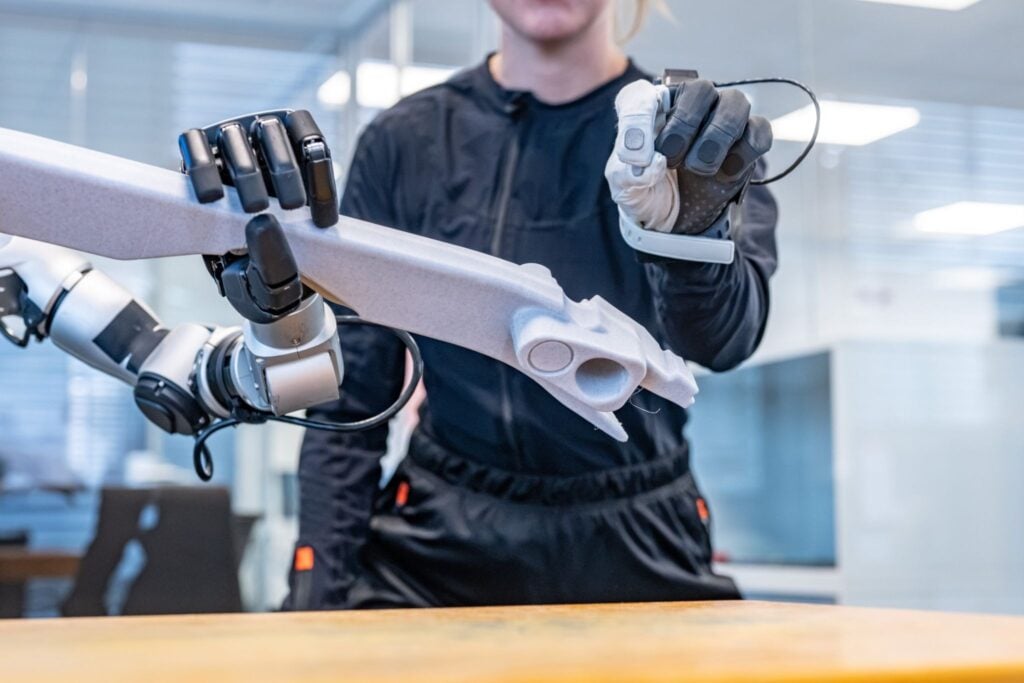
How robots learn: Demonstration-based training
BMW is keeping things practical with how they train their humanoid robots: demonstration-based learning. They have operators suit up in motion-capture gear and data gloves to do the work, while their every move is recorded and turned into general behavior models that can be shared across all kinds of robot systems.
This approach is significantly faster than manual programming and, crucially, the resulting skills can transfer across different robotic platforms and tasks rather than being locked to a single application.
All that training data is pulled right from the factory floor and test labs, then fed into simulations to map out movement patterns. It shows a huge shift in the world of robotics: instead of coding every tiny movement by hand, these robots are actually learning by watching us.
The “video-to-action” pipeline (where a robot watches a human perform a task, understands the sequence, and replicates it) is actually happening now.
For the AI space, this is a prime example of putting foundation models to work in the physical realm, finally bridging the gap between digital smarts and real-world tasks. If this pans out, it could really speed up how quickly humanoid robots get rolled out across manufacturing, logistics, and other industries.
At the moment, there are various developments from different companies in the tech-AI world. CMU researchers are also building this type of software. Tether and Neura Robotics just got a $1.4 billion funding round to back AI-powered autonomous robots. Framework Ventures also raised $400 million to invest in crypto, AI, and robotics. U.K.’s Humanoid raised $1.35 billion in funding. And the list goes on, showing that this tech is just starting to flourish.