

The conversation on social media platforms about XRP is very bullish after its integration with the Japanese payment platform, Rakuten Wallet. Digital asset expert Jake Claver stated that XRP prices could reach four digits in 2026, given that there is adoption and liquidity in the market. Claver’s statement comes at a time when the coin lost a key support level after the Federal Open Market Committee held the interest rates steady.
Bullish sentiment on XRP hits 2nd highest in 2 years
Bullish conversation about XRP has blown up on social media platforms. According to Santiment, an analytical tool, the “asset is seeing its 2nd highest bullish sentiment across social media in the past 2 years!” When the sentiment rises above a set limit, the crowd’s FOMO (fear of missing out) increases, and seasoned traders wait for this hype to be over before entering the market.
When markets enter a FOMO phase, price is often driven less by fundamentals or technical setup and more by emotion and herd behavior. This leads to sharp, extended moves upward where traders rush in simply because price is rising, not because they have a clear entry plan or risk management strategy.
At that stage, liquidity is often thin on the buy side, and strong hands may start taking profits into that demand, which increases the chance of sudden reversals or “fake breakouts.”
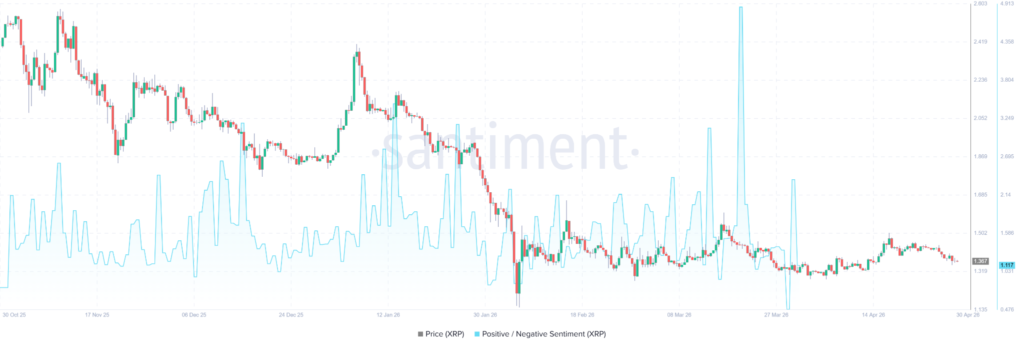
However, in this case, these positive sentiments on social media platforms seem to be coming from the XRP community talking about the integration with Rakuten Wallet. The recent XRP–Rakuten integration marks one of the largest real-world crypto payment experiments so far, where XRP has been embedded into Rakuten’s payments and loyalty ecosystem.
XRP enters into Asian markets with Rakuten wallet integration
With the rollout, up to 44 million customers using the Rakuten service can earn their loyalty points in XRP, store the cryptocurrency in their wallets, and make payments using Rakuten Pay through millions of merchants in Japan. In essence, the collaboration allows crypto to be linked with day-to-day regular consumer spending, which puts XRP within a working consumer payment cycle, rather than the asset simply acting as a means of trade.
The move is particularly significant as it will change the nature of the asset from being one purely driven by speculation to one that is driven by its usability, not just by institutions but by normal people. This typically translates into enhanced investor confidence in the coin since people start seeing the asset as having more utility than simply being a means of trade.
On the flip side, it lowers barriers to entry to the crypto space by embedding the digital coin into the regular lives of the users through a fintech company.
Jake Claver predicts XRP to hit four digits by 2026
With these adoptions, Jake Claver predicted that the coin could reach as high as $1500 and $2500. Although the prediction looks ridiculously high, Claver believes that with the rate of adoption and the necessary liquidity, the coin has the potential to hit these values.
What’s more striking is that Claver’s prediction comes at a time when the coin lost a major support level after the announcement of Fed interest rates. Yesterday, Fed Chairman Jerome Powell, attending his last FOMC meeting, did not alter the interest rates, which many believe is still a positive move, given the geopolitical conditions.
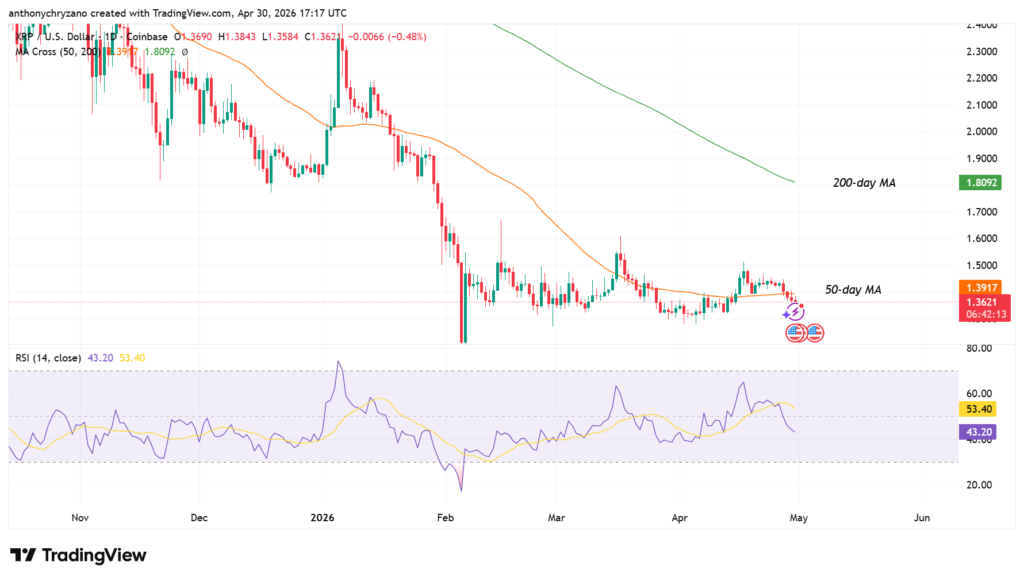
XRP crashes below the 50-day moving average
With the announcement, many cryptocurrencies had a retracement. XRP lost a major resistance level—the 50-day moving average (MA)—at $1.39. The 50-day moving average (50-day MA) is an important technical indicator because it helps traders identify the medium-term trend of an asset by smoothing out short-term price fluctuations.
This indicator is computed using the average closing price over the past 50 days and can be used as an excellent way of smoothing out daily fluctuations and getting a better feel of the market’s overall trend. Traders monitor this price very closely because it tends to act as an ever-shifting support and resistance area, with prices responding according to how buyers and sellers trade on either side of it. If the price is above this indicator, then it is taken as an indication that the trend is bullish, whereas being below indicates bearish momentum.
This indicator is also used by many retail and institutional traders and thus tends to develop a self-reinforcing dynamic as prices respect the levels due to collective market action.
XRP prices and RSI show a bullish divergence
But looking beyond what is visible in the charts, despite losing the 50-day moving average, XRP is still bullish. How? For instance, when the relative strength index line is put into perspective with the price action, there is a bullish divergence.
A bullish divergence is characterized by a continuation of the price consolidation or downtrends despite a continuation of RSI in the opposite direction. The case at hand indicates a consolidation in the price of XRP alongside a formation of higher highs and lower lows in the RSI. It suggests that even with a bearish price movement, there is a growing bullish momentum that isn’t reflected in the prices currently.
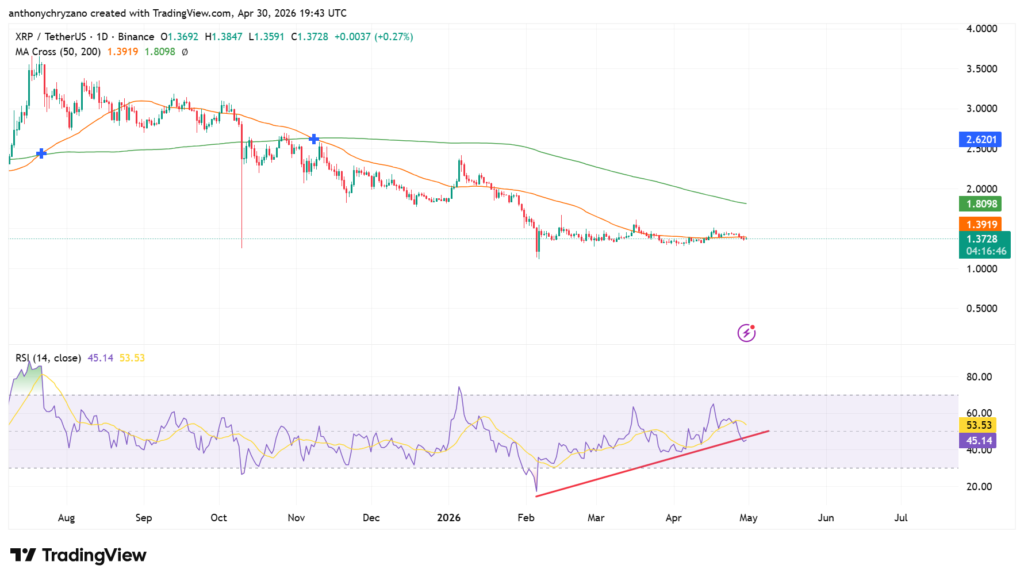
The situation is bound to be confusing for the markets. Despite price consolidation or downtrends due to short-term traders still selling in preparation for price reversal, the long-term and algo traders take note of the divergence and start preparing for a reversal to accumulate their positions.
Short sellers become wary of a squeeze since the downward momentum will be reduced. Accumulation takes place from both ends, and this results in a breakout of the downtrends.