

The total stablecoin market is valued at $312.9 billion at the time of writing. Comparing this figure from a year ago, it has experienced a rise of about 17 percent from $266.9 billion. Growth, however, has been on the slower side. Before slipping by around 3 percent over the few months, the supply metric peaked with the value of $323.6 billion.
USDT and USDC are still leading, making up about 83 percent of the total stablecoin supply. About 80 percent of all stablecoins are on-chain on either Ethereum or Tron, but one thing is becoming increasingly clear: supply growth is stagnating as the blockchain activity increases.
The usage follows an uptrend but the stablecoin remains flat
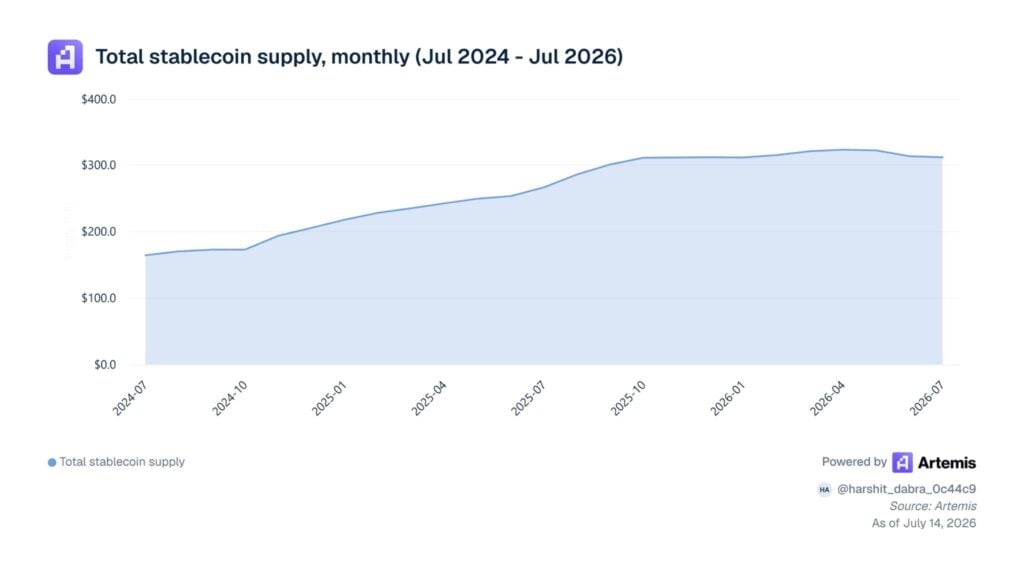
The above-provided monthly supply chart is depicting steady growth from mid-2024 through early 2026 prior to leveling off approximately $310 billion. A new all-time high was marked by the supply in the month of April but has been in the downtrend since then.
In addition to this, the demand hasn’t faded. It means more and more activity is migrating from new stablecoins to those existing ones. In other words, even as the supply grows more slowly, transaction volume is on the rise.
The leaders in the stablecoin market are serving different markets
USDT currently offers the highest supply of $184.6 billion for any stablecoin and around $37.3 billion in daily transfer volume. Comparatively, USDC provides only $76 billion in supply, while it accounts for nearly $68.9 billion in daily volume.
This is reflecting that Tether is used primarily to store value on exchanges and to facilitate big settlements. USDC moves around much faster across trading venues, in DeFi, and across payment systems. We see a similar pattern with smaller stablecoins, such as DAI, that, although having just a $4.9 billion market cap, settle more than 2 million daily transactions. This trend is an indication of its high day-to-day usage.
The role performed is different for every blockchain
The largest stablecoin network is Ethereum, which is accounting for $160.6 billion of circulating stablecoins and $33.9 billion in adjusted daily transfer volume. The next largest network by supply, Tron, commands $91.6 billion of circulation and registers $22.8 billion of daily transfers while supporting the active use of over 807,000 daily active addresses, and this makes it one of the highest volumes of traffic for retail transfers.
The Base network sets itself aside for a specific reason. Even with the holdings of $4.5 billion in stablecoins, its adjusted daily volume is around $30.9 billion. In other words, stablecoins circulate around Base more frequently than they stay idle on the network.
A million transactions take place on the chains like BNB and Polygon, and all of this when they are holding a small portion of their stablecoin balance. Compared with the Solana, it combines $16 billion in supply with the daily volume close to $13.3 billion. This is what places it between high-supply networks like Ethereum and high-turnover chains like Base.
The reason why adjusted volume is important
Adjusted transfer volume, a measure that eliminates wash trading, bot activity, and internal exchange transfers, is depicting a clearer picture of real usage. According to the data providers like Artemis, it shows adjusted volume at roughly $79 billion, relative to $127 billion in raw transfers and this is highlighting nearly one-third of reported activity does not represent genuine economic transactions.
The next important factor is that total stablecoin supply also consists of a number of gold-backed assets, which include XAUt and PAXG, combined with tokenized treasury products like BUIDL, USYC, and USDY. These add to the overall market size but do not function as dollar-backed payment stablecoins.
Taken together, the data suggests the stablecoin market is entering a new phase. Instead of rapid issuance, the focus is shifting toward how efficiently existing stablecoins are used. Networks like Base and assets like USDC are benefiting from higher turnover, while USDT continues to dominate overall supply.