

Near Protocol (NEAR) once again tested the $1.80 support level, where the buyers showed up and rescued the token from further falling. With the token recovering from this level, there is a possibility that it could once again rally towards $2 and above.
NEAR crashes to $1.80 after major sell-off
After testing the $1.80 support level, NEAR has recovered in style. There was a major sell-off back during May and the beginning of June. During the aforementioned time, the token touched values close to $3, and the traders saw this as an opportunity to make some profits.
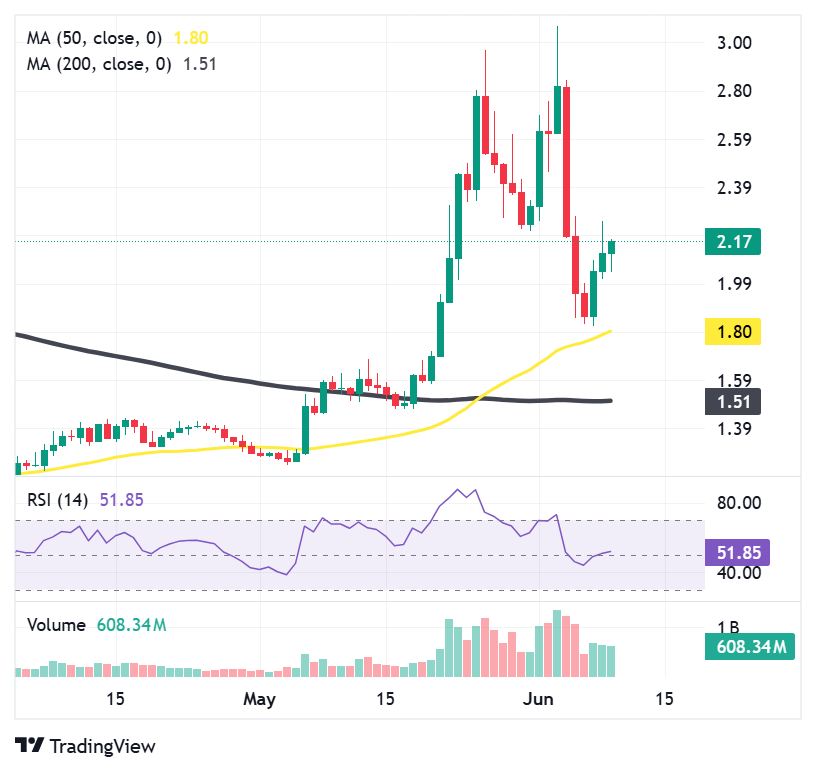
Many market participants who entered around the $1.50 level after NEAR reclaimed the 200-day moving average were sitting on gains of nearly 100% when the token approached $3. As a result, selling pressure intensified, leading to a sharp correction as traders sought to secure their profits rather than risk a potential reversal.
The pullback shook off all weak hands
However, the pullback appears to have served a healthy purpose. By returning to the $1.80 support zone, NEAR was able to shake out weaker hands and absorb the excess supply created by profit-taking. Buyers quickly stepped in at these lower levels, indicating that confidence in the broader trend remains intact.
From a technical perspective, the rebound from support suggests that the market still views the recent decline as a correction rather than the start of a new bearish trend. The ability of NEAR to defend a higher low is particularly important, as it signals that buyers are willing to accumulate the token at progressively higher price levels.
If the current momentum continues, traders will likely watch for a move toward previous resistance zones, where a breakout could further strengthen the bullish outlook and attract additional market participation.
NEAR trades inside a bullish symmetrical triangle
When the broader price action is considered on a macro level, NEAR is currently trading inside a symmetrical triangle, making higher lows and lower highs. As the range of motion narrows, the token is gradually approaching the apex of the pattern, where a decisive breakout is likely to occur. This structure reflects a period of consolidation in which neither buyers nor sellers have complete control of the market.
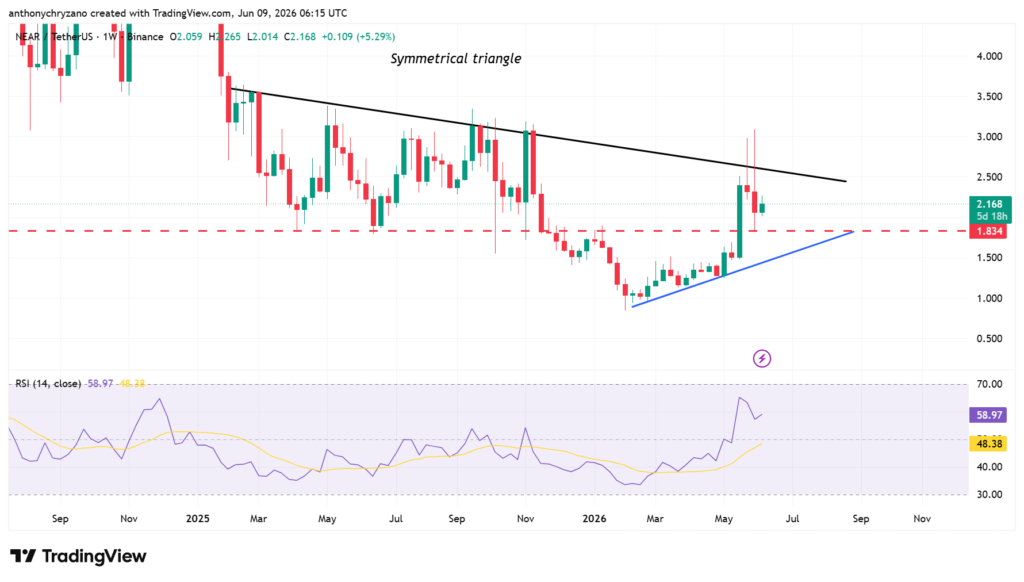
The higher lows indicate that buyers are becoming increasingly aggressive, stepping in sooner after each pullback, while the lower highs suggest that sellers are still active and preventing a sustained rally. As these opposing forces converge, volatility typically declines before expanding sharply once the pattern is resolved.
Traders often view symmetrical triangles as continuation patterns, meaning the breakout tends to occur in the direction of the prevailing trend. If NEAR can break above the upper trendline with strong volume, it could trigger a fresh wave of buying activity and potentially mark the beginning of a larger upward move.