

The European Central Bank has unveiled plans for a digital euro app designed to exceed European Union accessibility requirements, marking the latest step in preparations for a pilot scheduled to begin in 2027.
In a statement issued on July 30, the ECB said the app would go beyond the European Accessibility Act and its related standards, applying the highest level of Web Content Accessibility Guidelines adapted for mobile payment services.
Planned features include screen-reader support, full keyboard navigation, enhanced visual design, simplified language, time-out warnings, error-prevention tools and reduced-motion settings.
The ECB said the proposal was developed with consumer organizations, accessibility experts and national central banks, with testing set to involve members of the ONCE Foundation for Cooperation and Social Inclusion of People with Disabilities as well as staff from the ECB and 19 national central banks.
The Eurosystem app would provide access to basic digital euro services, although users could also use channels offered by their payment providers, which would remain their main point of contact.
Europe to confront its reliance on foreign payment networks
The latest announcement forms part of the ECB’s wider push to establish a digital euro as a public payment option that could work alongside cash, commercial bank deposits and private payment services.
In a report prepared through the Euro Retail Payments Board in October 2025, the ECB said the digital euro should function as a “digital banknote” covering person-to-person transfers, online purchases and payments in physical stores across the euro area.
The ECB argues that no private European payment solution currently covers all major use cases across every euro-area country, leaving the bloc dependent on international card schemes, global wallets and mobile payment platforms.
That reliance is reflected in the declining share of domestic card schemes across several European markets, as global networks continue to capture a larger portion of card payment value.
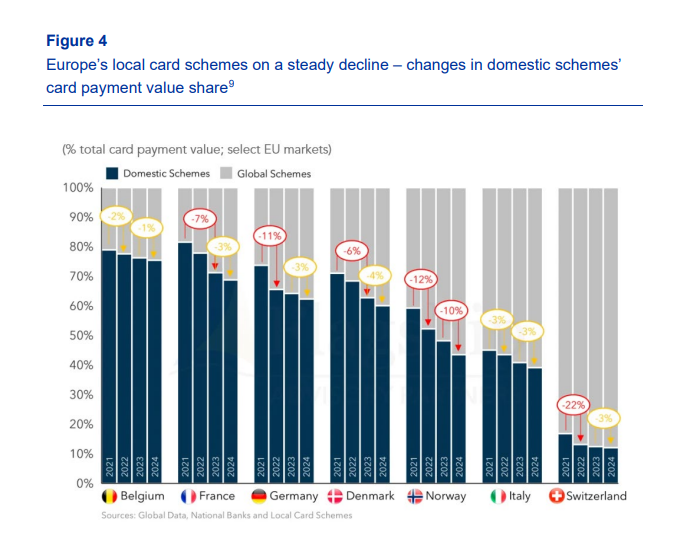
The ECB believes the digital euro could help counter that trend by offering merchants and European payment companies a widely accepted alternative, with the Eurosystem charging no scheme or processing fees.
A shared payment network emerged as the central goal
The report’s clearest area of agreement is the need for a common European acceptance layer built on open, non-proprietary standards.
Such infrastructure could allow the digital euro and private account-to-account payment services to operate through the same merchant systems at physical stores and online checkouts.
The ECB said existing standards, terminals, interfaces and industry processes should be reused wherever possible to cut costs and prevent further fragmentation of Europe’s payment network.
The ECB also wants established procedures for customer verification, anti-money laundering checks, fraud monitoring and merchant onboarding to be adapted rather than rebuilt.
A common acceptance layer could give private European payment systems broader reach while allowing merchants to support more payment options without repeatedly upgrading their infrastructure.
Rollout priorities exposed new divisions
Banks, non-bank payment providers, merchants and consumer representatives broadly support introducing the digital euro in stages, though they remain divided over which services should be launched first.
Some payment providers favor launching with person-to-person transfers to build public familiarity quickly, while merchants want in-store payments prioritized because of their greater importance for resilience during outages and broader disruption.
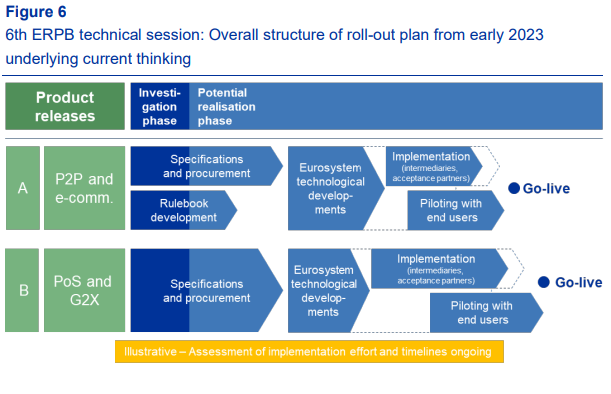
The ECB said a phased approach could spread investment costs, allow pilot testing and align equipment upgrades with normal replacement cycles.
Consumers could access the digital euro through bank apps or other approved wallets, with a standalone ECB-backed app serving as a fallback to improve accessibility, financial inclusion and resilience when private systems fail.
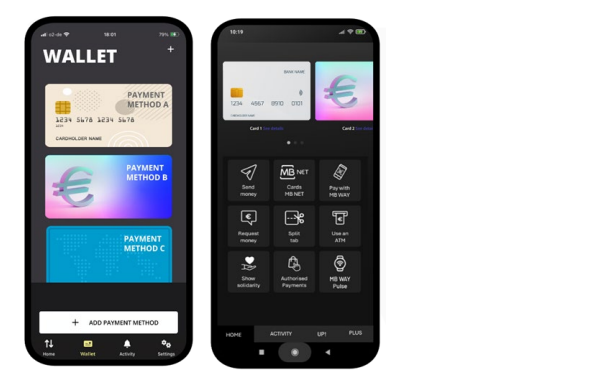
Banks and non-bank providers oppose mandatory support for that app, warning that it could increase costs and weaken their direct customer relationships.
Fees, liabilities and competition will shape the next phase
The business model remains the project’s biggest unresolved issue.
Basic digital euro services would be free for consumers, while providers could charge merchants within a capped fee structure and the Eurosystem would cover issuance, scheme and processing costs.
Payment firms insist that compensation must reflect their investment, operational burden and legal liabilities.
The report called for further work on fees, offline payments, fraud controls and cooperation with private European schemes.
Beyond the cost dilemma, banks remain skeptical, warning that the digital euro could divert transactions from existing European systems rather than mainly displacing global providers, potentially weakening private initiatives already seeking broader regional reach.
As a safeguard, the ECB has proposed voluntary co-badging, allowing a domestic payment scheme to remain the preferred option where accepted while the digital euro acts as a fallback elsewhere in the euro area.
The project is moving from broad policy design toward pilot testing, but its success will depend on whether Europe can balance strategic urgency with the commercial realities facing the companies expected to deliver it.