

Senator Cynthia Lummis released a statement on the Clarity Act, declaring “this fight is far from over” after Senate Majority Leader John Thune confirmed the bill will not receive a vote before the August recess.
The Senate will now take up the landmark crypto market structure legislation in September. Lummis expressed deep frustration after 11 months of negotiations and over 100 Democratic-backed changes, stating “we’ve come too far to quit now.”

616 pages, over 100 amendments, but no vote
Lummis’s statement comes after months of what she has described as “pussyfooting around” from Democrats. The bill has grown from 168 pages in 2022 to 616 pages today, with more than 100 Democratic-backed changes incorporated over 11 months of negotiations.
Lummis is pointing out to new ethics provisions, including a first-of-its-kind ban on the president, vice president, and members of Congress issuing or sponsoring digital assets.
Adding more voices, the National Fraternal Order of Police (FOP) has also backed the bill, addressing concerns about law enforcement tools.
Yet Democrats still withhold support. Lummis has grown visibly frustrated, recently telling colleagues: “I genuinely don’t know what else my Democrat colleagues need before we act.”
The political calculus: Why the vote was delayed
Senate Majority Leader Thune confirmed the delay, stating: “The Dems are insistent on no Clarity vote… we’re getting that queued up first thing when we come back.” It sounds like Democrats are dragging their feet because they are worried about the political fallout with the midterms coming up and the crypto industry’s growing influence.
Meanwhile, Coinbase policy chief Faryar Shirzad gave a shout-out to Thune for his commitment to revisit the bill as soon as possible, adding that “there is every reason to be confident that we can get it done.”
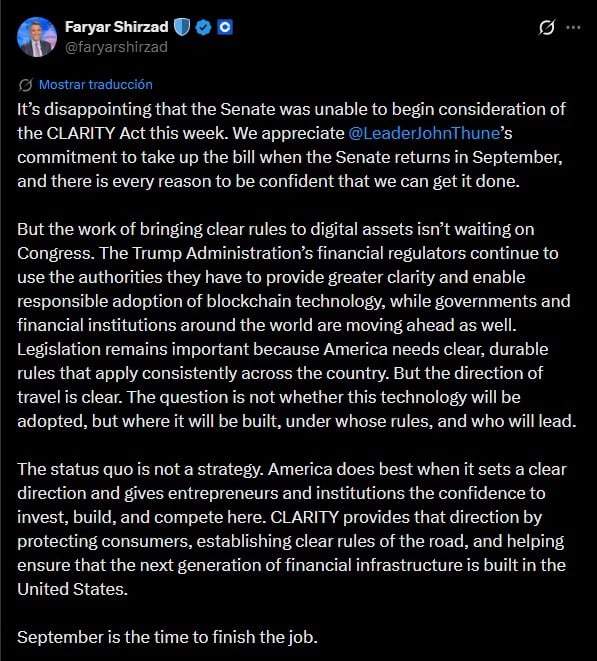
Furthermore, per latest reports, Thune’s office could be telling crypto industry leaders he “still intends to file cloture on the motion to proceed to the CLARITY Act before lawmakers leave for August recess,” opening an even narrower window for this to happen.
Now, the delay gives lawmakers more weeks to try to secure the 60 votes needed to advance the bill. The bill needs at least seven Democratic votes to overcome a filibuster. If the Clarity Act clears the Senate, it would have to go back to the House for a vote before being sent to President Donald Trump’s desk.
Though the September window is narrow, lawmakers will return in mid-September for only a few weeks before attention shifts to the November elections.
The September cliff
The delay into September is not a procedural formality; it’s a potential death sentence. The Senate will return around September 14 with roughly three weeks of legislative session before attention shifts to the November midterm elections.
Industry experts have long warned that the Clarity Act needs to pass before the August recess, as election-year politics typically freeze major legislation.
The math is unforgiving: Republicans hold 53 seats, short of the 60 needed to invoke cloture, meaning at least seven Democrats must support the bill. Yet no Democrats have publicly committed, and research firm TD Cowen estimated the chamber could sit about 10 votes short.
At the same time, Republican support has also wavered: Sens. Josh Hawley (R-MO) and Jerry Moran (R-KS) said they will not support the bill in its current form due to concerns about its potential effects on the banking industry.
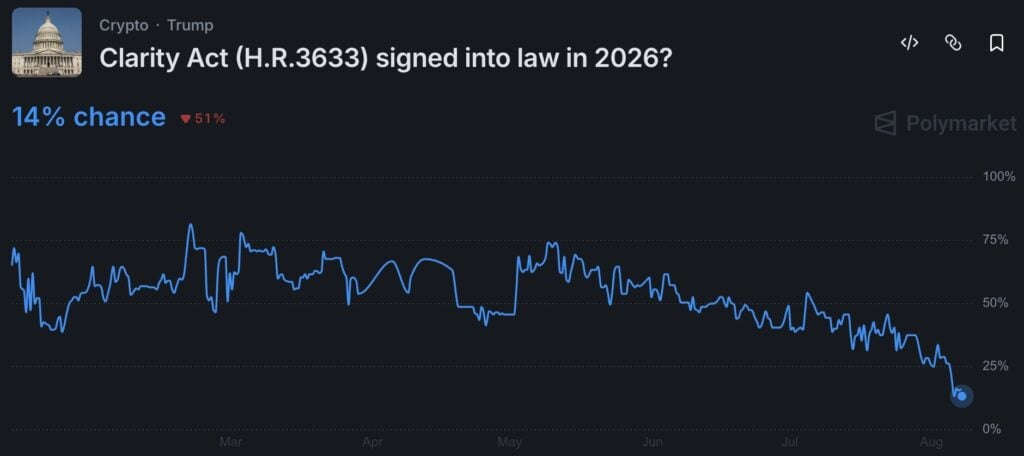
Prediction markets reflect the pessimism: Polymarket odds of passage this year have collapsed to 14 percent, down from 82 percent in mid-February. The September window is narrow, the opposition is real, and the clock is ticking.