

After suffering a horrific denial-of-service attack on its mining pools, Litecoin (LTC) has once again recovered above an important resistance level. levels, and it indicates that a major move could be coming up for LTC in the coming days.
LTC rise above the 50-day MA
The Litecoin price has moved above a significant level after being stuck under this resistance level for more than 6 months. Litecoin has risen above the 50-day moving average, which is currently at $55, or the short-term price trend indicator. Usually when the prices move above this level, the market considers the price to be bullish in the short term.
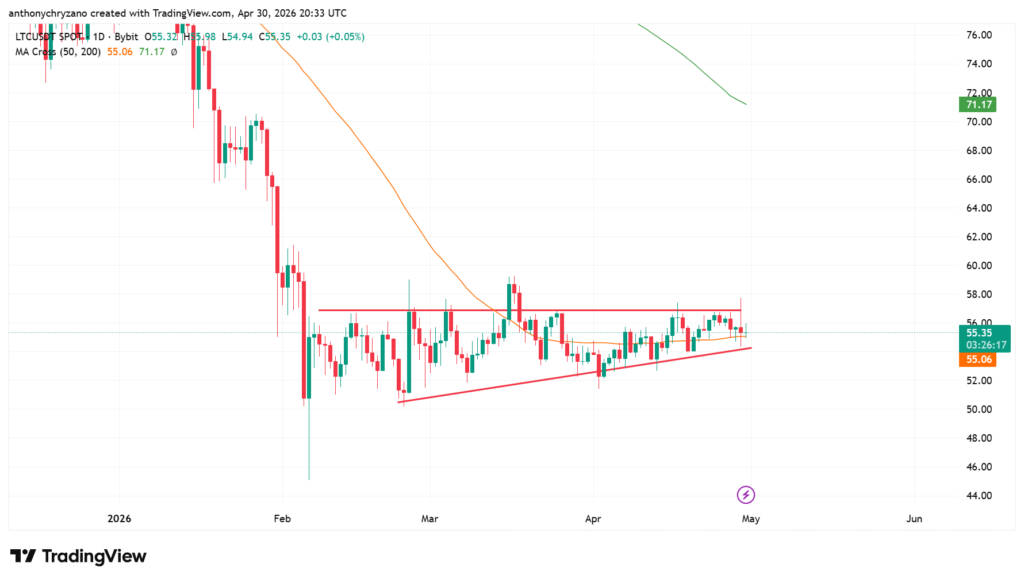
Put it simply, the 50-day moving average is the average price of the token during the past couple of months. So when the price of the coin rises above this level, it means that the coin is performing better than the past 50 days on average. Although this recovery is an important aspect to consider, there is something that is much more important than recovery alone.
The recovery comes after a week of DOS attack
The timing of the recovery is crucial. Why? Just about a week ago, the layer-1 blockchain network Litecoin came under a denial-of-service attack that leaked funds from the chain to third-party exchanges. During the attack, 13 blocks were reorganized. When a DOS attack happens, the hackers overwhelm the network and slow it down or make it completely unavailable for users.
Although the Litecoin development team calls this attack a ‘zero-day’ vulnerability, the others say the developers were aware of the loophole or the bug.
A zero-day vulnerability is a security flaw in software that is unknown to the developer or vendor, which means there’s no fix or patch that is readily available for it. The name is derived from the idea that developers had a certain number of days to fix it. “Zero days” here means that they did not have time to fix.
For instance, let’s say a bug exists in a system (like an app, website, or operating system). Before the team finds the bug, hackers exploit it. They can exploit and steal funds while everyone else is unaware. Since there is no immediate patch and developers had no time to work on it, it’s called a zero-day exploit.
Investigator states LTC DOS attack was insider activity
However, Alex, an investigator, stated this was not a zero-day attack that the developers were not aware of, but it was a well-orchestrated attack by insiders.

Usually allegations that a project’s own team was involved in a DoS attack would normally be enough to shake market confidence, as they raise concerns about insider activity, governance, and overall network integrity. In most cases, such narratives lead to sustained selling pressure as users question the credibility of the protocol.
The recovery in Litecoin prices goes onto say that the market either did not fully validate the claims or viewed them as insufficient to impact the asset’s long-term fundamentals.
In crypto markets, price movements can be equally influenced by liquidity, overall sentiment, and technical factors as by singular occurrences of news. For example, a sudden increase in buying activity after a price dip would suggest that market players still see value and potential in it, thus overcoming any negative sentiments.
In this situation, the recovery suggests that the confidence level, although temporarily affected, did not suffer any structural damage, and the traders managed to weather the storm.
Meanwhile, the Bollinger bands on the LTC daily chart have shrunk like never before. An analyst stated that the last time that these bands tightened, there was a vertical rise. As such, history may repeat itself.
Litecoin forms the apex of the triangle before breakout
As shown in the chart below, Litecoin is about to complete the ascending triangle pattern. Under this pattern, the actions of the buyers and sellers reveal much about their intentions. The buyers are getting more aggressive in their actions, coming into play at higher and higher levels, forming the rising trend line (higher lows), signaling increasing demand since the players are not content to wait for big retracements before taking action.
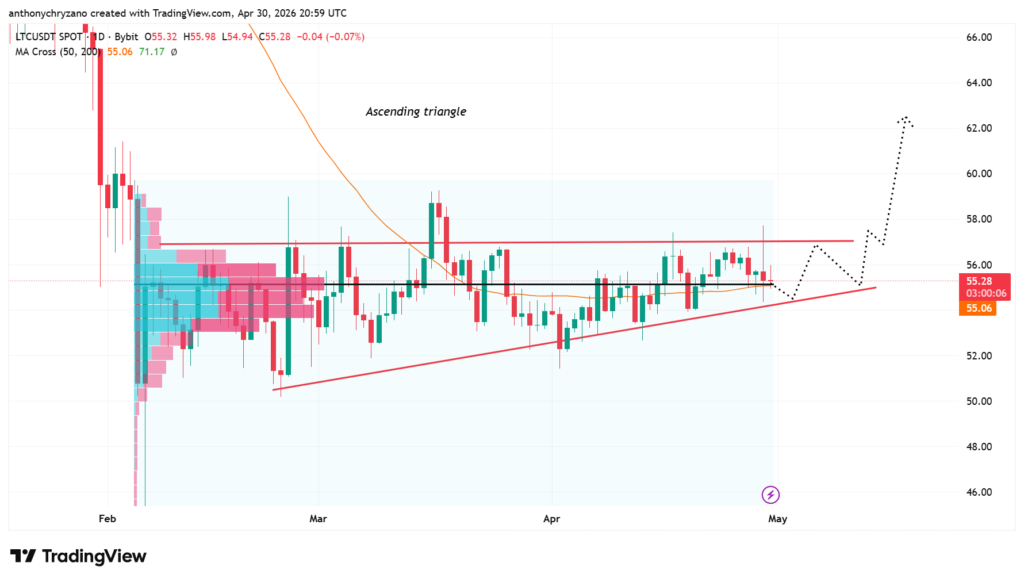
Meanwhile, the sellers are resisting at certain resistance levels by selling at certain price levels, which results in the formation of a flat top. Nevertheless, each time the resistance is touched, the retracement becomes weaker than the last. Once the apex of the triangle is formed, LTC price could soar above $60.