

Lido Decentralized Autonomous Organization has officially flipped the switch on NEST, which is the Network Economic Support Tokenomics mechanism, and it’s now live on mainnet. This represents a pretty major step toward getting LDO token value right in line with how the protocol is actually performing.
This new automated, rule-based system is designed to take a portion of the extra staking revenue Lido brings in and automatically turn it into LDO acquisitions. It’s a transparent and permissionless way to handle buybacks, which helps strengthen the whole economic model for the token.
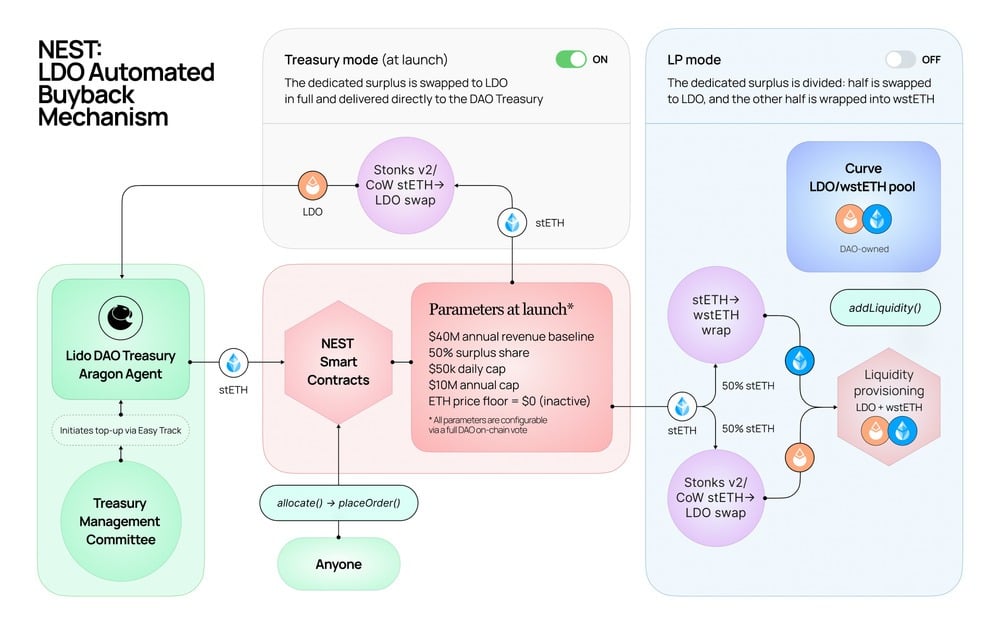
How NEST works and its key parameters
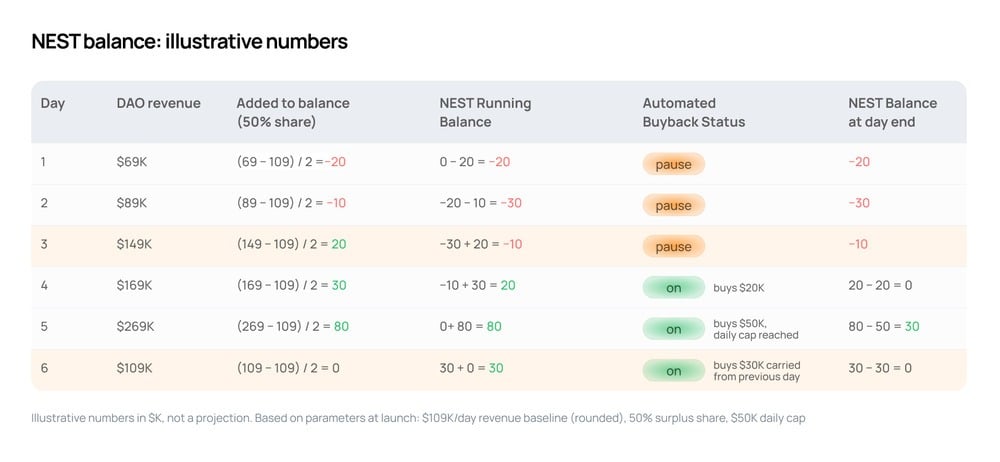
NEST is a programmatic engine that compares the DAO’s share of daily staking revenue against an annualized baseline of $40 million, approximately $109,000 per day.
When revenue exceeds this threshold, 50 percent of the surplus is allocated to a running NEST balance. As long as this balance remains positive, the system automatically executes daily LDO purchases via CoW Swap, subject to a $50,000 daily cap and a $10 million rolling annual cap.
The way the accounting works is simple: if revenue drops and the balance goes negative, the buying stops on its own without needing a vote; any gaps have to be filled by future wins before the buybacks start up again.
This mechanism is funded by the DAO treasury and operates in a fully permissionless manner.
Treasury mode and future flexibility
The NEST mechanism initially operates in “Treasury-only mode,” where all purchased LDO tokens are deposited directly into the DAO treasury.
This approach was chosen over the alternative Liquidity Provider mode, which would pair purchased LDO with wstETH to provide DAO-owned liquidity in a Curve v2 pool, as further modeling showed LP mode had limited application at launch.
The DAO can still totally change things up with an onchain vote if the market looks better later on, plus that Curve pool is already deployed and ready.
A fresh way to sync up revenue
With NEST, Lido is getting past those old manual buybacks and burns, instead creating a solid, onchain connection between how the protocol does and what LDO is worth.
Every parameter, from the revenue baseline to the daily cap, is subject to change only through a DAO vote.
Backtesting on 2024-2025 revenue data suggests the mechanism would have executed approximately $7.09 million in LDO purchases, demonstrating its potential to create consistent buy pressure while maintaining robust risk controls, including emergency pause mechanisms and oracle safeguards.