

The retail traders have lost their patience, and bearish words on social media platforms have started to increase. The usual configuration is that when the retail sentiment goes bearish, the market starts to pick up. However, Bitcoin has lost the 50-day MA despite the US consumer price index (CPI) showing cooling inflation.
Bearish words across social media increase
Words like “dead,” “dying,” “over,” “ended,” “ending,” and “finished” are gaining traction across social media platforms like X, Reddit, Telegram, and other crypto channels. This shows that the retail traders who have been waiting for the market conditions to get better have lost their patience.
However, the crypto market has often moved against retail sentiment, making extreme bearishness among smaller traders a potential contrarian signal. When retail investors become increasingly pessimistic and begin reducing their exposure, larger market participants may view the weakness as an opportunity to accumulate at lower prices.
Crypto markets behave strangely after retailers go bearish
This is particularly relevant in a market like Bitcoin, where short-term sentiment can shift quickly based on price action and macroeconomic data. As a result, a decline in retail confidence does not necessarily mean that Bitcoin is headed for a deeper correction.
However, the crypto market did not respond the same way it usually does when the retail market goes bearish. In fact, Bitcoin has crashed below the 50-day MA. The flagship crypto lost the $63.5K support level, and it is now trading at $62.8K.
Bitcoin loses 50-day MA, putting leveraged longs at risk
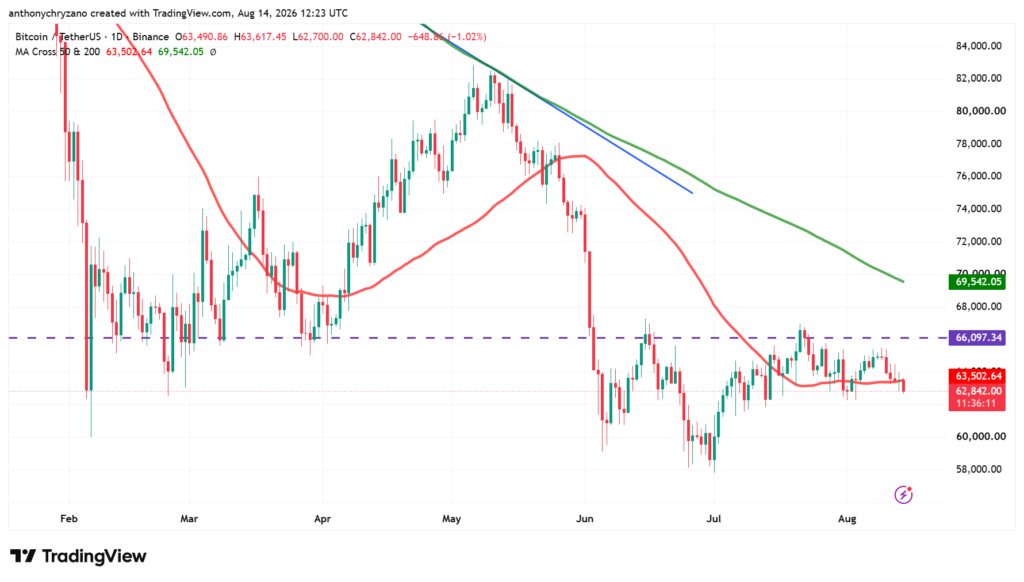
What makes this crash even weirder is the status of the US economy. Just a couple of days ago the US consumer price index and the producer price index were released, and they revealed inflation was cooling.
Usually, when inflation cools, risky assets such as Bitcoin benefit because lower inflation reduces pressure on the Federal Reserve to maintain high interest rates. As inflation moves closer to the Fed’s target, markets may begin to expect a more accommodative monetary policy, including potential interest-rate cuts. Lower rates can reduce bond yields and make relatively higher-risk assets more attractive to investors.
At the same time, easier financial conditions can encourage greater liquidity and risk-taking across financial markets. This can lead investors to move capital into assets such as stocks and cryptocurrencies in search of higher returns. However, it was not to be this time.
With Bitcoin failing, spot buying has weakened, and thereby the liquidity is thin at these price levels. In addition, the leverage positions are at risk, and if Bitcoin further moves down, there will be a cascading effect, and there could be a long liquidation cascade.