

Crypto, for instance, has various strategies for generating passive income. Some of the highly successful are staking, liquid staking, lending, yield farming, participating in earn programs, and running validator nodes. These strategies are playing a big part in the crypto ecosystem as investors try to get some return from their digital assets, apart from the price appreciation.
The mechanics may be well documented, but the truly critical element is to grasp the origin of the yield. Although an attractive APY is often a key attention-getter, its longevity is fully dependent upon what supports the activity that is giving rise to the yield. Yield stemming from actual network activity, trading volumes, or borrower demand is generally far more sustainable than yield issued solely to draw in fresh liquidity.
The working of crypto’s passive income
Staking is the process of locking tokens in order to help secure the network as part of a proof-of-stake system and earn staking rewards in the process. On proof-of-stake networks like Ethereum and Solana, stakers can generally earn between 3 percent and 8 percent APR on staked tokens, with real yields dependent on activity, network inflation, and market volatility.
Users earn by allowing others to borrow from them through lending and charging a fee for the usage of their assets. Rates on stablecoin lending can be anywhere from 4 percent to 8 percent depending on loan demand across decentralized and centralized platforms and are likely to rise during the busy market days when more liquidity is required by traders.
In yield farming, participants deposit funds into decentralized exchanges and get to earn either a slice of the trading fees or token rewards in return. It gained traction amid the DeFi hype due to its promising APY, but not without risk of smart contract hacks, impermanent loss, and dependency on token incentives.
Earn products offer an easy way of earning passively where you deposit funds and are paid interest and it has nothing to do with the active trading of positions. They are more user-friendly products, though they will generally provide less if compared to a more active DeFi strategy.
The operation of a validator node demands more technical knowledge and funds, although it lets participants explicitly support blockchain networks in addition to earning rewards. For investors with the required resources, the direct connection to the blockchain activity can be made with the use of validators.
The important information about the origin of yield
The source of yield is one of the most important factors when evaluating crypto income opportunities.
Returns backed by real activity, such as network fees, trading volume, and borrower interest, usually have stronger foundations. These models depend on actual demand within the ecosystem.
Token emissions or promotional incentives also make high-yield products too heavily dependent on them. In the early stages of a protocol, the relative rewards can bring more adoption. The thing to note is that it may decline once the incentives are reduced or there is a change in market conditions.
The failures of platforms such as Celsius, Voyager, and Terra/Luna highlighted the risks of products offering attractive returns without enough sustainable revenue behind them. A high yield percentage alone does not explain whether a product can survive periods of market stress.
The market participants should keep an eye on this
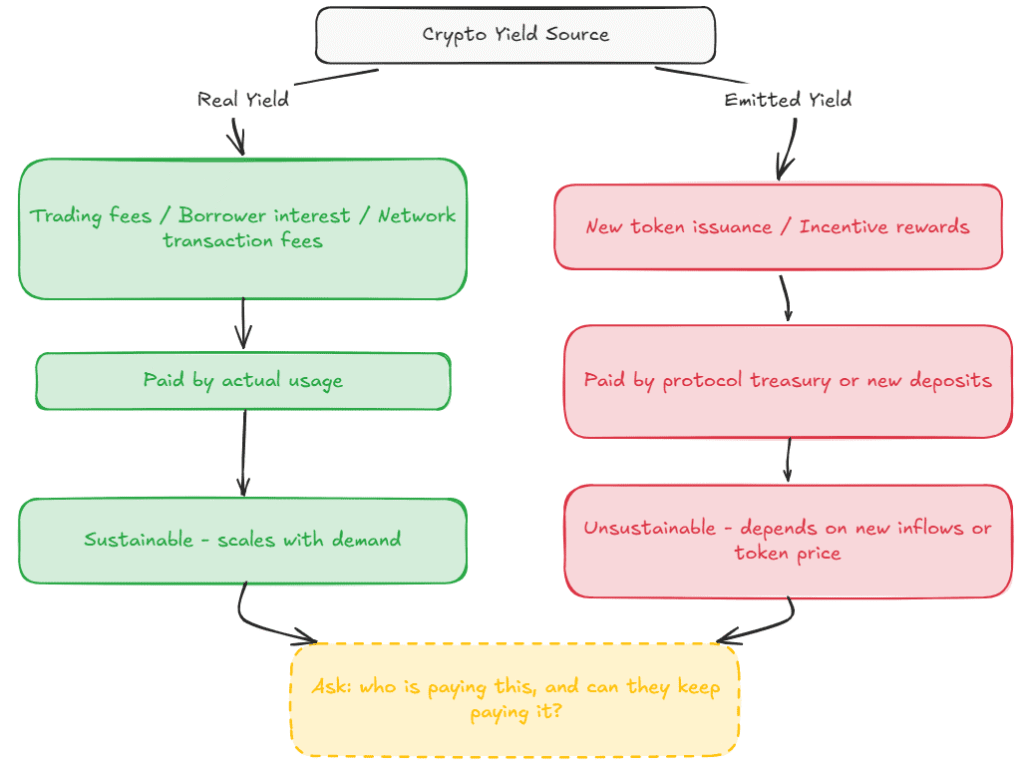
It is not just about the APY and TVL (total value locked). Most of the investors just focus on these two but the quality of the deposits carries the same weightage. In the case mainly driven by temporary incentives, the strong TVL numbers can mislead.
It’s also a good reminder about the difference between real yield vs. emitted yield, where earned yield is an organic revenue source coming from user activity and trading fees, compared to token rewards, which disappear when the protocol no longer has the same incentives. Protocols with the loyal users, transactions, and real demand will tend to outlast them.
Liquid staking has also turned into a significant source of crypto income for users who wish to be rewarded with staking gains without having their assets locked up and off the DeFi space. Another added risk that needs attention is the linkage of liquid staking tokens to their collateral. When market strain hits tokens like stETH and jitoSOL, they might show signs of liquidity trouble before the rest of the market does.