

Argentine Federal Judge Marcelo Martínez de Giorgi ordered the freezing of 25 crypto wallets linked to the LIBRA token investigation and demanded six international exchanges, including Binance and Bybit, identify their holders. The ruling, requested by prosecutor Eduardo Taiano, follows a Federal Police cybercrime report tracking funds from “Team Libra Wallets” across Solana and Tron networks. The case involves over 40,000 investors who suffered losses after Argentine President Milei’s post.
How investigators traced the funds
The police report used backward tracing and open-source analysis to reconstruct the flow. Funds moved from “Team Libra Wallets” to the Meteora liquidity protocol on February 14-15, 2025, before pooling in an intermediary wallet.
On November 25, 2025, the cash hit an address Arkham tagged as “Solana First Funder: Libra – Squads Vault – Milei CATA.” The big move happened on May 10, 2026, when 498,539.85 USDT was transferred to the Tron Network in 16 seconds flat using an automated cross-chain protocol, skipping the traditional exchanges.
Once on Tron, funds were fragmented daily across multiple wallets using a smurfing technique, and 17 separate Solana-to-Tron bridges were identified. At least 10 of those transfers passed through Binance, with smaller numbers on Bybit, OKX, and Bitfinex.
What the exchange orders require
The judge has ordered each exchange to hand over complete Know Your Customer (KYC) files for the targeted accounts, including account-opening documents, internal memos, Internet Protocol (IP) connection logs, linked bank accounts, and full transaction histories.
The order aims to attach real identities to the blockchain addresses, potentially uncovering who controlled the funds. The judge noted the measure was necessary due to Argentina’s lack of a regulatory crypto authority and to prevent “harm that later cannot be remedied.”
The political dimension: Milei’s endorsement and its aftermath
The case originates from a moment of presidential endorsement that ended in financial disaster. On February 14, 2025, President Javier Milei posted about the Solana-based LIBRA token on his X account, sending its price from $0.01 to nearly $5 (a 500-fold increase) before it collapsed within hours as a small cluster of wallets allegedly withdrew around $100 million.
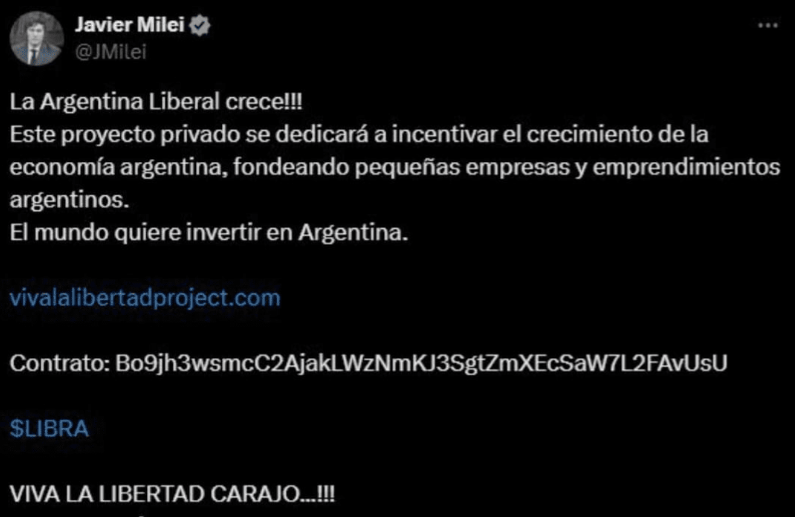
More than 40,000 buyers who entered after the endorsement were left with losses. Milei later deleted the post and denied involvement, telling a radio interviewer that he had not promoted the token, but simply shared information about a private initiative to fund entrepreneurs in Argentina.
The way the price spiked and then crashed, especially looking at the timing of those withdrawals, is the core of why prosecutors are now arguing that the whole launch was just a coordinated extraction from the beginning.
The situation has turned into a serious political liability for a president who’s been all about dollarization and economic reform, and what happens now could completely change how presidential support for crypto projects is handled in Argentina.