

There are more than 3 times as many Ethereum holders as Bitcoin holders. This reveals an undeniable fact: BTC remains the ultimate store of value, even as ETH continues to be the foundational currency of Web3. Despite the increase in ETH holders, the ETH/BTC pair is still facing resistance, as it struggles to break free from an 8-month-long downtrend.
Non-empty ETH wallets hit 190 million
According to a report from Santiment, an on-chain analytics tool, the Ethereum network has reached a milestone of 189.49 million non-empty wallets, which is 3.2 times larger than Bitcoin’s holder base of 59 million non-empty wallets.
This behavior shows that Bitcoin has become a store of value, while Ethereum becomes the central network for the Web3 space. Bitcoin’s price behavior over time reflects characteristics similar to a store-of-value asset rather than a transactional or utility-driven one.
Bitcoin remains unchallenged as a store of value
Unlike other assets that rise and fall depending on usage demands or network activity, Bitcoin prices usually follow capital flows, liquidity, and accumulation cycles than on fundamental changes in their utility over the long run.
The cryptocurrency goes through multi-year growth cycles followed by consolidation periods. In the latter, prices remain relatively unchanged for prolonged periods as supply accumulates within the hands of long-term investors.
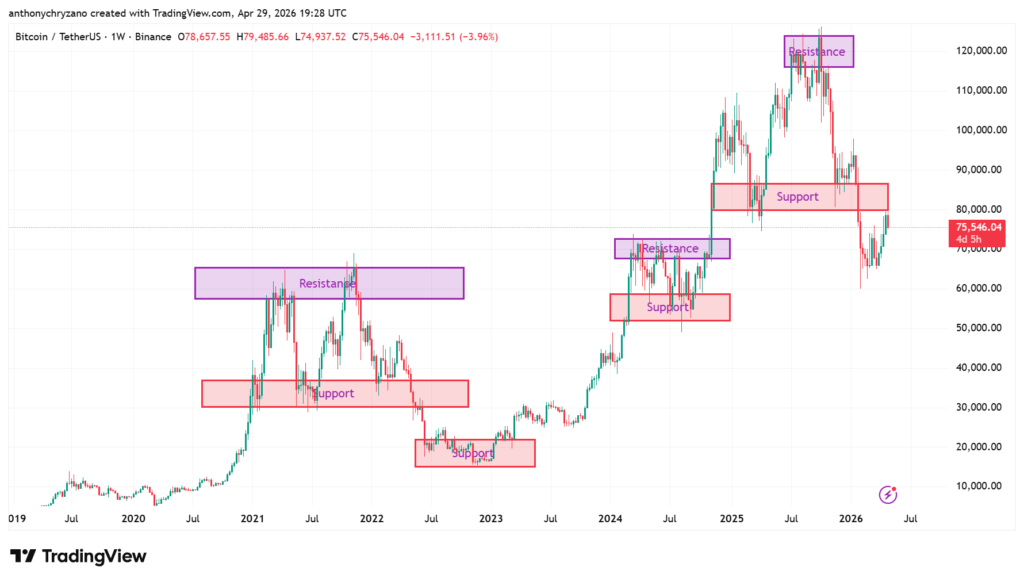
Yet another attribute of Bitcoin that supports its status as a store of value is its ability to defend significant psychological and technical levels over an extended period of time. Regardless of severe declines in the past, the cryptocurrency has managed to rebound back and revisit its previous highs, forming a consistent rising trend in the long term. This is illustrated in the graph below.
When considering Bitcoin being concentrated in fewer wallets compared to Ethereum, it can be explained by a mix of design, usage behavior, and market structure rather than a single factor.
For example, most of the transactions carried out on the blockchain network of Bitcoin are mainly for store of value assets, whereby the majority of the individuals holding BTC do not move funds from their accounts. This phenomenon commonly referred to as “HODL” means that many Bitcoin owners retain BTC and do not use it frequently.
Therefore, although many people have Bitcoin on their accounts, the balances are usually stored on fewer addresses, particularly on cold storage, custodial wallets, and institutional custody services.
BTC is kept in exchanges, while ETH is used for gas fee
Additionally, the effect of custodial concentration is vital since many people’s BTC is kept at central exchanges like Binance and Coinbase. Hence, even if many people hold BTC, their balances can be pooled into few wallets by these exchanges, resulting in the perception of concentration.
Conversely, the Ethereum blockchain has a high level of activity in the ecosystem. For instance, the Ethereum network requires ETH for gas fees when interacting with the system through decentralized applications like Decentralized Finance (DeFi) protocols, non-fungible tokens (NFT), and smart contracts. Thus, Ethereum holders usually engage in more activities than those of Bitcoin, hence resulting in more movement in the network.
Therefore, the nature of the Bitcoin and Ethereum networks contributes to the huge variation. Over $1 trillion in stablecoins has already been transferred so far this month, revealing how far the market has evolved in a relatively short time.
ETH/BTC pair continues the downtrend
As shown in the chart below, the ETH/BTC pair has been in a clear downtrend since August 2025. There were many repeated rejections from the same resistance zone where sellers consistently step in. Each time the price approaches that trendline, the behavior from traders becomes almost predictable.
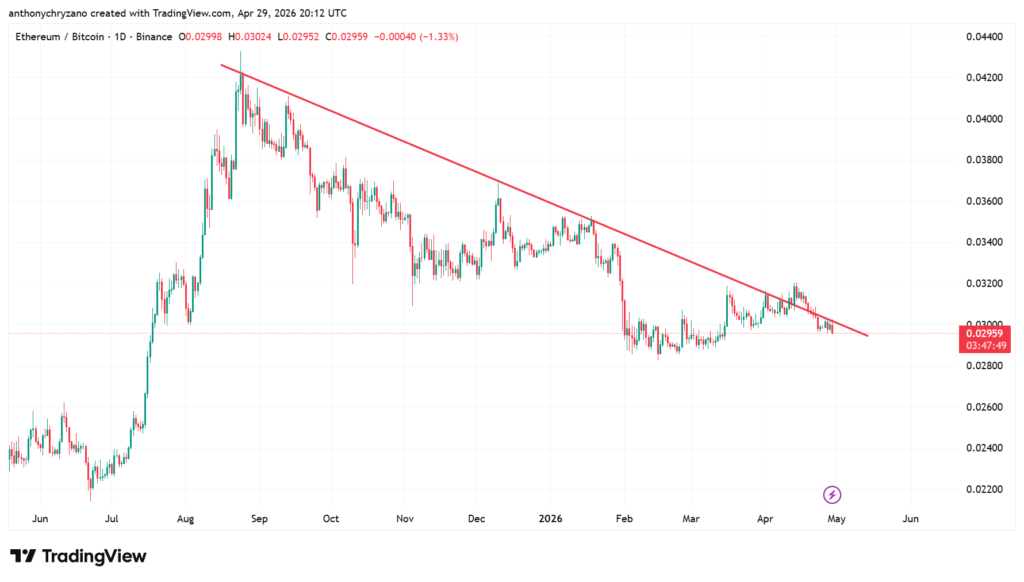
Early buyers try to push it higher, momentum traders jump in on short bursts of strength, but as soon as it taps resistance, profit-taking kicks in aggressively. That’s what creates the familiar pattern of rejection — not just a technical level, but a psychological one where traders have learned that “this is where it usually fails.”
The retest of resistance is different this time
But something different is happening this time.
Instead of weakening momentum on each retest, RSI is starting to show higher highs, even while price is still struggling against resistance. That divergence matters more than it looks at first glance. It tells you that underneath the surface, the strength of buyers is gradually improving even though the price hasn’t broken out yet. In simple terms, each push toward resistance is now being supported by more underlying momentum than before.

This is where trader behavior starts to shift.
On earlier attempts, most traders treated the resistance as a clean rejection zone — they would short the retest or exit longs early, expecting the downtrend line to hold. But when RSI starts making higher highs while price is still capped, it creates doubt in that pattern. Traders who normally fade resistance begin to hesitate. They see that momentum is not fading the way it used to, and that hesitation itself reduces selling pressure.
At the same time, breakout traders start positioning earlier. Instead of waiting for a clean breakout above resistance, they begin accumulating into the final retests because they notice the divergence. This creates a subtle shift: instead of strong rejection selling every time price hits resistance, liquidity starts getting absorbed.
Sell zone transforms into the compression zone.
So what used to be a “sell zone” slowly turns into a compression zone.
Now the key psychological level is no longer just the trendline itself—it becomes the decision point where traders ask, “Is this another rejection, or is momentum finally strong enough to flip the structure?” When RSI is already trending higher, the market is quietly telling you that each rejection is becoming less efficient. Sellers are still active, but they are not as dominant as before.
If this continues, the breakout scenario becomes more likely because resistance weakens over time. Every failed rejection attempt removes liquidity from sellers and increases pressure on the upside. Once a clean break finally happens, it often doesn’t move slowly — it accelerates. That’s because trapped short sellers begin to cover, and late breakout buyers rush in at the same time.
So in this ETH/BTC structure, the difference this time is not just price touching resistance again — it’s the quality of momentum underneath it. Higher highs in RSI during repeated resistance tests suggest that the downtrend is losing internal strength, even if the price hasn’t confirmed it yet.
That’s usually how reversals start: not with a clean breakout first, but with a quiet shift in momentum that traders slowly begin to notice before the level finally gives way.