

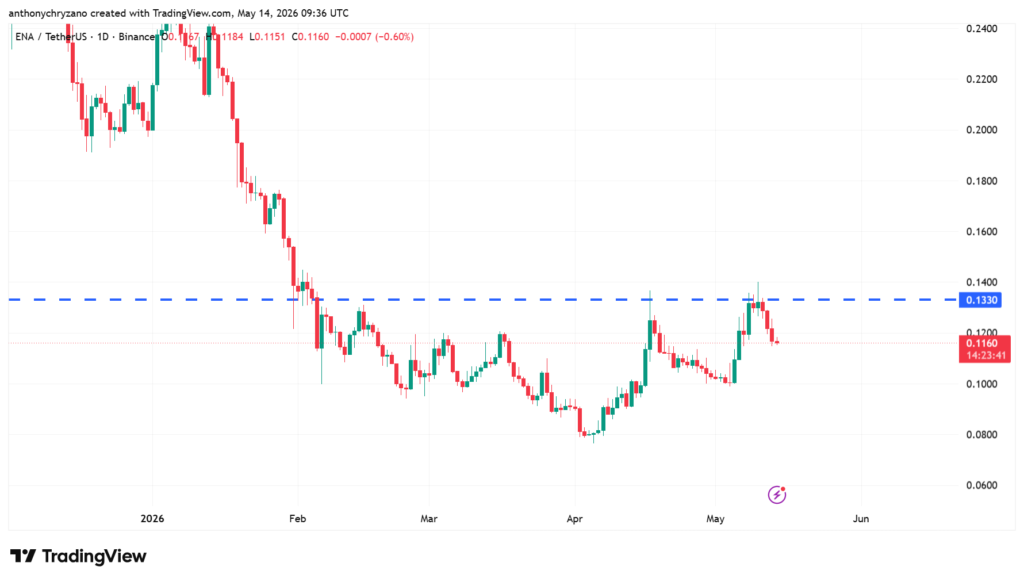
A series of events in the Ethena ecosystem led to a spike in wallet creations. Even the whale has gotten busy, increasing the activity to a 5-week high. Despite these developments, the Ethena (ENA) price has been rejected at the local resistance level of $0.133. However, the overall picture shows the price bottoming.
ENA price hit resistance at $0.133
ENA prices have been restricted under the local resistance of 0.133 for more than a couple of months now. The coin entered this zone, as the macro downtrend dragged the coin to these low levels. However, after it hit rock bottom, the coin once again mustered the strength to rise from the dust. Although the bulls gave it their best shot to push the local resistance level, they were outnumbered by the ferocious bears who defended the local resistance level.
Grayscale includes ENA in its DeFi fund
The inclusion of ENA in the Grayscale DeFi Fund with a position of 13.59% on May 7th represents another positive development for Ethena, as it indicates that institutions are getting more interested in the project and increases the legitimacy of Ethena in the crypto world. Such inclusion usually serves as a credibility trigger, as it helps in exposing the asset to conventional investment capital flows.
Following the above, another important event occurred on May 8th when there was a $310M USDC transfer by an Ethena-connected wallet address. The reason for the mentioned event is unknown, but it definitely increased trader interest in Ethena.
LayerZero bridging increases visibility
On May 9th, the temporary suspension of LayerZero bridging added another layer of uncertainty, bringing additional attention to Ethena’s cross-chain infrastructure and operational dynamics. While such events can raise short-term concerns, they also tend to amplify visibility and trading engagement.
Together, these elements could serve as a price catalyst due to increased narrative, liquidity, speculation, and attention. The allocation from institutions helps build legitimacy, whereas large allocations represent the flow of capital in action. At the protocol level, news is able to drive traders into markets, creating a strong likelihood of increased volatility and a price rally if market sentiment remains positive.
Activation of the fee switch
On top of that, activation of Ethena’s long-awaited “fee switch” was another catalyst that the community was looking forward to. “The Ethena Foundation has confirmed that all parameters set by the Risk Committee have been met, with a governance vote by ENA holders expected to follow shortly. Santiment, an on-chain analytical tool, reported that whales started to accumulate ahead of this vote, creating a classic DeFi positioning pattern.
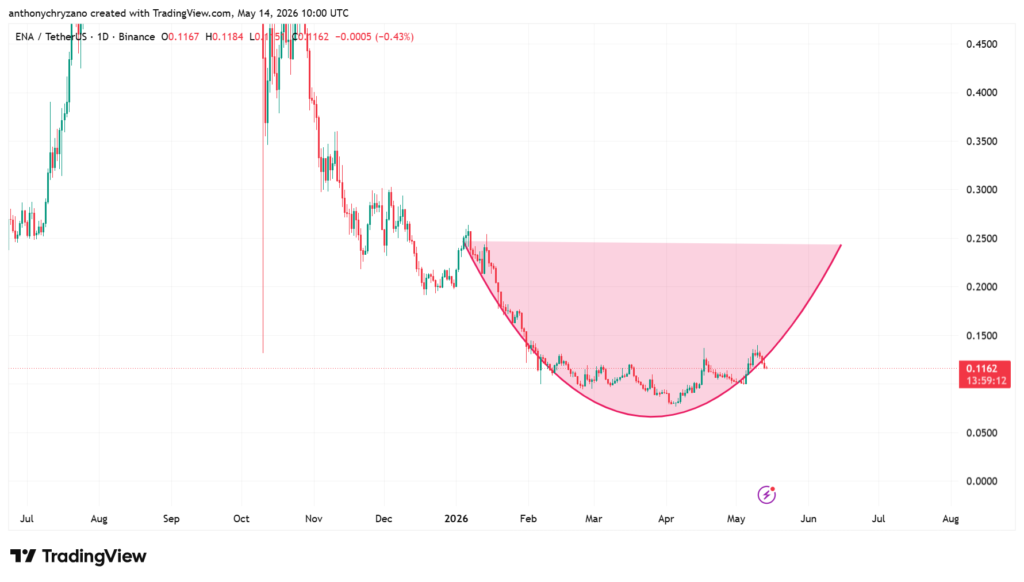
Although ENA looked like it was rejected off the local resistance level at $0.132, the bigger picture shows that price are gaining momentum after bottoming, as shown in the chart. When people say prices are “bottoming,” they are referring to a phase where the market may be forming a potential low after a sustained downtrend. It doesn’t confirm that the bottom is in, but rather suggests that selling pressure is starting to weaken and the market is transitioning into a possible accumulation or stabilization zone.
In this phase, there will be a change in the behavior of the price action from establishing new lower lows to becoming more range-bound. The momentum on the downside will be losing strength, volatility will become compressed, and there could be the appearance of long lower shadows as buyers reject lower prices.
ENA’s bottoming is manifestation of market psychology change
Underneath the surface, the usual activity occurring is the change in the players in the market. Weak hands have been flushed out in the declining period. On the other hand, the buying party, which are usually bigger players, starts to pick up the supply at their own pace without forcing the price higher.
The difference between trader behaviors is also strikingly obvious in the case of bottoming. Retail traders will either capitulate out of fear or be afraid to enter the market; momentum traders do not normally enter the market prematurely. Instead, they will try and wait for further confirmation of the reversal pattern. Swing traders can begin to take smaller positions as they approach key support levels while waiting for confirmation.
Psychologically speaking, bottoming is the transition from fear to skepticism and eventually confidence. Bottoming is less about price action than the transition from selling to buying.