
Testifying in a high-stakes federal courtroom against OpenAI in Oakland, Elon Musk pivoted from his legal war against Sam Altman to shoot a sharp warning against the crypto industry. Musk, who was one of the loudest voices supporting crypto in the past years, now believes that a majority of assets circulating in the market are a scam.
Musk, for the last two days, has been arguing against OpenAI’s decision to pivot from a “non-profit” business model to a “for-profit” one before a nine-people jury.
On Thursday, Musk was questioned about OpenAI’s early idea of launching an Initial Coin Offering (ICO) to raise funds to push for advancements in the AI technology. In an ICO, a project essentially creates a native token for their brand allowing interested investors to buy the token promising special network access and other sorts of utilities.
As per reports, discussions around OpenAI’s ICO idea were brought forward via internal emails.
Responding to why that idea did not shape-up, Musk said that most crypto tokens are scams and that only some manage to retain legit merit, New York Times reporter Mike Issac posted on X. As of Thursday, over 47.7 million crypto tokens are in circulation, data by CoinMarketCap showed.
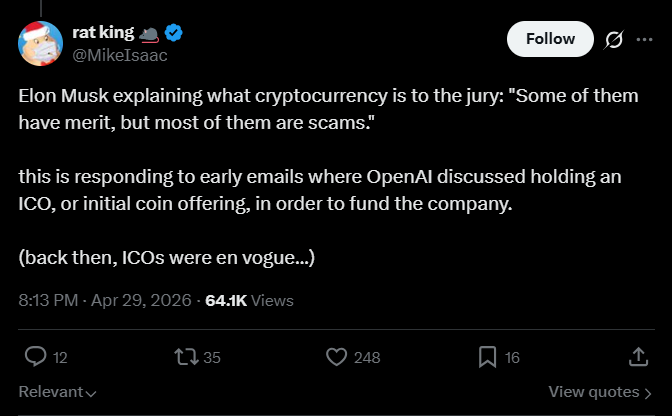
Source: X/ @MikeIssac
Interistingly, Musk’s dismissive stance against crypto in Oakland’s Federal courtroom aligns with the crypto fatigue that its own platform X has clocked in the last few weeks.
On Thursday, X’s head of product, Nikita Bier released a list of the new “Snooze” feature that lets X users temporarily mute topics from the “Your Feed” tab.
As ber Bier’s list, crypto-related topics are the most snoozed ones on the platform. Until the CLARITY Act moves past the to-and-fro part of the ongoing negotiations and gives the market a reason to wake up, it seems both the billionaire and his users have decided to keep the industry on mute.
Meanwhile, crypto is not the only technology that was slammed by Musk during his legal standoff against OpenAI this week. He also said that AI, if not developed responsibly, could “kill us all”.