


After falling more than 22 percent in price over the past month, Bitcoin (BTC) is yet to show confirmation of a market bottom. Two key metrics suggest that despite the losses suffered by BTC holders, the digital asset is still in oversold territory and not necessarily showing any signs of a potential reversal.
What does Bitcoin’s MVRV reading indicate?
According to BTC’s latest price action, the cryptocurrency is steadily moving into a zone that has historically been associated with bottom formation. However, BTC’s on-chain structure still points to capitulation, not confirmation.
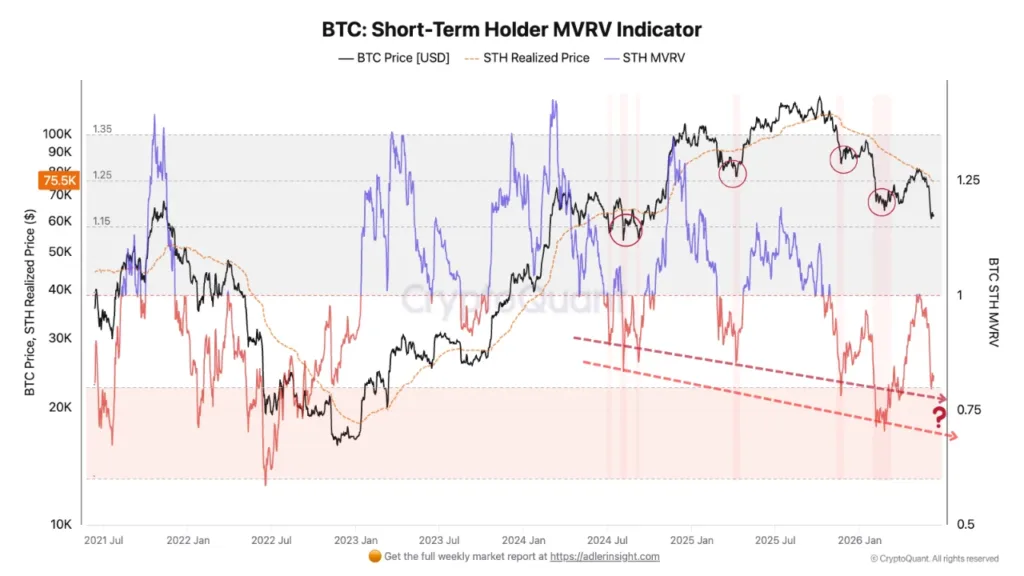
Bitcoin’s short-term holder (STH) market value to realized value (MVRV) has fallen down to 0.75 – 0.80 range, which is below the break-even point of 1. It means that the average coin bought in recent months now sits at loss.
For the uninitiated, the BTC STH MVRV compares the current market value of Bitcoin held by recent buyers – typically within the last 155 days – to the price at which they originally acquired it.
When the ratio is above 1, short-term holders are on average in profit, and when it is below 1, they are on average underwater, signaling stress or potential capitulation.
Historically, BTC’s current STH MVRV reading is where the so-called ‘weak hands’ are flushed, and strong bottom formations are developed. Every tap of this zone, in the past, has preceded a local bottom.
However, each Bitcoin rally since 2024 has printed a lower MVRV high and low – essentially a descending channel as shown in the below chart. It means that the digital asset’s demand momentum is fading, even as the metric is reaching an oversold zone.
BTC’s adjusted SOPR provides confirmation
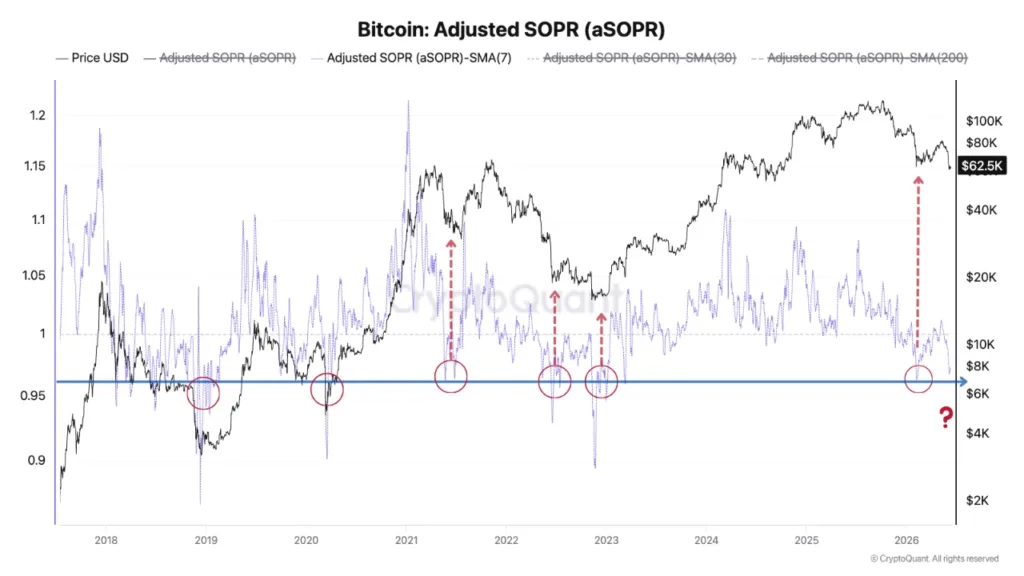
Bitcoin’s adjusted spent output profit ratio (aSOPR) gives more insight about the state of an average coin purchased over the past few months.
To explain, the aSOPR measures whether coins being moved on-chain are being sold at a profit or a loss. It filters out short-term noise like internal wallet transfers and exchange movements.
An aSOPR reading of more than 1 means coins are being sold at a profit on average, while below 1 means holders are realizing losses, which signals capitulation conditions.
As of Thursday, Bitcoin’s 7-day simple moving average (SMA) is tapping the aSOPR at around 0.96, a level that has marked every major sell-exhaustion event since 2019. A consistent print below 1 would be the precise condition for a potential price reversal once the selling base is spent.
Some silver linings are already on the horizon, with traders eyeing a contrarian rally in BTC despite the derivatives momentum tumbling.
Lower than expected U.S. core inflation for May 2026 further helped BTC regain some of its recent losses.