

Monday was a disappointing day for the bulls, with Bitcoin closing at $61,643 while it had struggled to surpass and hold above $64,000 for much of the last week. The chart doesn’t look that good but the on-chain data shows more negative sides. The Exchange Stablecoins Ratio on Binance is derived by dividing BTC by the stablecoin reserves.
The metric has risen from 0.00000765 on May 14 to 0.00000801 on Tuesday. While that sounds technical in and of itself, the takeaway is this: over the time period, BTC has gone down by 24 percent from $81,051 to the present day, and the focus is not just about that drop; the amount of stablecoin reserves available to take on the selling is actually diminishing.
Looking at the ratio in dollar terms gives us more clarity about this trend. May 13’s figure shows that stablecoin reserves at the centralized exchange, Binance, were equivalent to ~$0.613 in dry powder per dollar of BTC on exchange. Reading for Tuesday was recorded with the figure at $0.494. The result was that the buyers were leaving and were not into accumulation at the time of distribution phase of the asset.
Is the historical data pointing towards weaker demand?
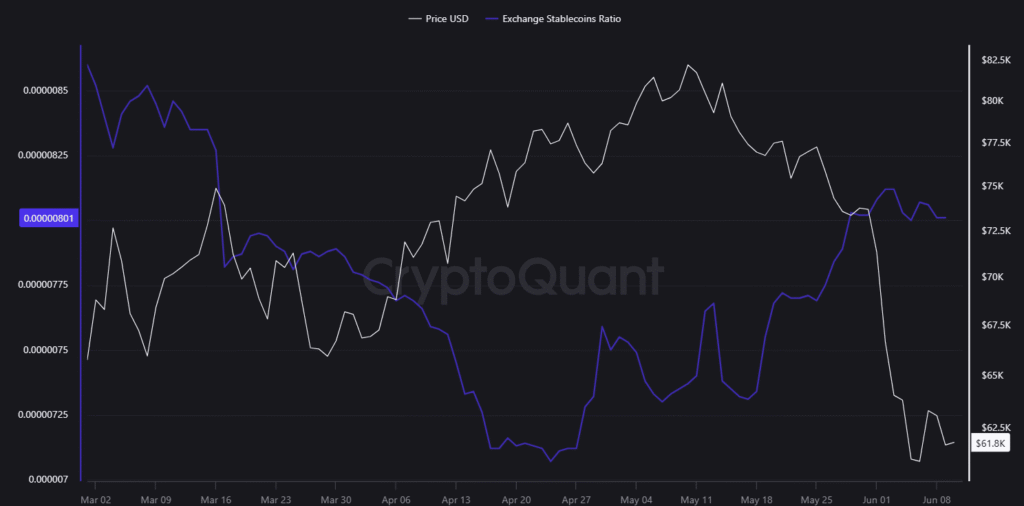
In mid-March, when Bitcoin was trading around $83,000, the ratio reached its highest point in the timeline. At that point, the stablecoin reserves on Binance were fairly thin compared to the amount of Bitcoins in the exchange and that indicates that there wasn’t much buying power available to absorb the selling pressure. It wasn’t prolonged until this largest cryptocurrency sold off to around $74K.
In april, the opposite took place. Stablecoin balances were refilled back, BTC reserves on the exchange diminished and the ratio hit its lowest point as Bitcoin pushed past $93K for a short bit. That was a much stronger position to be in since there was the available power to buy. Analyzing the current situation looks more the same as the March scenario than the April one. The ratio has seen a rise of 14 percent from its April low regardless of Bitcoin’s drop and this suggests that the stablecoin support that acted as fuel for the previous recovery has faded.
Is the current situation more of a capitulation or distribution for Bitcoin?
This June 4-5 sell-off is the key event to be considered. From the price level of $64,664 down to $59,109 on June 4-5 (closing at $60,923), $71.5 billion was traded and this figure comes as the highest reading in the mentioned timeline. Sell-offs marked by high trading volume are typically correlated to capitulation or distribution.
Here, the stablecoin data suggests a distribution. In the case that the buyers positioned themselves to absorb the price decline, stablecoin reserves should have risen based on approaching the downtrend, but on the other hand, the ratio of USD stablecoins went down from 0.511 on June 4 to 0.494 on June 10 and this states that buying power has still been exiting the exchange even while Bitcoin’s price was still in the correction phase.
The mentioned problem is more of a structural problem. Binance needs stablecoins building value relative to BTC on the exchange for a sustained bottom and the result is still anticipated. The ratio has been ranging between 0.00000797 and 0.00000809 for a week now and can be termed as more of a consolidation and has nothing to do with accumulation. The dollar ratio for eight sessions has failed to hold above 0.52.
The price can bounce here; there can be an extremely sharp, aggressive move from short covering alone. A short squeeze and a bottom constructed on actual buying and demand are two different variables and the difference is the output from the ratio. For the real demand, the stablecoin reserves must grow on Binance and this must be done before the price shows a recovery, not after it. The level we need to keep an eye on is $59,100 (Friday Intraday low). Below that level, there is no significant support in the price structure for the last 6 months.