

Bitcoin is changing hands near $81,500 at the time of writing. Simply that fact should have pushed the derivatives market to bull positioning but it hasn’t. Funding rates across all exchanges have plunged to -0.023 percent, a reading more negative than the May 2023 extreme of -0.017 percent when Bitcoin was trading under $30k and sentiment was in the recovery phase from the FTX crash. Comparison against this figure is a start for figuring out what is happening in the market currently.
A signal that cuts against the price action
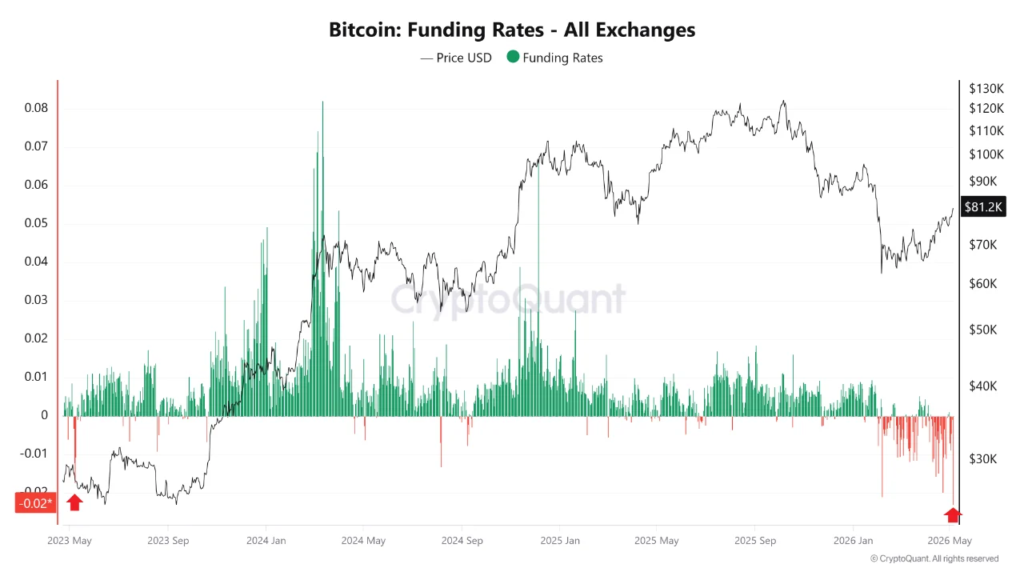
Funding rates are the price of holding an open perpetual futures contract. If the funding rates are positive, long traders pay short traders (Bullishness is evident), and if the funding rates turn negative, the roles switch, where the short traders have to pay longs to maintain their position. The further the funding rates dip negative, the more congested and committed the short positions become.
This -0.023 percent figure is not simply a small dip toward the bearish side. It’s a magnitude of conviction that bears have towards perpetuals, which has not existed since the bottom of the bear market from 2022 to 2023 and it is being achieved at prices about 3x that high at the time when this prior comparison reading was achieved.
The straightforward conclusion comes out as many derivatives traders are not simply on the wrong side of the market during the rally; they are betting against it with enthusiasm.
Volume confirms the market is not quiet
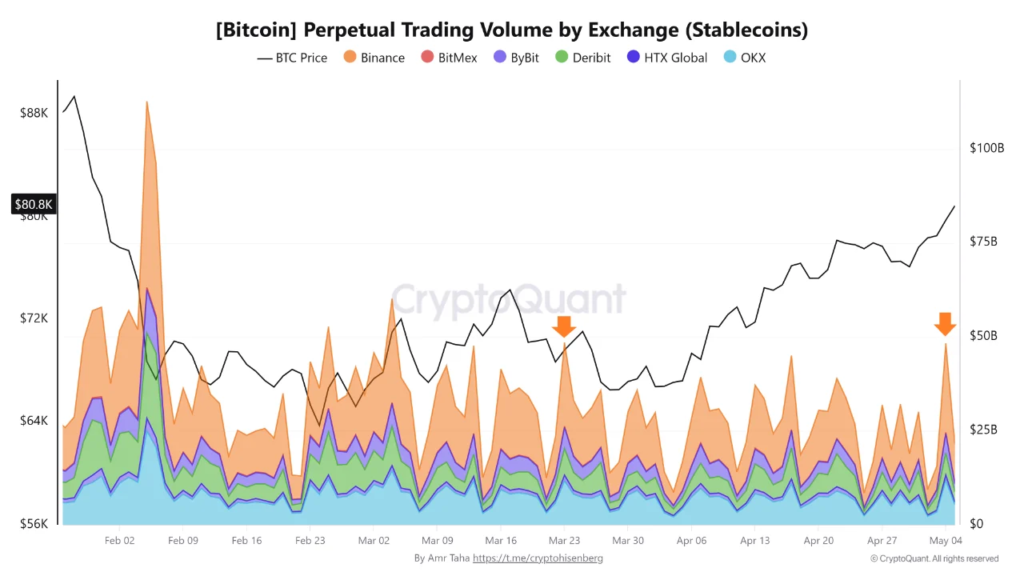
One may attribute the bearish funding simply to it being the most expired of post-market positions if the volume had been thin, but that is not the case. Bitcoin perpetual trading volume on Binance jumped above $23 billion yesterday and it’s the first time since 23 march 2026 volume has been north of this mark. Binance has consistently taken more of the global BTC perpetual volume than any other exchange so we can take these figures as representative and not outliers.
This is emphasized in the chart of perpetual trading volume by exchange. Aggregate volume in Binance, Bybit, OKX, Deribit, and HTX Global began a large leap upward on May 4 when the Bitcoin price neared $81,000 and crossed over it. The last jump this high was from the May 23 event, which also was accompanied by the orange arrow marking a volume anomaly. These were both inflections of the price.
This increases volume under deeply negative funding. This is an active condition; it’s not being a passive participant in a market where derivatives are very active. A substantial portion of that focuses on the short side. The mechanics of forcing the crowd who pay to hold the directional exposure to cover now become a relevant risk.
What a short squeeze requires and what would trigger it
It doesn’t automatically mean a short squeeze will be ignited just because of a negative funding rate. In order for this to take place, the price of Bitcoin must maintain or be increasing above a level that sees all those who have entered a short position underwater. A short squeeze is a mechanical phenomenon. Increased pressure from margin calls leads to liquidation of positions that drive price up and therefore force further liquidations and subsequent price rises.
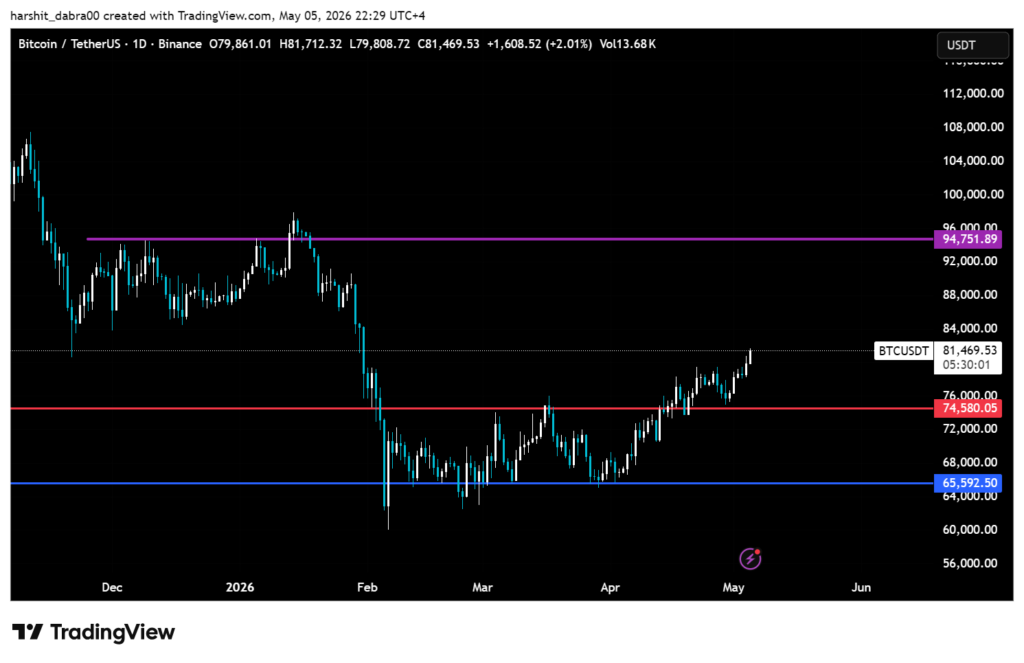
The current configuration carries this risk. Bitcoin already made its way above $80K, which acted as both psychological resistance and an epicenter of derivatives trading. Funding is at -0.023 percent and volume at Binance is way above $23 billion. The structure of a squeeze is present. The only question is whether BTC can stay above the levels that are important for short book risk managers.
On May 4 volumes at this level spike to a reading that seems indicative that the market participants are moving on the level as opposed to holding off on it.
The market absorbed $207 million in profit-taking
As further confirmation, the derivatives picture is an independent data point from the spot and on-chain sides of the market. Sunday the net realized profits for bitcoin soared to $207.56 million, their highest print in a month, according to Santiment data. This print came just as bitcoin crossed $80,000 for the first time since Jan. before briefly retreating to $79,000 late Monday and recovering above $80,000 again in Asian morning hours Tuesday.
The realized profit event of 207 million dollars is the highest one-month value the market has experienced. In prior bull markets for Bitcoin, actual cycle tops resulted in multiple billions’ worth of realized profit being generated, which typically resulted in price retracing in a few days after. $207 million is significantly lower than the prior bull markets, which were in the billions.
This reading does, however, point to a changing cost basis. Existing long-term holders, with a substantial unrealized profit, sold into the $80,000 breakout. Their coins were purchased by new buyers at ~$80,000, pushing up the network average entry point and deepening the concentration of holders whose breakeven is in line with or near where they purchased. This new pool of holders will probably not capitulate at a regular 10-20 percent correction; they were able to participate in and were able to offload it from old holders at a profit.
The $207 million of sell-side flow that was consumed without structural breakdown under $80k is a significant part of the data. It seems to imply demand was there to absorb supply without experiencing a meltdown.
The positioning in the options market also has an interesting thing to note. Traders are still paying more for downside protection than upside exposure, showing similar caution as the negative funding rates display. Also, the options desks have demand for cheap call ratio structures, which is a trade that thrives with steadily upward Bitcoin rather than in a quick explosion. It also states that the directional traders have hedged. The smarter flow is geared for a steady grind higher.