

Since the beginning of 2026, Bitcoin (BTC) market cap has trimmed from $1.7 trillion to slightly above $1.2 trillion as of Thursday – representing a decline of almost 30 percent. As a result, the leading digital asset has also fallen out of the list of top 5 global assets ranked by market cap.
It will take time for BTC to make a comeback
According to data from asset market cap aggregator, Companies Market Cap, Bitcoin’s rank has slipped from 5th place in May 2025, to 15th place as of June 2026 in terms of reported market cap.
In comparison to its all-time high market cap of $2.48 trillion in October 2025, BTC’s current market cap is almost 50 percent lower. Essentially, BTC has slid 10 positions in the list of global assets, paving the way for new entrants like SpaceX.
Commenting on the development, crypto analyst ColinTalksCrypto, said that the fall in BTC’s ranking is just a product of “the nature of a volatile asset that outpaces other assets in the long run.” He predicted that he expects Bitcoin to take at least 5 to 10 years to reach the top 5 again.
For the uninitiated, market cap is the total value of an asset or company, calculated by multiplying its current price by its total circulating supply or number of outstanding units. It is used to estimate the overall size and relative ranking of cryptocurrencies, stocks, or other financial assets.
As of June 2026, the leading 5 assets and companies in terms of reported market cap are gold ($29.5 trillion), NVIDIA ($5.07 trillion), Alphabet ($4.44 trillion), Apple ($4.36 trillion), and silver ($3.73 trillion).
Bitcoin heading to $49,000?
Following its fall to $59,000 on June 12, BTC made a little recovery as it hit a high of $67,200 on Monday. However, the top digital asset is once again under pressure – down 5 percent over the past 24 hours.
On Thursday, crypto analyst CryptoBullet observed that on its weekly chart, BTC performed a textbook weekly bearish retest. The digital asset is now susceptible to falling all the way down to $49,000.
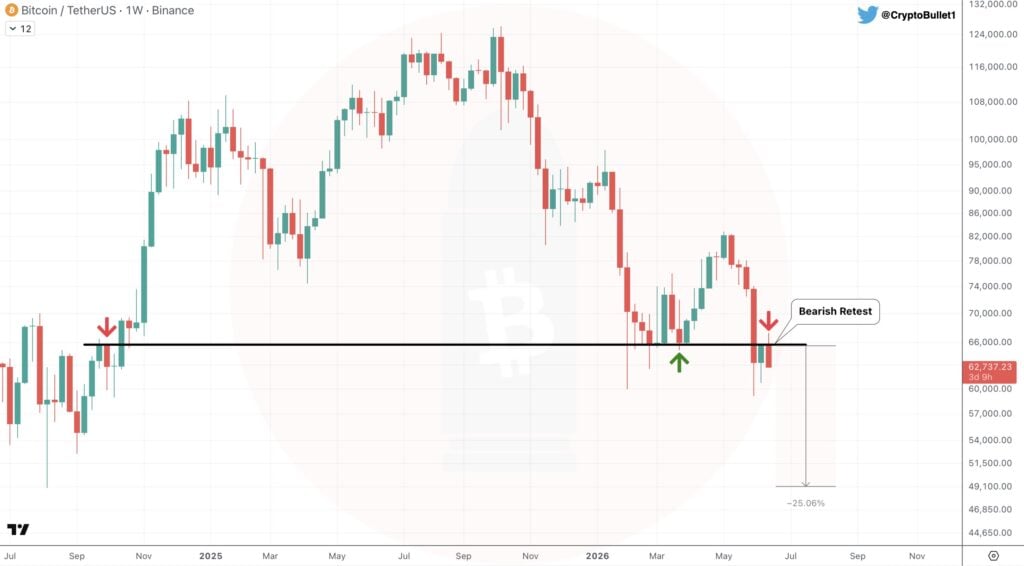
A weekly bearish retest happens when price breaks below a key support level on the weekly timeframe, then rallies back up to test that broken level from underneath. If the level holds as resistance and price gets rejected, it confirms continued downside momentum.
A major sell-off could indeed be looming, as hinted by the rising Bitcoin leverage ratio. On the contrary, on Wednesday, the proportion of long-term BTC holders hit a record high of 79 percent, suggesting that the bear market may be nearing an end.