

While the crypto market participants are showing mild jubilation following Bitcoin (BTC) and altcoins’ swift recovery over the past few days, on-chain data suggests that the celebration might be a little too early. Bitcoin’s elevated leverage ratio is showing warning signs of a potential sell-off.
Bitcoin leverage ratio jumps to 0.20
According to on-chain data obtained on Tuesday, Bitcoin’s Binance Estimated Leverage Ratio has moved into its higher range. At the same time, the recent price rebound has failed to meaningfully increase the digital asset’s open interest across all exchanges.
Elevated leverage ratio, coupled with less than expected increase in open interest hint toward a rise in position risk. It also points toward weak overall market participation and demand for BTC. Past instances support this thesis.
For instance, in November 2025, despite a surge in Bitcoin’s leverage ratio its open interest remained stagnant. As a result, Bitcoin failed to sustain its rebound, and came under renewed downward pressure.
A similar pattern appeared earlier this year in January 2026. As BTC’s leverage rose, its open interest failed to recover to its previous highs. Indicating weak capital inflows into new positions, BTC later experienced a sharp price correction.
The current phase shows a similar structure, with the BTC leverage ratio jumping to 0.20 but open interest only recovering a fraction of its slump, now hovering around $23.4 billion.
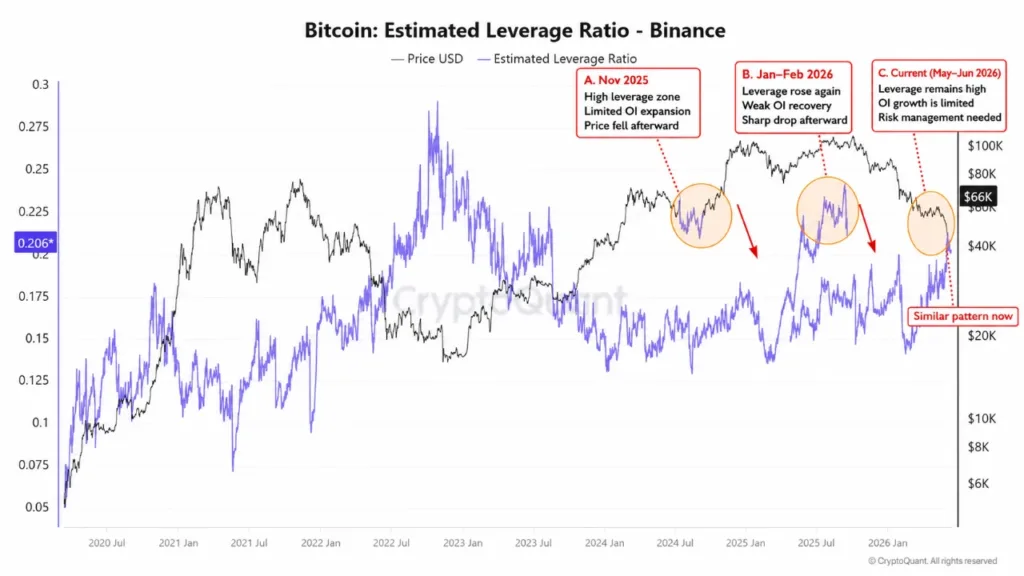
In simple terms, the market is not expanding on strong new demand. Instead, leverage pressure is increasing within a lower-liquidity environment and with limited market participation.
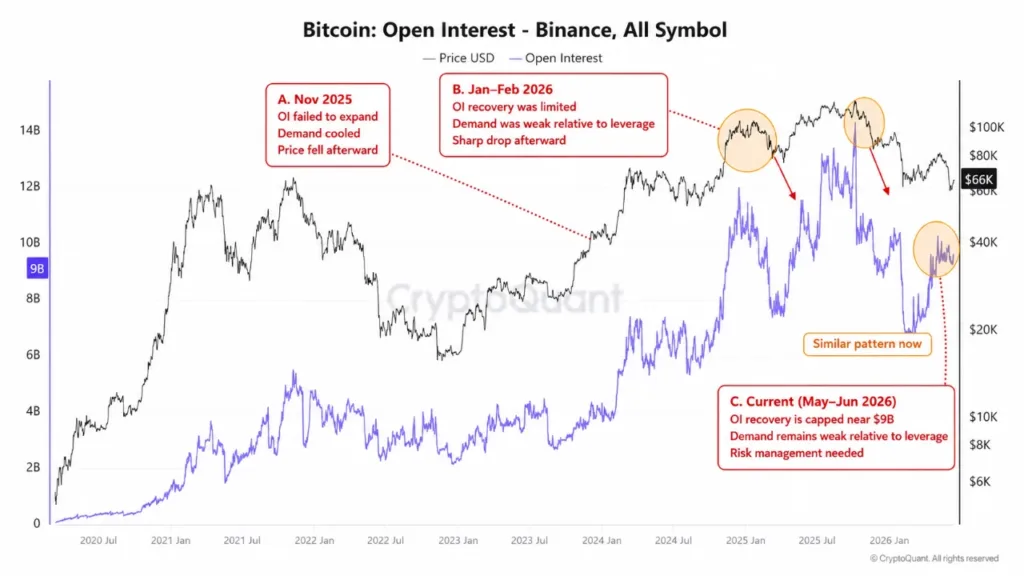
BTC not in a bullish trend yet
The aforementioned dynamics between Bitcoin’s leverage ratio and open interest show that the digital asset’s current setup should be viewed less as a confirmed bullish trend, and more as a risk-management zone.
Essentially, traders are waiting to see whether BTC open interest can rise up alongside its price. If Bitcoin continues to gain without a significant increase in open interest, then the risk of higher price volatility and additional liquidation events can increase sharply.
Further downside could be on the cards for BTC. On-chain data on Thursday showed that BTC is still lacking concrete evidence of a market bottom despite oversold signals. In contrast, banking behemoth Standard Chartered called BTC’s plunge to $59,000 its bottom for the ongoing market cycle.