

Bitcoin’s (BTC) famous 4-year cycle theory is coming under serious questioning as on-chain data points suggest that the cycle thesis may no longer be valid. The cryptocurrency’s coming of age into an institutional-grade digital asset may have completely discredited the 4-year cycle theory.
Bitcoin 4-year cycle theory no longer valid?
For the uninitiated, Bitcoin’s 4-year cycle theory says that the year following a post-halving bull market becomes a bear market. Since the latest BTC halving occurred in April 2024, BTC created its current all-time high in October 2025 – the following bull market year.
Subsequently, 2026 is supposed to be the bear market year for the top digital asset. While BTC has declined by more than 50 percent from its ATH value, the reasons are vastly different than initially thought.
According to on-chain data received on Monday, Bitcoin’s market value to realized value (MVRV) metric has consistently declined across cycles. It has fallen from 5.88 in 2013, to 4.72 in 2017, to 3.96 in 2021, to 2.74 in 2025.
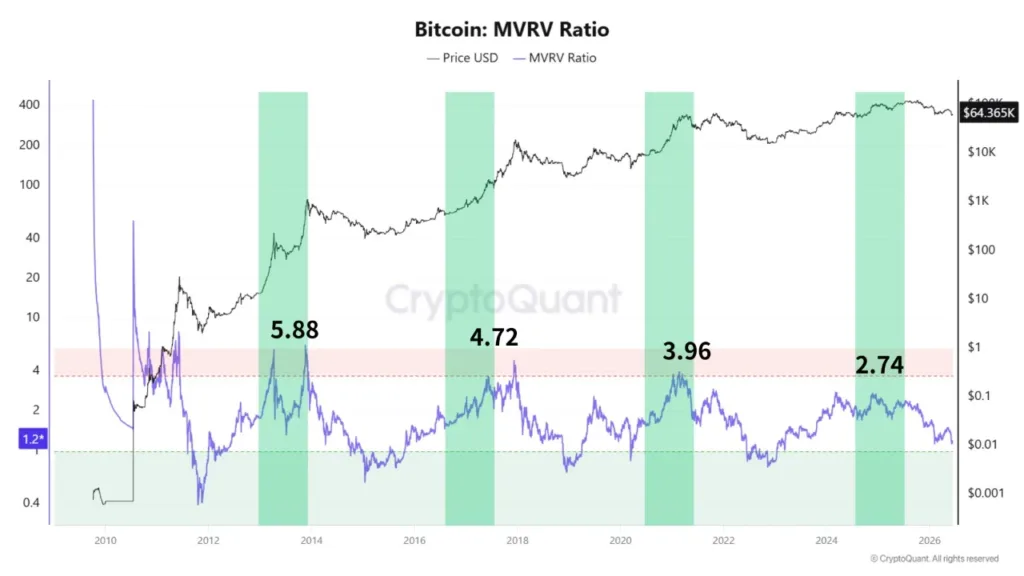
To explain, Bitcoin MVRV compares its current market capitalization, to the value at which all the coins last moved on-chain. It helps measure whether the market is overvalued or undervalued relative to investors’ cost basis.
High MVRV levels have historically coincided with market tops and very high speculation levels, while low MVRV levels tend to appear near cycle bottoms and periods of undervaluation.
Similarly, Bitcoin’s Apparent Demand – a measure of whether the market is absorbing newly issued BTC – has also turned negative. In the past, major bull markets have coincided with periods of strong demand for BTC.
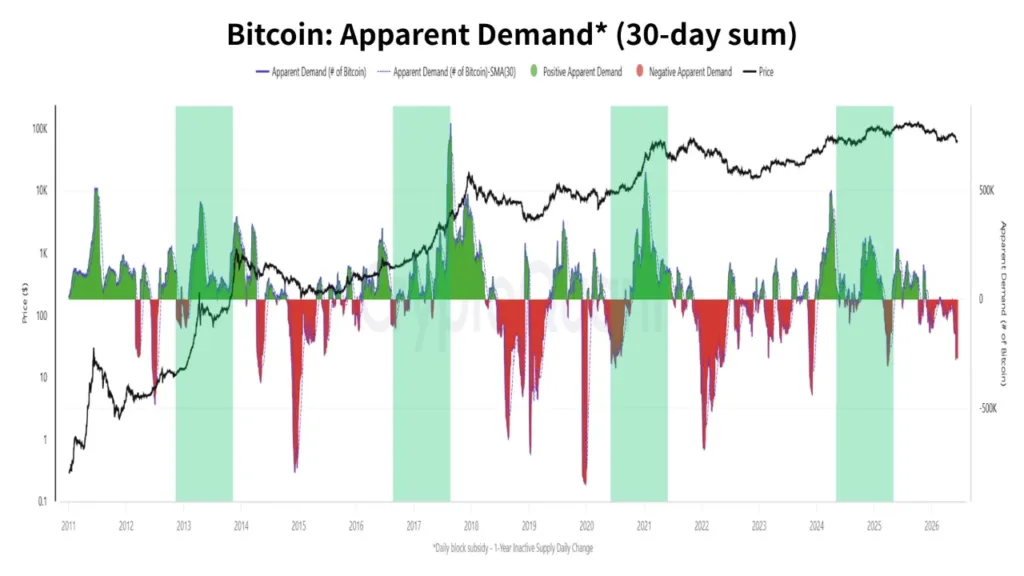
In contrast, the bear markets of 2014, 2018, and 2022 were coupled with weak demand. It confirms that currently BTC may not be declining simply because “the cycle says so.” Rather, it’s the demand for the digital asset that has gone tepid.
BTC futures data tells similar story
Bitcoin’s open interest has slumped from its 2025 peak, indicating that excessive leverage has been flushed out of the market. At the same time, the number of open positions in the market remain elevated, suggesting that a full capitulation event may not have occurred yet.
That said, analysts at Standard Chartered disagree, going on record that BTC’s plunge to $59,000 was likely its bottom for this cycle. Trading volume in spot Bitcoin exchange-traded funds (ETFs) is also picking momentum, rapidly approaching the $2T milestone.