
Binance CEO Richard Teng has refuted Wall Street Journal (WSJ) reports about the platform’s Iran linked crypto transactions, stating that the report lacked context.
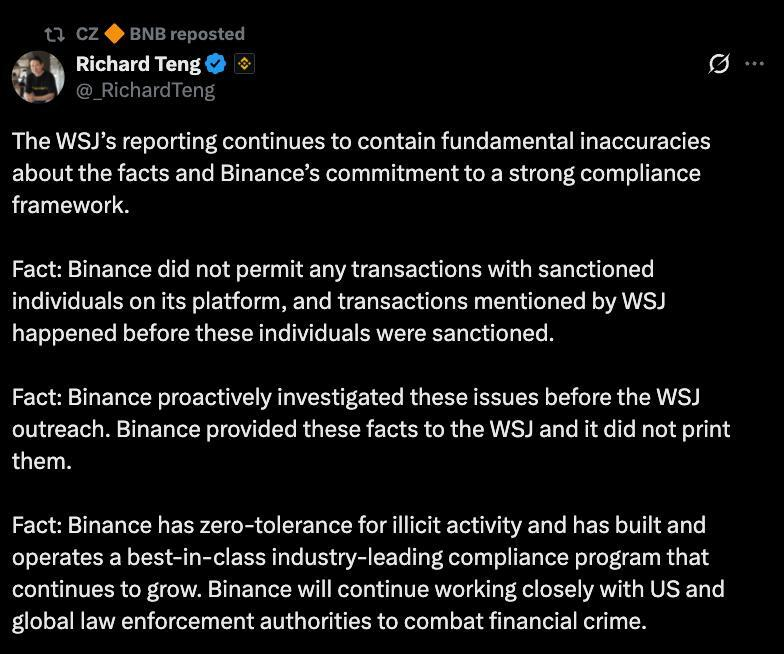
Teng took to social media platform X on Thursday, saying that WSJ’s report against Binance’s compliance measures had “fundamental inaccuracies”.
The assertive stance comes after the WSJ published a report “Iran Moved Billions Through Binance to Fund Regime-Continuing Into This Month.”
Teng replied by saying,”Fact: Binance proactively investigated these issues before the WSJ outreach. Binance supplied these details to the WSJ, but it did not print them.”
Teng highlights flaws in WSJ reporting
In the same statement, Richard Teng said the transactions highlighted in the latest report took place before the individuals involved were officially sanctioned.
He also pushed back strongly against the allegations, defending Binance’s anti-money laundering controls and saying the exchange maintains a “zero-tolerance” approach toward illicit finance while continuing to cooperate with law enforcement agencies globally.
The recent comments are part of the larger and more heated dispute between Binance and The Wall Street Journal that has been evolving for months now.
In February 2026, Teng responded to WSJ news regarding claims that Binance was involved in transfers of crypto assets worth $1 billion related to Iran, stating that these accusations were “false” and “defamatory,” with Binance demanding a retraction.
This dispute took on an even more serious tone in March, when Binance sued The Wall Street Journal based on claims that the organization had disbanded its internal probe into Iranian connections.
On the same day, other news reports came out suggesting that the U.S. Department of Justice launched another probe into Iran potentially using Binance to evade U.S. sanctions.
Other publications jumped on the bandwagon
Adding to the WSJ report, a Fortune investigation during that period made similar assertions and stated internal investigators reported more than $1 billion in questionable payments purportedly tied to networks linked to Iran-supported entities.
Binance refuted the charges and disputed assertions that staff were fired for citing compliance issues. Founder Changpeng Zhao objected to the research by calling the claims “self-contradictory” and claiming that the investigation relied too much on unidentified, anonymous sources, risking skewed perspectives.
Dispute comes as regulators increase scrutiny over crypto exchanges
The clash is taking place amid increased attention to the ability of crypto exchanges to comply with sanctions requirements and monitor transactions to prevent money laundering.
Regulators are questioning crypto exchanges’ capability to identify sanctioned parties, detect suspicious transactions across borders, and prevent the flow of money through digital assets.
Following the record settlement agreement reached in 2023 between Binance and regulators in the United States, the crypto exchange has been investing a substantial amount in its compliance framework, oversight programs, and cooperation with law enforcement organizations.
Recently, following new concerns related to sanctions risks posed by the company, it was reported that some 25 percent of Binance’s staff worldwide are working in compliance-related positions, while sanctions-related risks have decreased by an impressive 97 percent.
However, in parallel with heightened regulation of cryptocurrency businesses in the United States, Europe, and Asia, due to their expanding into the realm of payments, stablecoins, tokenized finance, and other financial services for corporations, it has become increasingly clear that compliance standards will need to be the same as those used by banks.