

Binance, in a research report released on Monday, claimed that it intercepted over 22.9 million scam attempts between the first quarters of 2025 and 2026 leveraging AI-fueled defenses. These attacks could have cost the crypto industry around $1.98 billion, Binance claimed.
Binance said it is now accelerating the use of AI to combat dangers that are evolving in the age of intelligence frauds. By late 2025, the exchange had deployed over a hundred AI models in a bid to protect its users.
“AI is amplifying social engineering at an unprecedented level, powering deepfakes, phishing bots, fake platforms, voice cloning, and impersonation. In 2025 alone, crypto-related fraud reached $17 billion – a 30 percent year-on-year increase. Without a proportionate response, the impact is likely to worsen,” the exchange highlighted.
More threat actors now have access to advanced AI tools, making them more sophisticated in curating and implementing targeted attacks especially at the crypto sector, which as of press time was valued at $2.73 trillion.
In an alarming update, Binance claimed that creating a smart contract exploit now costs as little as $1.22 per contract, that has falen by 22 percent month-on-month. Additionally, the report said that exploits whipped via advanced AI models have clocked a success rate of over 72 percent.
As part of its AI-powered threat detection, the exchange said it has been using computer vision to identify fake payment proofs and its real-time language analysis is being used to track suspicious patterns in peer-to-peer transactions.
“AI-driven decisioning now powers 57 percent of fraud controls, contributing to a 60–70 percent reduction in card fraud rates compared to industry benchmarks,” Binance said. “As AI becomes more deeply embedded in everyday life, security needs to be built into the system.”
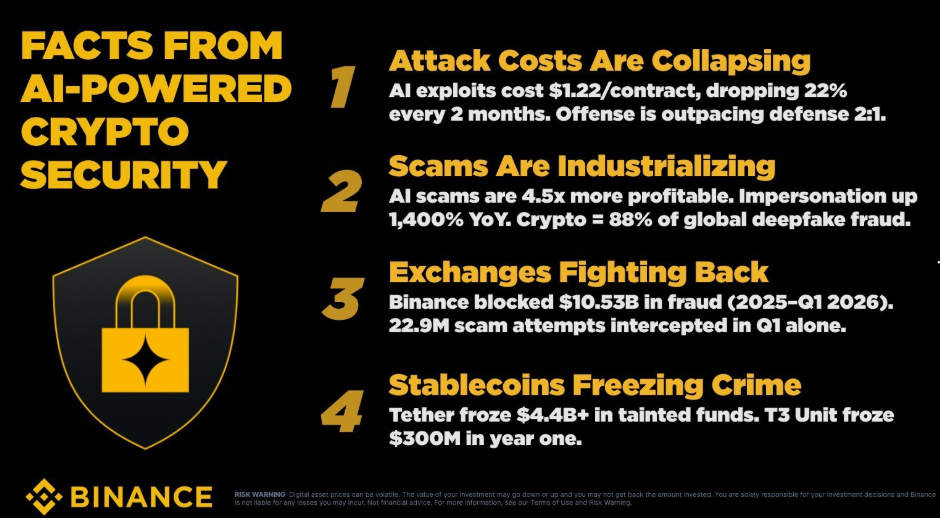
Source: Binance
The exchange plans to keep engaging with law enforcement agencies from around the world to participate in detecting illicit crypto funds. It said in 2025 it met with over 71,000 requests from lae enforcement agencies and assisted them in confiscating over $131 million in illicit funds.
The injection of AI into the crypto and broader financial ecosystems is increaingly raising concerns among policymakers. Last week, the International Monetary Fund (IMF), for instance, had sounded an alert that given that the global financial ecosystem is so interconnected, one major AI-fueled exploit could result in a disastrous domino effect.
The IMF has called for an urgent attention to upgrading the cybersecurity solutions we know and use today to be better equipped to handle the AI advancements.