

According to Chainspect’s latest dashboard, TON blockchain is actually leading the pack in decentralization. It ranks a Nakamoto Coefficient of 79 with 376 validators. To put that in perspective, that metric (which measures how many independent entities must collude to compromise consensus) is way higher than other leading blockchains. For instance, Avalanche is at 27, Cardano at 25, and Solana sits at 20. Even Ethereum is trailing behind with a coefficient of just 2 because its validators are so concentrated.
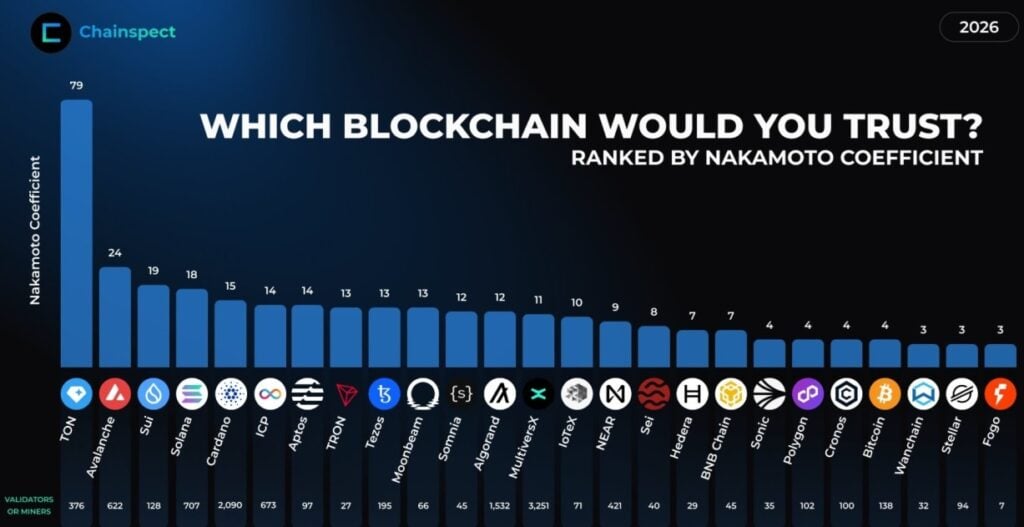
What the Nakamoto coefficient measures
The Nakamoto Coefficient is the minimum number of independent entities [validators in Proof-of-Stake (PoS) or miners in Proof-of-Work (PoW)] that would need to collude to compromise a network.
Basically, a higher score means the network is tougher to crack and much safer from coordinated attacks. For PoS networks, it tracks how many validators would have to team up to control 33 percent of the stake. Since TON sits at 79, an attacker would need to compromise 79 different validators just to take control, making it a huge step up in difficulty compared to networks with much lower scores.
Why TON blockchain’s decentralization stands out
TON’s validator set comprises approximately 370 active validators across 28 countries, with a combined stake of roughly 845 million TON ($2.15 billion). Even though Ethereum has more validators overall, its power is a lot more concentrated, giving it a lower Nakamoto score.
TON’s higher score highlights how much more spread out its staking is. Pavel Durov also recently shared that Telegram is set to become the biggest validator on the network, which will be a real test for the network’s decentralization down the road. The network’s proof-of-stake consensus requires a minimum of 300,000 TON to participate, with an effective bar around 1 million TON.
The full picture: Speed, scale, and validator distribution
The Nakamoto Coefficient is only one dimension of TON’s infrastructure story. The network also leads in performance metrics: TON currently processes approximately 26 to 31 transactions per second with a block time of roughly 409 milliseconds and finality reaching around 0.6 to 0.8 seconds, significantly faster than Solana’s 13-second finality and Ethereum’s 13-minute settlement.
This speed is the result of April’s Catchain 2.0 consensus upgrade, which cut block times from 2.5 seconds to 400 milliseconds. TON’s total transaction volume has surpassed 3.2 billion.
For Web3 users, this combination of speed and its validator distribution addresses a fundamental critique of the metric: a network can have high Nakamoto scores but low operational decentralization if infrastructure is concentrated.
TON’s performance, paired with its solid validator count, shows that its decentralization goes deeper than just the numbers. That said, Telegram joining as a validator is going to be an interesting development to watch for how things balance out.