



LI.FI Protocol, a liquidity aggregation and routing protocol for Web3, unveiled LI.FI Intents, an enterprise-grade infrastructure that lets applications, wallets, and neobanks integrate stablecoin payments, real-world assets (RWAs), and compliant liquidity through a single Application Programming Interface (API).
LI.FI Intents, the ‘invisible clerk’ for onchain finance
Think of LI.FI Intents as a smart concierge. You don’t tell it how to swap or bridge, you just state what you want (“swap 1,000 USDC for EURC on Solana”). The Intents layer then matches your request with a network of Know Your Business (KYB)’d solvers (verified legal entities, not anonymous bots). These solvers compete to fill the order using their own inventory, centralized exchange (CEX) desks, or Over-the-Counter (OTC) partners. The result? Users never hold gas tokens, experience zero slippage on stablecoin swaps, and don’t even know a “solver” exists. It’s like ordering a taxi instead of learning to rebuild an engine.
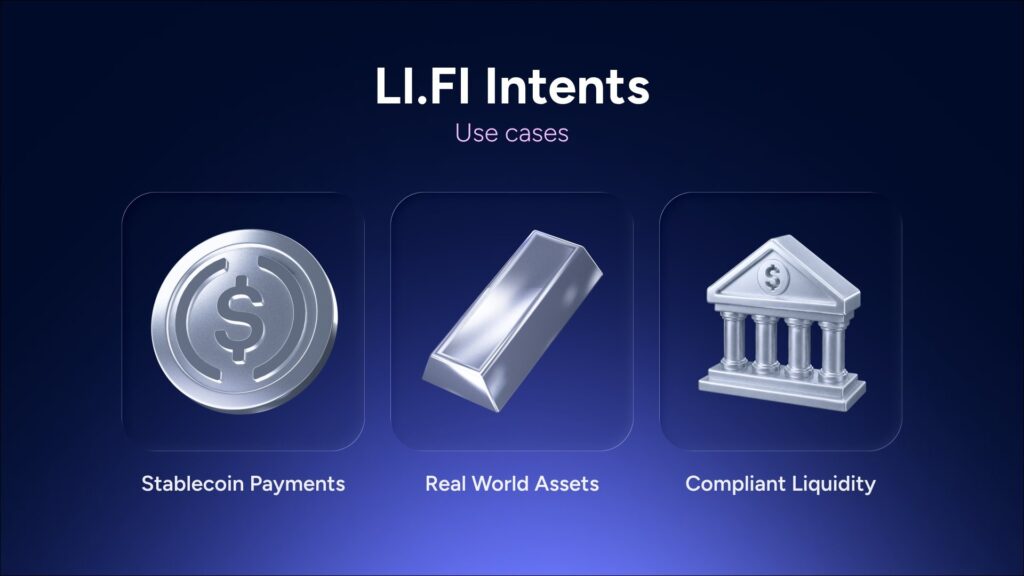
LI.FI Intents, use cases: (Source: X)
How this upgrades the crypto industry: No more gas token hell
Right now, moving stablecoins between chains is a total headache because you have to hodl native gas (like ETH, SOL, or TRX), which is a nightmare for businesses and regular users alike. And here LI.FI Intents completely gets rid of that friction or “problem.” For the first time, for example, a neobank can offer cross-chain stablecoin payments without having to explain “gas fees” to its customers. Plus, this tech opens the door for tokenized real-world assets like private credit or treasury bills, giving global businesses a compliant way to dive into onchain finance. In the end, this is not just some decentralized finance (DeFi) update; it’s more like the new plumbing for mainstream finance.
Value to the RWA Sector: Compliant liquidity at scale
Let’s put it this way. The RWA market has long faced a trilemma: compliance, liquidity, and chain fragmentation. LI.FI Intents solves this by letting integrators control which KYB’d solvers execute their flows. Another use case would be a European bank that can route only through European Union (EU)-licensed solvers, while an Asian exchange picks local OTC desks. Meanwhile, solvers pull from institutional liquidity pools, ensuring tight spreads even for large orders. In short, RWAs finally have a highway instead of a dirt road.